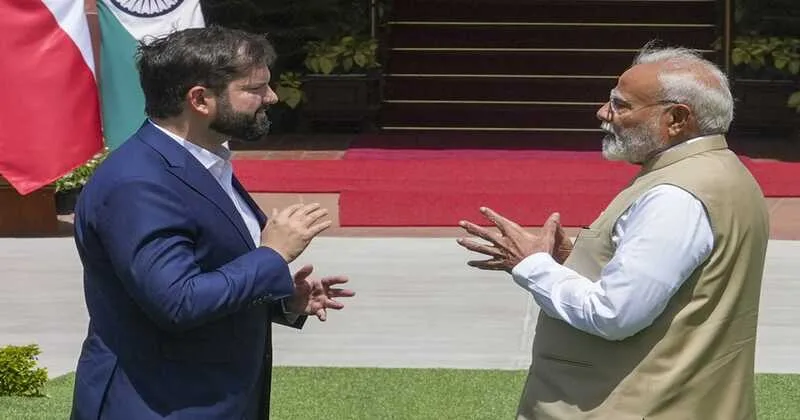
New Delhi: After major trade agreements with the European Union and the United States, India is preparing for another significant deal, one that promises benefits far beyond conventional trade. New Delhi is in the final stages of negotiations with Chile, a Latin American nation widely regarded as home to the world’s largest lithium reserves. Chile’s president, Gabriel Boric, visited India last year to advance discussions. If concluded, the agreement is expected to deliver strategic gains for India’s manufacturing, defence, and space research sectors.
Chile, located along South America’s Pacific coastline, is rich in critical minerals such as lithium, copper, and cobalt, resources essential for electronics, electric vehicles, and solar energy industries. Securing stable access to these materials has become increasingly important for India’s industrial growth and national security, particularly after China imposed unilateral restrictions on rare-earth exports. While India has opened talks with several countries in response, negotiations with Chile date back nearly two decades. Formal discussions to deepen trade ties began in 2005, followed by a Preferential Trade Agreement in 2006. That pact offered tariff concessions on select products but fell short of a comprehensive free trade agreement. Current negotiations aim to expand the scope of cooperation across multiple sectors. Both countries are exploring partnerships in digital services, investment, and MSMEs. Union Commerce Minister Piyush Goyal recently indicated that a broader trade agreement with Chile is likely to be signed soon.
Trade between India and Chile reached approximately $3.76 billion in the 2024–25 financial year. India’s exports accounted for $1.15 billion, while imports stood at $2.60 billion. India primarily exports vehicles, pharmaceuticals, chemicals, steel products, textiles, leather goods, rubber, and footwear. In return, Chile supplies commodities such as copper, iodine, walnuts, kiwi, and apples, strengthening India’s access to both industrial inputs and agricultural products. Indian companies have already begun positioning themselves to benefit from the emerging partnership. Public sector major Coal India recently announced plans to establish a wholly owned subsidiary in Chile to pursue research and exploration in rare earth and critical minerals. This move signals India’s intent to secure overseas mineral assets directly.
Private players are also showing strong interest. Conglomerates, including the Adani Group, are actively exploring opportunities in Chile, particularly in mining and infrastructure. As negotiations enter their final phase, the proposed India–Chile agreement is increasingly seen as a strategic partnership, one that could strengthen supply chains, reduce dependence on limited sources, and support India’s long-term ambitions in clean energy, advanced manufacturing, and technological self-reliance.