Hindu is a civilisational identity, not a religion: Dr Mohan Bhagwat
June 29, 2026
  • Read Ecopy
  • Circulation
  • Advertise
  • Careers
  • About Us
  • Contact Us
Android AppiPhone AppArattai
Organiser
  • ‌
  • Bharat
    • Assam
    • Bihar
    • Chhattisgarh
    • Jharkhand
    • Maharashtra
    • View All States
  • World
    • Asia
    • Europe
    • North America
    • South America
    • Africa
    • Australia
  • Editorial
  • International
  • Opinion
  • RSS @ 100
  • More
    • Op Sindoor
    • Analysis
    • Sports
    • Defence
    • Politics
    • Business
    • Economy
    • Culture
    • Special Report
    • Sci & Tech
    • Entertainment
    • G20
    • Azadi Ka Amrit Mahotsav
    • Vocal4Local
    • Web Stories
    • Education
    • Employment
    • Books
    • Interviews
    • Travel
    • Law
    • Health
    • Obituary
  • Subscribe
    • Subscribe Print Edition
    • Subscribe Ecopy
    • Read Ecopy
  • ‌
  • Bharat
    • Assam
    • Bihar
    • Chhattisgarh
    • Jharkhand
    • Maharashtra
    • View All States
  • World
    • Asia
    • Europe
    • North America
    • South America
    • Africa
    • Australia
  • Editorial
  • International
  • Opinion
  • RSS @ 100
  • More
    • Op Sindoor
    • Analysis
    • Sports
    • Defence
    • Politics
    • Business
    • Economy
    • Culture
    • Special Report
    • Sci & Tech
    • Entertainment
    • G20
    • Azadi Ka Amrit Mahotsav
    • Vocal4Local
    • Web Stories
    • Education
    • Employment
    • Books
    • Interviews
    • Travel
    • Law
    • Health
    • Obituary
  • Subscribe
    • Subscribe Print Edition
    • Subscribe Ecopy
    • Read Ecopy
Organiser
  • Home
  • Bharat
  • World
  • Operation Sindoor
  • Editorial
  • Analysis
  • Opinion
  • Culture
  • Defence
  • International Edition
  • RSS @ 100
  • Magazine
  • Read Ecopy
Home Bharat

100 Years of Sangh Journey – New Horizons: “Hindu is a civilisational identity, not a religion,” says Dr Mohan Bhagwat

Rashtriya Swayamsevak Sangh (RSS) Sarsanghchalak Dr Mohan Bhagwat called for a united Hindu society, warning that India’s rise faces resistance from “selfish and monopolistic forces” operating globally

WEBDESKWEBDESK
Feb 8, 2026, 09:15 pm IST
in Bharat, RSS News, RSS in News, Maharashtra
Follow on Google News
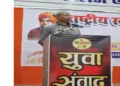
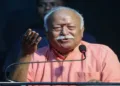
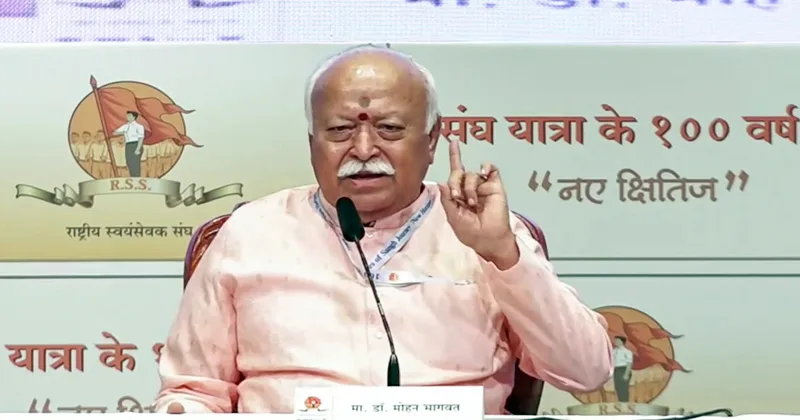
Mumbai, Feb 07 (ANI): RSS Sarsanghchalak Dr Mohan Bhagwat speaks on Swadeshi during RSS centenary event, in Mumbai on Saturday. (RSS/ANI Video Grab)

Mumbai, Feb 07 (ANI): RSS Sarsanghchalak Dr Mohan Bhagwat speaks on Swadeshi during RSS centenary event, in Mumbai on Saturday. (RSS/ANI Video Grab)

FacebookTwitterWhatsAppTelegramEmail

MUMBAI: Rashtriya Swayamsevak Sangh (RSS) Sarsanghchalk Dr Mohan Bhagwat on February 7 urged people not to rely on Wikipedia or general media coverage, which he labels “misleading” or “propaganda,” and called for internal unity while warning about deep scepticism toward external portrayals of the Sangh.

Addressing the gathering at Vyakhyanmala titled “100 Years of Sangh Journey – New Horizons”, in Mumbai, Bhagwat urged a deeper exploration of what “Hindu Rashtra” means, framing it not just as a political label but as a call for citizens to work with “selfless purpose” and “excellence” in their respective fields.

“When forming an opinion about the RSS, base it on what you see and the original sources. Avoid relying on Wikipedia or perceptions, as they contain misleading information. You won’t understand the RSS through propaganda… Observe the Sangh directly: examine its workers, their homes, its branches, and its programs. This will give you a clear understanding of what RSS is… What does it mean that India is a Hindu nation? What does it mean that we are Hindus? Understand all of this and then do whatever you are doing with excellence, with authenticity, with selfless purpose, and with all your heart and soul for the benefit of the country…,” he said.

This comes at a time when the RSS is increasingly focused on social cohesion projects (Samajik Samrasta) and expanding its footprint beyond traditional strongholds.

By dismissing digital sources like Wikipedia, Bhagwat is attempting to bypass the “information war” and re-establish the Sangh’s identity through grassroots interaction.

Bhagwat emphasised that “Hindu society” must stand together to create a “righteous strength” that he believes is necessary for the country’s progress and defence.

He urged unity, saying India’s rise faces challenges from “selfish and monopolistic forces”. He emphasised the strength of Hindu society, urging people to understand the RSS through direct observation rather than propaganda.

Also Read: “Shared love for Tamil language connects India and Malaysia”: PM Modi on deep people-to-people ties

“Everyone needs to be active; the times demand it, and we face many challenges. There are selfish and monopolistic forces in the world working to prevent India from rising… If the entire Hindu society stands together, no one will be able to withstand its righteous strength. Their days are numbered. Now it’s just a battle of wills. If we continue our work, build our country, and protect ourselves from their attacks, their power will naturally diminish…,” he added.

In this continuation of his speech at the “New Horizons” lecture series in Mumbai, Dr Bhagwat expanded on the RSS’s ideological definition of identity and the historical concept of national unity.

His emphasised that the cultural identity of “Hindu” is not a religious label, but a civilizational one that encompasses all inhabitants of India, regardless of their personal faith or lifestyle.

Bhagwat ji asserted that “Hindu” is an adjective, not a noun. He argues that whether one uses the word “Indian” or “Hindu,” the meaning is essentially the same in the context of the nation’s ancient culture.

“There are constant squabbles among people (of different religions)… But the country has never broken apart, except for that one time when the Hindu spirit was forgotten… Our worship, our language, everything will be safe; on the contrary, Hindutva itself guarantees their safety, because that’s the very nature of that ideology… We need to accept that whether we belong to a particular province, worship particular deities, have certain food habits and customs, or are vegetarian or non-vegetarian, we are one as a society, as a nation, as a culture. We call that Hindu. Whether you say it or not, the word you use will be synonymous. Whether you say Indian or Hindu, it’s the same thing,” he said.

He argued that Hindutva–which he defines as the “Sanatan spirit”–is inherently pluralistic. He suggested that because this ideology is naturally inclusive, it is the best guarantee for the safety of all diverse worship practices and languages.

He said that the phrase “Hindu-Muslim unity” is fundamentally flawed. In his view, “unity” implies bringing together two separate things, whereas he says that the various communities in India are already one entity that has simply “forgotten” its common roots and called for peaceful dialogue to resolve “squabbles,” stating that disrespecting another’s faith is “not the nature of a Hindu” and that this behavior must be consciously unlearned.

“We never disrespect anyone’s faith. That is not the nature of a Hindu. But this will have to be learned… There will have to be dialogue. We will have to sit down and talk peacefully. … The words ‘Hindu-Muslim unity’ are wrong. You unite those who are two separate entities. How can you talk about unity when they are already one? We have forgotten that unity; we need to remember it again, not create it,” he added.

Bhagwat ji stated that the Indian Constitution not just as a legal document, but as a byproduct of a specific cultural “mindset.” He said that the decision to remain a pluralistic nation, rather than a religious one like Pakistan, was a deliberate choice rooted in Hindu values.

Bhagwat ji drew a direct line between ancient Indian philosophy and modern governance, describing the Constitution as a contemporary manifestation of Dharma.

He highlighted that while Pakistan and later Bangladesh defined themselves as “Muslim nations,” India chose to be a “nation for all.” He asserted this wasn’t a “mistake” or a purely secular innovation, but a natural result of the “Hindu nature.”

“India has a constitution. It was created because of the Indian mindset… The country was divided into separate parts for Muslims and Hindus. But the newly separated Pakistan declared itself a Muslim nation. Pakistan broke up, Bangladesh was formed, and even that ultimately became a Muslim nation. We declared ourselves a nation for all, because we are Hindus. There are people who say that this was a mistake. But this happened because of the Hindu nature, the nature of “Vasudhaiva Kutumbakam” (the world is one family). Our constitution is, in a way, a modern form of the practice of dharma. We need to be informed about it,” he added.

Mohan Bhagwat ji pivoted from identity and the Constitution to economic philosophy, framing Swadeshi (self-reliance) not as isolationism, but as a lifestyle and a strategic policy and used a simple, domestic example–buttermilk versus imported soft drinks–to illustrate a larger economic point.

“…What’s made in our own homes shouldn’t be brought from outside. Excellent spiced buttermilk or lemonade can be made at home… There are people here who sell buttermilk. There are also Indian companies that sell buttermilk… Now that ancient systems can’t be implemented exactly as they were, times have changed. But we can do this much: whatever we buy, we will buy things that boost employment in our own country,” he added.
He advocated for international trade, but only on India’s terms, emphasising that trade should happen because it’s beneficial, not because of external pressure or unfavourable tariff structures.

“At the policy level, we will say that we will conduct trade, because transactions are necessary in international trade. We can’t remain isolated. But whatever transactions we do, we will do them of our own free will, not under anyone’s pressure, and not because of tariffs. This policy is gradually progressing, but policies change at their own pace, and it will change. Let’s implement this in our own homes,” he added.

(With inputs from ANI)
Topics: Dr Mohan BhagwatRSS at 100100 Years of Sangh Journey – New HorizonsRSS on US trade dealRSS on Hindu Muslim UnityRSS on Pakistan
ShareTweetSendShareSend
✮ Subscribe Organiser YouTube Channel. ✮
✮ Join Organiser's WhatsApp channel for Nationalist views beyond the news. ✮
Previous News

100 Years of Sangh Journey – New Horizons: “Detect, report infiltrators and deny them jobs,” says Dr Mohan Bhagwat

Next News

India-US ink interim trade deal: Strategic leverage for the labour intensive sectors to sail against economic headwinds

Related News

RSS Sarasanghachalak Dr. Mohan Bhagwat at the valedictory address on the concluding day of the 3-day National Conference on "Operationalizing NEP 2020: Integrating Indian Knowledge Systems," held at Art of Living International Centre, Bengaluru organised by Bharatiya Shikshan Mandal.

Bharat’s complete & integrated vision holds the answers that the world today is seeking: Dr Mohan Bhagwat in Bengaluru

RSS Sarsanghchalak Dr Mohan Bhagwat

Udaipur | Haldighati was a victory of Bharat’s civilisational resolve: RSS Sarsanghchalak Dr Mohan Bhagwat

RSS Sarsanghchalak Dr Mohan Bhagwat addressing the gathering in Keralam on the occasion of lecture series on 100 years of RSS

Journey of RSS in 100 Years | Hindu means cultural heritage of Bharat; none is outsider to Sangh: Dr Bhagwat in Keralam

RSS Sarsanghchalak Dr Mohan Bhagwat

The time of Bharat has arrived; we need to expedite our preparation: Dr Bhagwat at RSS Karyakarta Vikas Varg 2

Padma Bhushan awardee and noted industrialist Kumar Mangalam Birla Kumar Mangalam Birla addressing the Samapana Samaroh (Valedictory Function) of the Rashtriya Swayamsevak Sangh Karyakarta Vikas Varg – Dwitiya at Nagpur, on June 4, 2026

“RSS always stood by the society and nation”, Kumar Mangalam Birla at RSS Karyakarta Vikas Varg 2 in Nagpur

Union Home Minister Amit Shah

Home Minister Amit Shah announces high-level committee to probe demographic changes: “Infiltration a major challenge”

Load More

Latest News

Bhimrao Kamble Sentenced to Death in Pune Child Rape-Murder Case

Pune Nasrapur Child Rape-Murder Case: 65-year-old Bhimrao Kamble gets death penalty in record-time trial

West Bengal CM Suvendu Adhikari (Left) and Former West Bengal Chief Minister Mamata Banerjee (Right)

West Bengal’s OBC Amendment Bill: How Suvendu government seeks to end Mamata’s Muslim reservation framework

People jump into streams in Paris, unable to bear the heat and railway tracks melting in Germany due to heatwaves

Europe heatwaves peak amid human-caused climate change; Death toll crosses 1300, infrastructures melt & NRIs miss India

BKS National General Secretary at a gathering in Jaipur wherein he urged the government to provide 4 times more compensation to the farmers once their land is acquired

Bharatiya Kisan Sangh urges government to pay fourfold compensation to farmers for agricultural land acquisition

The Netherlands' return of the 11th-century Chola-era Leiden Copper Plates to India marks a significant milestone in restoring India's cultural heritage

Historic Homecoming: Netherlands returns 11th-century Leiden Copper Plates to India, preserving legacy of Chola Empire

Keralam: BJP complains to Kannur Collector over oath taken in the name of Allah by UDF, SDPI councillors; seeks action

Reawakening of Bengal

Civilians injured in Afghanistan after Pakistan airstrike

Afghan Govt says Pakistani air strikes kill 36 Civilians, injure 163 amid escalating border tensions

Chinese President Xi Jinping

From Economic Miracle to Authoritarian Revival: Why Xi is rewriting China’s social contract

Malkangiri police recover large cache of Maoist arms and explosives

Major Maoist arms cache recovered in Malkangiri; Odisha records seventh anti-insurgency seizure within three weeks

Load More
  • Privacy
  • Terms
  • Cookie Policy
  • Refund and Cancellation
  • Delivery and Shipping

© Bharat Prakashan (Delhi) Limited.
Tech-enabled by Ananthapuri Technologies

  • Home
  • Search Organiser
  • Bharat
    • Assam
    • Bihar
    • Chhattisgarh
    • Jharkhand
    • Maharashtra
    • View All States
  • World
    • Asia
    • Africa
    • North America
    • South America
    • Europe
    • Australia
  • Editorial
  • Operation Sindoor
  • Opinion
  • Analysis
  • Defence
  • Culture
  • Sports
  • Business
  • RSS @ 100
  • Entertainment
  • More ..
    • Sci & Tech
    • Vocal4Local
    • Special Report
    • Education
    • Employment
    • Books
    • Interviews
    • Travel
    • Health
    • Politics
    • Law
    • Economy
    • Obituary
  • Subscribe Magazine
  • Read Ecopy
  • Advertise
  • Circulation
  • Careers
  • About Us
  • Contact Us
  • Policies & Terms
    • Privacy Policy
    • Cookie Policy
    • Refund and Cancellation
    • Terms of Use

© Bharat Prakashan (Delhi) Limited.
Tech-enabled by Ananthapuri Technologies