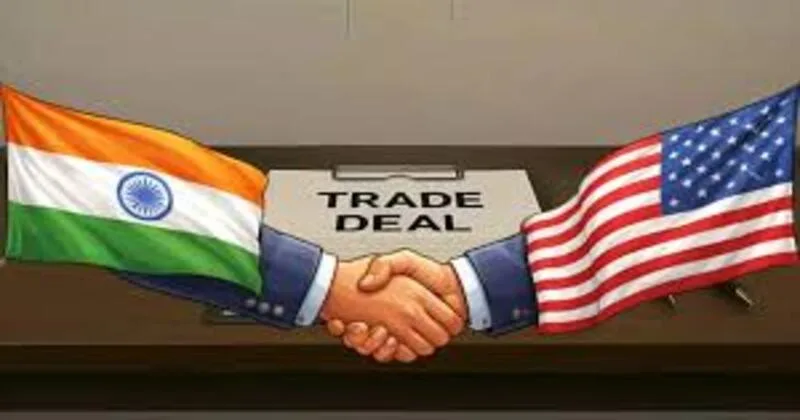
India and the United States have forged the landmark trade deal which will render one of the biggest strategic leverages to India to fortify the national interests and sail against the geopolitical headwinds. India has indeed scripted a clear strategic edge in the US trade deal and with fervour diplomatic capabilities has consolidated the interests of sensitive sectors of India which includes agriculture and allied activities, dairy sector, labour intensive MSMEs etc. The pivotal fact is that the deal will open the massive scale US market to the Indian exporters, thus striking an overarching strategic edge for India in the geo-economic landscape.
Tariffs slashed & Trade set to spike
The tariffs imposed on the Indian exports to the United States have been drastically slashed from a massive 50 per cent to 18 per cent. This is indeed a strategic advantage to India as it now experiences less tariffs compared to other Asian or European countries. This will facilitate a hike in the exports of Indian commodities into the US market, as they are now cheaper and more competitive, thus more in demand than products from the competing countries.
As an impact of the lower tariffs, Indian goods will gain easier access to the American market. This includes textiles, apparels, leather and footwear, plastic and rubber products, organic chemicals, artisanal products etc. Also, there are zero tariffs on certain sets of Indian goods which include pharmaceuticals, gems and diamonds and aircraft parts. As these commodities experience zero tariffs, they are set to swiftly enter into the American market which will indirectly give push to the Make in India agenda as well, thus bolstering the domestic economy as well.
USD 30 trillion American market fortifies Indian producers
With the reduced tariffs, a massive American market worth USD 30 trillion will open up for the Indian manufacturers and exporters. This will be a big boost to the sensitive sectors of India such as agriculture, dairy, fishermen, textiles etc. This will also indirectly fortify the lives of Indians who are dependent on these sectors for livelihood. Higher demand for the Indian goods in the US market due to reduced tariffs, will create more employment opportunities for the manufacturers in India.
The Government of India has always committed to secure the lives of Indian farmers, MSMEs and the workers in other vulnerable sectors against the irrational tariff threats by the Trump administration. New Delhi has repeatedly reiterated that it will not ink a trade deal at the cost of Indian farmers or the workers in other industries. India has been vigilant to fortify its economy against the overflow or dumping of American goods in the Indian market that will act against the interest of the domestic producers.
The latest India-US trade deal completely aligns with this agenda or vision of the Prime Minister Narendra Modi government. The trade deal not just shields the indigenous producers but also provides them greater opportunities to export home-grown commodities to the US market, due to reduced tariffs and comparatively cheaper price. With this, the US market will act as an additional source of income for the Indian agricultural and manufacturing sector.
Under the decisive leadership of PM @NarendraModi ji, India has reached a framework for an Interim Agreement with the US. This will open a $30 trillion market for Indian exporters, especially MSMEs, farmers and fishermen. The increase in exports will create lakhs of new job… pic.twitter.com/xYSjxML6kt
— Piyush Goyal (@PiyushGoyal) February 7, 2026
Trade deal reassures the protection of Indian farmers
With loud, prolonged and strong negotiations, India has inked a fair and mutually beneficial trade deal with the US and has fully protected the interests of Indian farmers, amidst all the global pressure and despite the irrational tariff threat from the Trump administration. Union Commerce and Industry Minister Piyush Goyal hailed the trade deal as securing the rural livelihood. No concession and access has been rendered to the United States to entrench into the Indian agriculture sector.
Thus, the farmers who produce grains, fruits, vegetables, oil seeds, dairy, poultry and other meat are holistically protected against any foreign intervention into the Indian market which would have pushed the Indian producers to a competitively disadvantageous position. The dairy sector is also protected. American dairy goods such as milk, cheese etc. are not allowed into India as cooperative dairy farming is the backbone of the Indian economy. On the other hand, people engaged in agriculture and allied activities have gained preferential access to the US market, under the new India-US interim trade agreement.
Thus, the Government of India has been unapologetic in trade negotiations in order to protect the interests of its farmers. Despite the repeated attempts by the United States to gain permission into the huge Indian market in order to dump its goods and make profits, India has been firm and solid in its trade negotiations. Securing the livelihood of Indian farmers is more important than making profits with business motives, the vision is clear in New Delhi.
The interests of our farmers remain paramount in all trade negotiations. The Modi Government remains fully committed to protecting our Annadatas and securing rural livelihoods.
No concessions have been extended to sensitive agricultural sector produce in grains, fruits,… pic.twitter.com/6QiohiyKL5
— Piyush Goyal (@PiyushGoyal) February 7, 2026
Shielding the labour-intensive MSMEs of India
The trade deal not just secures the Indian farmers but also aids to solidify the interests of Indian MSMEs who were vulnerable to the erratic tariffs imposed by the Trump administration. “It is a big thrust to MSMEs employing a large number of women and youth. With exports from labour intensive sectors like textiles & apparel, leather & footwear, toys and gems & jewellery to the US set to scale, lakhs of jobs will be created while boosting domestic manufacturing”, asserted Commerce Minister Piyush Goyal.
The labour-intensive small and medium industries of India have employed a huge population and are a source of livelihood. This has been keenly protected in the India-US trade deal. Infact, with the trade deal, Indian textiles, leather commodities, shoes and other finished goods will get greater market opportunities in the US due to low tariffs. As mentioned, greater potential in the US market will stimulate higher manufacturing and employment opportunities, thus rendering greater livelihood to the Indian human resource.
This is also set to revolutionise the goal of Atmanirbharata(self-reliance) with state-of-the-art manufacturing units and industrial corridors are set to accelerate in the country. For example, the textile sector particularly where export had been difficult due to higher tariffs now has indeed gained a greater push. Silk has zero tariffs. Similarly, cotton clothes, curtains, bed linen, bed spreads, blankets, gloves, Indian carpets, staple fibres and other bleached fabrics will gain access to the US market worth USD 113 billion, which is a biggest strategic and economic advantage to the Indian economy.
It is a big thrust to MSMEs employing a large number of women and youth.
With exports from labour intensive sectors like textiles & apparel, leather & footwear, toys, and gems & jewellery to the US set to scale, lakhs of jobs will be created while boosting domestic… pic.twitter.com/p25DGN5QCd
— Piyush Goyal (@PiyushGoyal) February 7, 2026
The India-US trade deal is thus one of the biggest strategic wins for India in the 21st century geopolitical landscape which is attributed to unpredictability and severe bottlenecks. It is not a strategic defeat or the Indian farmers, MSMEs and other sensitive sectors are not pushed into the chaos of geopolitical vulnerability. It has in fact, unleashed more opportunities for Indian goods and manufacturers in the global market. Indian commodities are set to mark a solid strategic footprint in the US market which will bring back employment, investment and the Make in India potential.