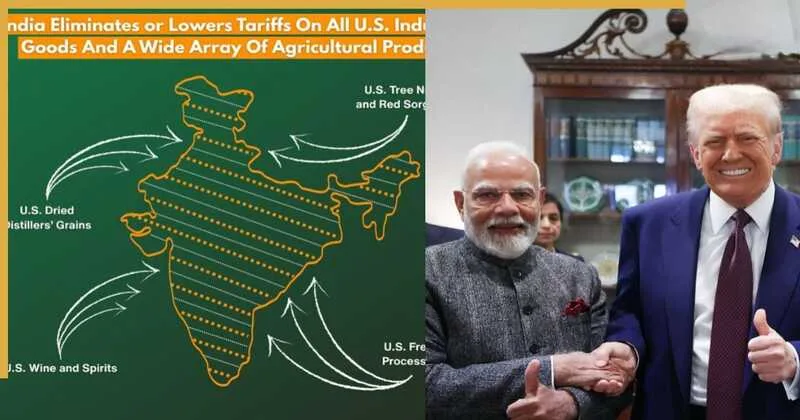
NEW DELHI: When India and the United States announced the framework for an interim trade agreement, an official map released by the United States Trade Representative quickly became a talking point across public platforms. More than a routine graphic, the map has come to symbolise a broader diplomatic breakthrough, suggesting that the deal represents far more than a commercial arrangement.
The map published by the USTR depicts J&K, including Pakistan-occupied Jammu & Kashmir, as an integral part of India. It also shows Aksai Chin, a region claimed by China, within Indian territory. This marks a clear departure from earlier cartographic representations by US agencies, including the United States Department of State, which traditionally demarcated Pakistan-occupied Kashmir separately, ostensibly to accommodate Islamabad’s sensitivities. The latest map shared under the Trump administration rejects both Pakistani and Chinese territorial claims. While India does not require external validation of its sovereignty and has consistently maintained that Kashmir is an inseparable part of the Union, this development represents a notable shift in Washington’s posture. Whether intentional or inadvertent, the move sends a powerful diplomatic signal to Pakistan that the current US leadership appears firmly aligned with India on this issue.
Historically, maps issued by the US State Department acknowledged Pakistan-occupied Jammu & Kashmir as disputed territory, reflecting concern for Pakistan’s position. The Trump administration’s latest representation breaks from that precedent entirely. Equally significant is the inclusion of Aksai Chin, located in northeastern Ladakh, as Indian territory. India’s Ministry of External Affairs has repeatedly objected to the misrepresentation of Jammu and Kashmir and Arunachal Pradesh in international maps. This revised depiction effectively addresses a long-standing grievance raised by New Delhi with US and other global institutions.
This episode of what analysts are calling “map diplomacy” has drawn praise from geopolitical observers and defence experts. The timing is also striking. Pakistan’s Army Chief, Asim Munir, has travelled to the United States three times over the past six months and reportedly met President Trump. Despite these outreach efforts, Washington’s release of a map favouring India is widely viewed as a major diplomatic setback for Islamabad. This map showing Pakistan-occupied Kashmir as part of India is a major shift in the US position, reflecting the broader sentiment among strategic commentators.
India secures export advantage as tariffs fall and US opens key markets
On the economic front, the interim agreement signals a reversal of the punitive trade measures imposed on India in 2025. The steep 50 per cent tariff levied on Indian goods, justified by India’s imports of Russian oil, has now been reduced to 18 per cent. India will also benefit from lower duties than competitors such as Vietnam and China, providing Indian exporters with a significant edge in the US market. Moreover, tariffs on key sectors, including gems, jewellery, and pharmaceuticals, have been reduced to zero.
In return, India has agreed to make certain strategic concessions. Over the next five years, New Delhi plans to purchase approximately $500 billion worth of US products. US agricultural commodities such as soybean oil and cashew nuts will also gain wider access to Indian markets. At the same time, India has held firm on sensitive domestic staples, ensuring that sectors like milk and rice remain protected.
Taken together, the revised map and the trade framework underscore Washington’s growing recognition of India as a pivotal geopolitical partner. With the full agreement expected to be signed soon, bilateral relations appear poised to enter a new and more strategically aligned phase.