Binary logic hidden in the Sanskrit verse
August 23, 2026
  • Read Ecopy
  • Circulation
  • Advertise
  • Careers
  • About Us
  • Contact Us
Android AppiPhone AppArattai
Organiser
  • ‌
  • Bharat
    • Assam
    • Bihar
    • Chhattisgarh
    • Jharkhand
    • Maharashtra
    • View All States
  • World
    • Asia
    • Europe
    • North America
    • South America
    • Africa
    • Australia
  • Editorial
  • International
  • Opinion
  • RSS @ 100
  • More
    • Op Sindoor
    • Analysis
    • Sports
    • Defence
    • Politics
    • Business
    • Economy
    • Culture
    • Special Report
    • Sci & Tech
    • Entertainment
    • G20
    • Azadi Ka Amrit Mahotsav
    • Vocal4Local
    • Web Stories
    • Education
    • Employment
    • Books
    • Interviews
    • Travel
    • Law
    • Health
    • Obituary
  • Subscribe
    • Subscribe Print Edition
    • Subscribe Ecopy
    • Read Ecopy
  • ‌
  • Bharat
    • Assam
    • Bihar
    • Chhattisgarh
    • Jharkhand
    • Maharashtra
    • View All States
  • World
    • Asia
    • Europe
    • North America
    • South America
    • Africa
    • Australia
  • Editorial
  • International
  • Opinion
  • RSS @ 100
  • More
    • Op Sindoor
    • Analysis
    • Sports
    • Defence
    • Politics
    • Business
    • Economy
    • Culture
    • Special Report
    • Sci & Tech
    • Entertainment
    • G20
    • Azadi Ka Amrit Mahotsav
    • Vocal4Local
    • Web Stories
    • Education
    • Employment
    • Books
    • Interviews
    • Travel
    • Law
    • Health
    • Obituary
  • Subscribe
    • Subscribe Print Edition
    • Subscribe Ecopy
    • Read Ecopy
Organiser
  • Home
  • Bharat
  • World
  • Operation Sindoor
  • Editorial
  • Analysis
  • Opinion
  • Culture
  • Defence
  • International Edition
  • RSS @ 100
  • Magazine
  • Read Ecopy
Home Bharat

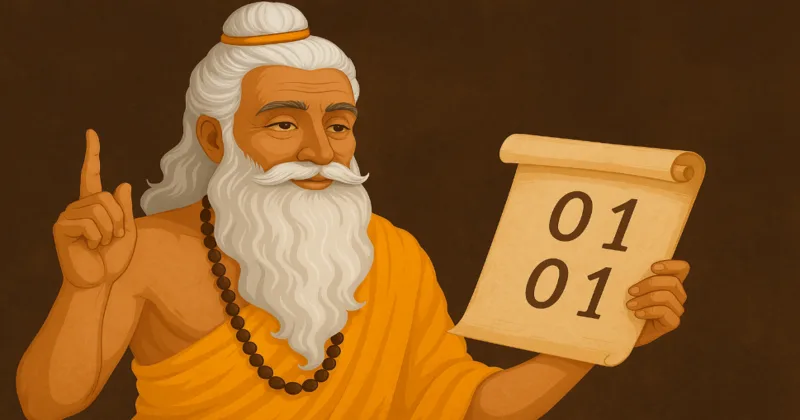
Binary logic hidden in the Sanskrit verse

What is less known is that the basic idea of binary thinking appeared in India more than 2,000 years earlier, not in engineering or mathematics, but in the study of poetry. This remarkable contribution came from Acharya Pingala, an ancient Indian scholar of Sanskrit prosody, through his famous work Chandahsastra

Dr Punit KumarDr Punit Kumar
Feb 8, 2026, 11:00 am IST
inBharat, Analysis, Culture, Sci & Tech
Follow on Google News
Representative Image

Representative Image

Facebook
Twitter
WhatsAppTelegramEmail

Today’s digital world runs on a very simple idea, binary numbers. Everything inside a computer, text, images, videos, calculations is finally reduced to just two symbols 0 and 1. This binary system is usually credited to the German philosopher Gottfried Wilhelm Leibniz in the 17th century and later became the backbone of modern computers.

What is less known is that the basic idea of binary thinking appeared in India more than 2,000 years earlier, not in engineering or mathematics, but in the study of poetry. This remarkable contribution came from Acharya Pingala, an ancient Indian scholar of Sanskrit prosody, through his famous work Chandahsastra. Pingala did not invent computers, but he developed binary logic, systematic counting and algorithmic methods that are strikingly similar to modern binary systems. Understanding his work gives us a broader and more balanced view of the global history of science.

Acharya Pingala lived around the 2nd century BC and is considered one of the earliest authorities on Chandas, the science of poetic meters in Sanskrit. His text, the Chandahsastra, studies how poems are structured based on the length of syllables. Instead of treating poetry as mere art, Pingala analyzed it with rules, patterns and logical procedures. In doing so, he unknowingly laid the foundation for ideas that today form the core of combinatorics and computer science.

Laghu and Guru: A two-symbol system

At the heart of Pingala’s system are two types of syllables :

  • Laghu (L) – short syllable
  • Guru (G) – long syllable

Every Sanskrit meter is a sequence made only from these two elements. This is where the connection to the binary system becomes clear. Modern computers are built on the binary system, where all information is ultimately expressed using just two symbols, 0 and 1. These symbols represent two basic states such as off/on or false/true, and by combining them in different ways, complex data and instructions are created.

In a remarkably similar way, Acharya Pingala used two fundamental symbols in his analysis of Sanskrit poetry, Laghu (L) for a short syllable and Guru (G) for a long syllable. Although Pingala worked in the context of language and meter rather than machines, his two symbol system functioned on the same logical principle as modern binary code. Both systems show how vast complexity can arise from the systematic arrangement of just two basic elements.

Prastara listing all possible combinations

Pingala introduced a method called Prastara, which systematically lists all possible combinations of Laghu and Guru for a given number of syllables.

For example, if a poetic meter has three syllables, the possible patterns are:

G G G

G G L

G L G

G L L

L G G

L G L

L L G

L L L

There are 8 combinations, which is 2³.

Now let’s look at modern binary numbers with three bits :

111

110

101

100

011

010

001

000

The structure is the same. Only the symbols are different. This means Pingala was effectively counting in binary, even though his goal was to analyze poetry, not numbers.

Nashta and Uddishta: The early algorithms

Pingala went even further by introducing two remarkably advanced procedures known as Nashta and Uddishta. Nashta is the method used to determine the exact Laghu – Guru syllable pattern when its position number in the sequence is given. In contrast, Uddishta works in the opposite direction, it identifies the position number when a particular syllable pattern is known. In modern terms, Nashta is similar to converting a decimal number into its binary form, while Uddishta resembles converting binary back into decimal.

These processes are clear early examples of encoding and decoding algorithms, which lie at the heart of today’s computer programming and data processing. What makes Pingala’s work truly extraordinary is that he explained these procedures in a clear, systematic, and logical manner, demonstrating a sophisticated understanding of abstract and algorithmic thinking long before the age of computers.

Meru Prastara: The Pascal’s triangle before pascal

Another major contribution of Acharya Pingala is the Meru Prastara, a triangular arrangement used to determine how many poetic meters can be formed with a given number of Laghu(short) and Guru(long) syllables. This structure is mathematically the same as what is known today as Pascal’s Triangle in modern mathematics and probability theory.

Pascal’s Triangle plays a central role in binomial expansion, probability calculations, combinatorics and information theory, all of which are foundational to modern science and computing. What makes Pingala’s work truly remarkable is that he described this powerful mathematical idea almost 2,000 years before Blaise Pascal and did so not in a formal mathematical framework, but through the study of poetry once again showing the deep scientific insight embedded in ancient Indian knowledge traditions.

Also Read: The News Minute does it again: Manufacturing communal outrage over Justice G.R. Swaminathan comment on Karthigai Deepam

Comparison with the Modern Binary System
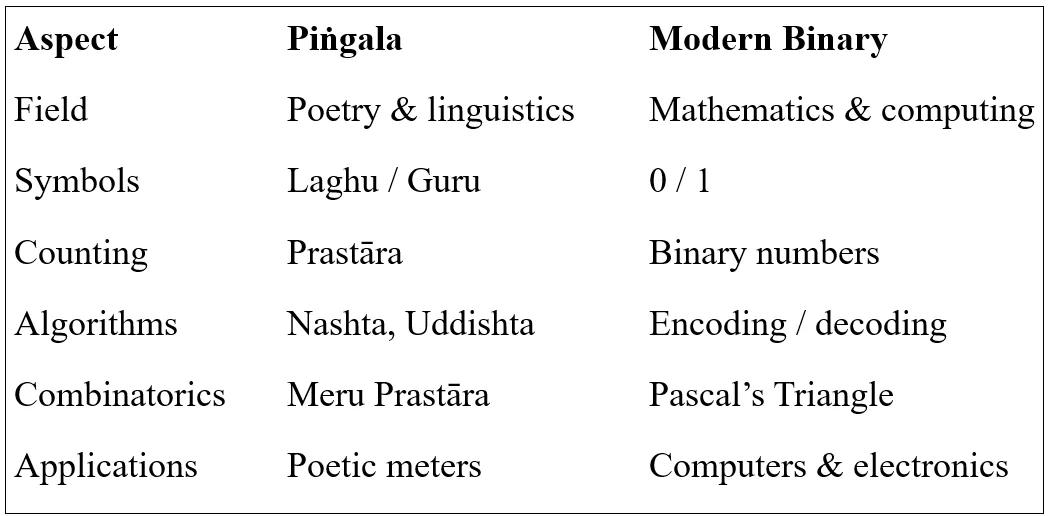

The key difference is application, not logic. Pingala used binary thinking to understand language, while modern science uses it to build machines.

Recognizing Pingala’s contribution does not mean claiming that ancient India invented computers. Rather, it shows that human reasoning evolves across cultures and disciplines. Indian scholars approached knowledge in an integrated way, where language, mathematics, logic and philosophy were deeply connected. Important ideas often appeared in unexpected fields, such as poetry. This also reminds us that the history of science is global, not limited to one civilization or era.

Acharya Pingala’s work shows that binary logic, systematic counting and algorithmic thinking existed in India more than two millennia ago. Through the simple concepts of Laghu and Guru, he explored ideas that today power the digital age. The journey from Laghu-Guru to 0-1 is a powerful example of how ancient knowledge can connect naturally with modern science. Long before computers, the language of binary was already being spoken, in verses, rhythms and syllables.

Topics: ancient indiaindian civilisationBinary SystemAcharya PingalaChandahsastraSanskrit
Share
Tweet
SendShareSend
✮ Subscribe Organiser YouTube Channel. ✮
✮ Join Organiser's WhatsApp channel for Nationalist views beyond the news. ✮
Previous News

Income tax department releases draft rules for new IT Act, 2025; Public consultation open till February 22

Next News

‘Girls were depressed after phones..’: Police flag emotional distress, gaming obsession in Ghaziabad suicide case

Related News

Vande Mataram exposes Congress’ appeasement politics

Bharat’s journey from ancient prosperity to colonial exploitation was marked by political upheaval, social disruption and economic decline (This image is generated by AI)

Bharat’s Historical Journey: Ancient prosperity, colonial exploitation and social disruption

Dr Hedgewar participating in the 1930 satyagraha against the British

Remembrance Day: RSS’ silent shield in India’s twilight hour of Partition in 1947

Decolonising the Mind: History, Education and Identity

Bharat’s diverse languages have historically served as bridges of cultural unity, connecting people through a shared civilisational ethos (AI-generated image)

World Hindu Congress 2026: Why Bharatiya languages are the soul of India’s unity

Bihar's 2,300-year-old Barabar Caves continue to intrigue with their mirror-like polish and extraordinary engineering

Barabar Caves of Bihar: India’s 2,300-year-old rock cut marvel that still puzzles archaeologists

Load More

Latest News

Representative Image

Balochistan: Hindu trader shot dead in Noshki; Policeman killed, 6 injured in IED blast in Mastung

SHANTI Act: When nuclear power transforms as national power

Sapta Dhara: Seven streams of national power with civilisational resonance

A representative image

How PM Janjatiya Vikas Mission is turning forest produce into tribal livelihoods

A representative image

Union government unveils five-year Rs 62,500 crore mobile manufacturing scheme

A Representative image

Centre steps up push for women-led rural enterprises with new entrepreneurship drive

A representative image

PM-AASHA: How the government steps in when farm prices crash

UP CM Yogi Adityanath has ordered strict action, including under the Essential Services Maintenance Act, against hoarding and black-marketing of Sugar

No Sugar Shortage in Uttar Pradesh: CM Yogi orders crackdown on hoarders, black-marketers

Swami Laxmanananda Saraswati

Swami Laxmanananda Saraswati Death Anniversary: A legacy of service, education and social reform

CGHS wellness centre to remain open

Fact Check: Health Ministry says wellness centres not closing for NEET-PG exam duty, check official update

Load More
  • Privacy
  • Terms
  • Cookie Policy
  • Refund and Cancellation
  • Delivery and Shipping

© Bharat Prakashan (Delhi) Limited.
Tech-enabled by Ananthapuri Technologies

  • Home
  • Search Organiser
  • Bharat
    • Assam
    • Bihar
    • Chhattisgarh
    • Jharkhand
    • Maharashtra
    • View All States
  • World
    • Asia
    • Africa
    • North America
    • South America
    • Europe
    • Australia
  • Editorial
  • Operation Sindoor
  • Opinion
  • Analysis
  • Defence
  • Culture
  • Sports
  • Business
  • RSS @ 100
  • Entertainment
  • More ..
    • Sci & Tech
    • Vocal4Local
    • Special Report
    • Education
    • Employment
    • Books
    • Interviews
    • Travel
    • Health
    • Politics
    • Law
    • Economy
    • Obituary
  • Subscribe Magazine
  • Read Ecopy
  • Advertise
  • Circulation
  • Careers
  • About Us
  • Contact Us
  • Policies & Terms
    • Privacy Policy
    • Cookie Policy
    • Refund and Cancellation
    • Terms of Use

© Bharat Prakashan (Delhi) Limited.
Tech-enabled by Ananthapuri Technologies