Today’s digital world runs on a very simple idea, binary numbers. Everything inside a computer, text, images, videos, calculations is finally reduced to just two symbols 0 and 1. This binary system is usually credited to the German philosopher Gottfried Wilhelm Leibniz in the 17th century and later became the backbone of modern computers.
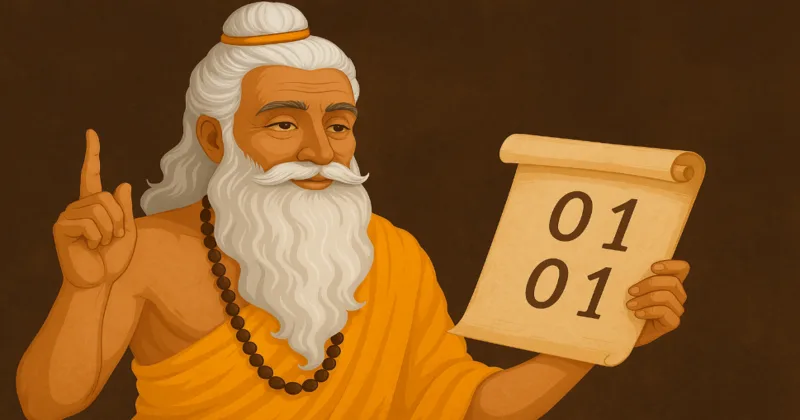
What is less known is that the basic idea of binary thinking appeared in India more than 2,000 years earlier, not in engineering or mathematics, but in the study of poetry. This remarkable contribution came from Acharya Pingala, an ancient Indian scholar of Sanskrit prosody, through his famous work Chandahsastra. Pingala did not invent computers, but he developed binary logic, systematic counting and algorithmic methods that are strikingly similar to modern binary systems. Understanding his work gives us a broader and more balanced view of the global history of science.
Acharya Pingala lived around the 2nd century BC and is considered one of the earliest authorities on Chandas, the science of poetic meters in Sanskrit. His text, the Chandahsastra, studies how poems are structured based on the length of syllables. Instead of treating poetry as mere art, Pingala analyzed it with rules, patterns and logical procedures. In doing so, he unknowingly laid the foundation for ideas that today form the core of combinatorics and computer science.
Laghu and Guru: A two-symbol system
At the heart of Pingala’s system are two types of syllables :
- Laghu (L) – short syllable
- Guru (G) – long syllable
Every Sanskrit meter is a sequence made only from these two elements. This is where the connection to the binary system becomes clear. Modern computers are built on the binary system, where all information is ultimately expressed using just two symbols, 0 and 1. These symbols represent two basic states such as off/on or false/true, and by combining them in different ways, complex data and instructions are created.
In a remarkably similar way, Acharya Pingala used two fundamental symbols in his analysis of Sanskrit poetry, Laghu (L) for a short syllable and Guru (G) for a long syllable. Although Pingala worked in the context of language and meter rather than machines, his two symbol system functioned on the same logical principle as modern binary code. Both systems show how vast complexity can arise from the systematic arrangement of just two basic elements.
Prastara listing all possible combinations
Pingala introduced a method called Prastara, which systematically lists all possible combinations of Laghu and Guru for a given number of syllables.
For example, if a poetic meter has three syllables, the possible patterns are:
G G G
G G L
G L G
G L L
L G G
L G L
L L G
L L L
There are 8 combinations, which is 2³.
Now let’s look at modern binary numbers with three bits :
111
110
101
100
011
010
001
000
The structure is the same. Only the symbols are different. This means Pingala was effectively counting in binary, even though his goal was to analyze poetry, not numbers.
Nashta and Uddishta: The early algorithms
Pingala went even further by introducing two remarkably advanced procedures known as Nashta and Uddishta. Nashta is the method used to determine the exact Laghu – Guru syllable pattern when its position number in the sequence is given. In contrast, Uddishta works in the opposite direction, it identifies the position number when a particular syllable pattern is known. In modern terms, Nashta is similar to converting a decimal number into its binary form, while Uddishta resembles converting binary back into decimal.
These processes are clear early examples of encoding and decoding algorithms, which lie at the heart of today’s computer programming and data processing. What makes Pingala’s work truly extraordinary is that he explained these procedures in a clear, systematic, and logical manner, demonstrating a sophisticated understanding of abstract and algorithmic thinking long before the age of computers.
Meru Prastara: The Pascal’s triangle before pascal
Another major contribution of Acharya Pingala is the Meru Prastara, a triangular arrangement used to determine how many poetic meters can be formed with a given number of Laghu(short) and Guru(long) syllables. This structure is mathematically the same as what is known today as Pascal’s Triangle in modern mathematics and probability theory.
Pascal’s Triangle plays a central role in binomial expansion, probability calculations, combinatorics and information theory, all of which are foundational to modern science and computing. What makes Pingala’s work truly remarkable is that he described this powerful mathematical idea almost 2,000 years before Blaise Pascal and did so not in a formal mathematical framework, but through the study of poetry once again showing the deep scientific insight embedded in ancient Indian knowledge traditions.
Comparison with the Modern Binary System
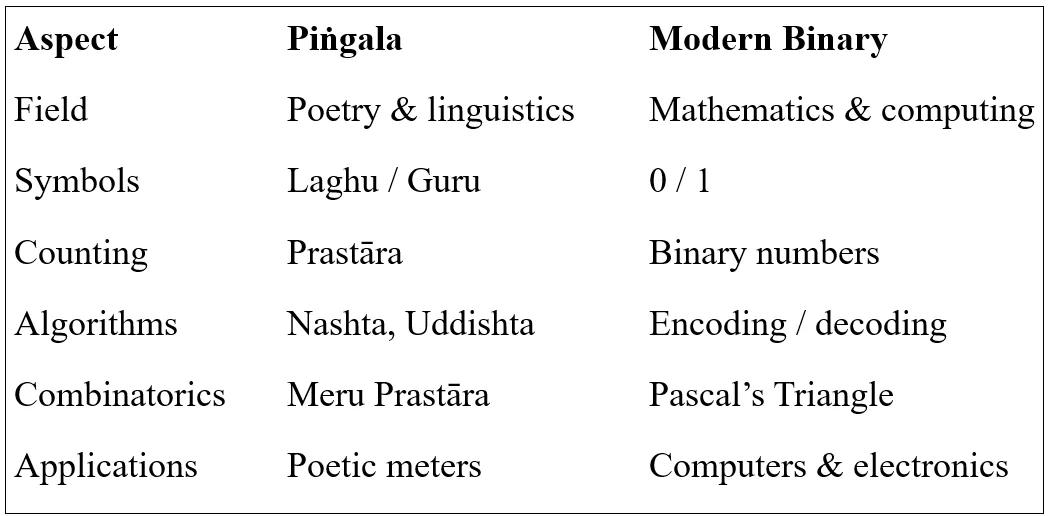
The key difference is application, not logic. Pingala used binary thinking to understand language, while modern science uses it to build machines.
Recognizing Pingala’s contribution does not mean claiming that ancient India invented computers. Rather, it shows that human reasoning evolves across cultures and disciplines. Indian scholars approached knowledge in an integrated way, where language, mathematics, logic and philosophy were deeply connected. Important ideas often appeared in unexpected fields, such as poetry. This also reminds us that the history of science is global, not limited to one civilization or era.
Acharya Pingala’s work shows that binary logic, systematic counting and algorithmic thinking existed in India more than two millennia ago. Through the simple concepts of Laghu and Guru, he explored ideas that today power the digital age. The journey from Laghu-Guru to 0-1 is a powerful example of how ancient knowledge can connect naturally with modern science. Long before computers, the language of binary was already being spoken, in verses, rhythms and syllables.