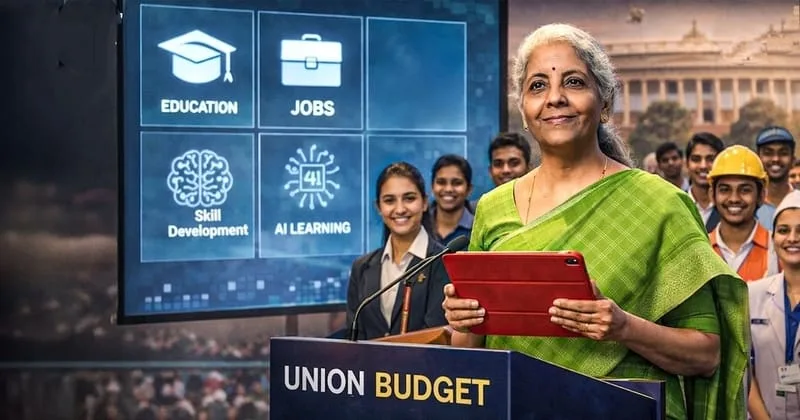
Under the Union Budget 2026-27, the Government of India has unveiled plans to establish a High-Powered ‘Education to Employment and Enterprise’ Standing Committee. This will be a major step toward realising the vision of Viksit Bharat by 2047. The initiative aims to bridge the gap between education, employability, and entrepreneurship while making India a global leader in the services sector. The announcement was made under the Ministry of Education’s segment on Human Capital for Viksit Bharat, and emphasised the government’s commitment to developing a workforce that can meet the evolving demands of a technology-driven economy.
The newly proposed Standing Committee will function as a strategic advisory body tasked with recommending comprehensive policy measures to strengthen the link between education and employment. Its primary focus will be on the services sector, which has emerged as one of the strongest pillars of India’s economic growth, contributing nearly 54 per cent to the nation’s GDP.
The Committee will bring together experts from academia, industry, and government to identify areas of growth, skill requirements, and global competitiveness. Its goal will be to ensure that the country’s education system keeps pace with technological and industrial transformation, preparing the youth for high-value employment and entrepreneurial opportunities.
Union Budget 2026-27 has announced setting up of a high powered 'Education to Employment and Enterprise' Standing Committee to recommend measures that focus on the services sector which is the core driver of Viksit Bharat. The Committee will look into the impact of emerging… pic.twitter.com/Uksfr8HNuY
— Ministry of Education (@EduMinOfIndia) February 1, 2026
According to the Budget document, the services sector will be positioned as the core driver of Viksit Bharat, with the government aiming for India to secure a 10 per cent global share in services by 2047. This aligns with India’s long-term goal of becoming a developed nation, focusing on innovation, skill excellence, and inclusive growth.
A key mandate of the Standing Committee will be to align education with employment outcomes. In recent years, the mismatch between academic curricula and industry requirements has been a growing concern, which leads to underemployment among graduates despite rising literacy and higher education rates. The Committee will work to address this gap by recommending curriculum reforms, vocational training programs, and skill certification frameworks. These will reflect the realities of a fast-changing job market.
The Standing Committee will also emphasise integration of emerging technologies, including Artificial Intelligence (AI), robotics, data analytics, and blockchain into the national education and skilling ecosystem. This will ensure that India’s youth are equipped not only with academic knowledge but also with practical, industry-relevant expertise that enhances employability.
One of the critical focus areas for the Committee will be assessing the impact of emerging technologies, particularly Artificial Intelligence (AI), on job creation and skill requirements. As automation and AI reshape industries worldwide, India’s ability to adapt its workforce will be crucial for sustaining growth and competitiveness. AI has already begun influencing diverse sectors such as healthcare, finance, education, logistics, and governance. However, it also poses challenges by altering traditional job structures. The Committee’s role will be to evaluate these dynamics, suggest strategies for reskilling and upskilling, and promote the creation of future-ready jobs. Moreover, the Committee will likely collaborate with key national initiatives like Skill India, Digital India, and the National Education Policy (NEP) 2020, ensuring a unified approach toward technology-driven human capital development.
The government has placed significant emphasis on expanding employment opportunities through the services sector, which includes IT and ITeS, tourism, healthcare, education, and financial services. The Standing Committee will identify high-potential sub-sectors that can create jobs and boost India’s export competitiveness.
While the Committee’s work will prioritise high-growth sectors, it will also pay attention to inclusivity and equitable access to education and employment. A key part of its vision is to make sure rural youth, women, and poor communities get equal chances to benefit from new opportunities.
The Committee will propose frameworks that integrate digital education tools, online skill courses, and AI-based learning platforms to make training accessible to learners across geographies. It will also evaluate the role of start-ups and social enterprises in generating employment and entrepreneurship in smaller towns and villages.
Experts believe that creating an education-to-employment pipeline is essential for leveraging India’s demographic dividend. With nearly 65 per cent of the population under 35 years of age, the coming decade represents a crucial window for building human capital capable of driving innovation and productivity.
A Vision for 2047: India as a global services leader
By 2047, when India celebrates 100 years of independence, the government envisions the country as a global leader in services with a 10 per cent share of the world market. To achieve this ambitious target, India will require not only technological advancement but also a highly skilled workforce capable of adapting to global trends.
The establishment of the ‘Education to Employment and Enterprise’ Standing Committee is a visionary step under the Union Budget 2026-27, and throws light on the government’s strategic focus on human capital development as the foundation of a Viksit Bharat. By prioritising the services sector, integrating technology, and aligning skills with employment opportunities, this initiative promises to transform India’s economic and social landscape over the next two decades.