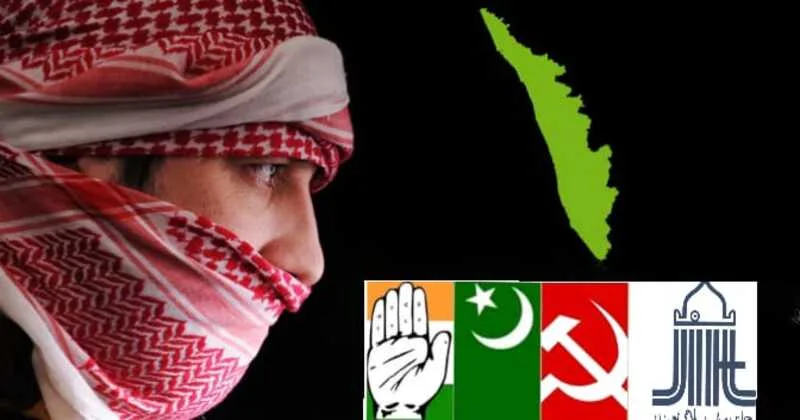
Can the progressive, democratic society of Kerala imagine a time when shadow groups made up of Islamic religious and organisational leaders even determine who becomes the Station House Officer (SHO) of a police station? Can it envision a future where such groups influence appointments all the way up to the post of Director General of Police (DGP) ? What once seemed unthinkable is now appearing increasingly plausible. The picture that is emerging in Kerala suggests that the interference of Islamic religious interests in state power, from local policing to top administrative positions, may not be far away.
Kerala appears to be moving towards an undeclared religious rule, where the approval and blessings of Islamic organisational leaders, from the local level to the state leadership, carry decisive weight in major political and administrative decisions. Ministerial portfolios, departmental control, and key appointments are gradually becoming arenas where Islamic religious considerations are asserted rather than constitutional principles upheld. This drift is no longer speculative. The Indian Union Muslim League, an ally of Congress-led UDF, has already publicly demanded the post of Deputy Chief Minister. Muslim League leader K.N.A. Khader stated that the Deputy Chief Minister’s position rightfully belongs to the Muslim League and that this demand must be seriously considered in light of the party’s electoral performance. Such assertions are not merely coalition bargaining tactics; they indicate a deeper political ambition rooted in identity-based entitlement.
The warnings about this trajectory have not come from political opponents alone. CPI(M) leader A.K. Balan once remarked that if the Congress-led UDF were to come to power, the Home Department would effectively be run by Jamaat-e-Islami. His statement reflected a widely shared perception in Kerala’s political discourse. It reinforced fears that the state is moving towards the supremacy of political Islam and, ultimately, a form of Sharia-oriented governance. Similarly, despite issuing an apology for controversial remarks, CPI(M)’s Minister Saji Cherian pointed out that “to understand communalism, one only needs to look at the names of those who win elections in Kasaragod and Malappuram districts.” His comment highlighted the dangerous direction in which Kerala’s politics is heading, even if it was later softened for political expediency. CPI(M) Former Chief Minister V.S. Achuthanandan, too, has repeatedly warned about the grave challenges Kerala faces. In stark terms, he cautioned that an organised effort is underway to turn Kerala into an Islamic-majority region within two decades.
From Bangladesh to Kerala: Jamaat’s blueprint for religious state power
To understand the seriousness of this situation, one only needs to look at neighbouring Bangladesh, a country now grappling with severe internal instability. Jamaat-e-Islami, which gained significant political influence after 2001, systematically built a powerful and organised grassroots network across Bangladesh. Its long-term objective has been the establishment of an Islamic political system that controls all aspects of governance. This infrastructure played a crucial role in inciting unrest and riots that ultimately led to the ouster of Prime Minister Sheikh Hasina.
A similar pattern appears to be unfolding in Kerala. During Bangladesh’s January election campaign, Jamaat candidate Afzal Hossain openly told his supporters that in a country where nearly 80 per cent of the population is Muslim, there should be no “infidel” or “immoral” representatives in Parliament. He asked voters whether they wanted the Quran or “deviations” from it. Jamaat’s position was unambiguous: Hindus, Sikhs, and Christians were deemed unfit to represent the nation in Parliament.
These views are not confined to Bangladesh. In Kerala, Jamaat-e-Islami’s state general secretary and Shura member, Sheikh Muhammad Karakunnu, has publicly declared that “no true believer can reject the idea of an Islamic Republic”. He has argued that “Islamic states have been established even in regions where Muslims were not in the majority”, citing Medina, where Prophet Muhammad founded the Ummah despite Muslims constituting only about 15 per cent of the population at the time. Such statements clearly reveal the political project Jamaat-e-Islami envisions for Kerala.
These pronouncements point unmistakably towards the creation of a shadow power structure at the local level, one composed of various Islamic organisations exerting influence beyond electoral politics. The rhetoric used today in Kerala mirrors the language employed in Bangladesh before its descent into instability. Similar declarations by Hossain in Bangladesh and Sheikh Mohammed in Kerala followed soon after extremist Muslim League leader and former MLA K. Muhammad Shaji stated in Kerala that “religion, religion, and religion is our problem,” asserting that the Muslim community had been deprived of power for the past ten years and was now moving to reclaim power in order to secure Muslim rights. The Popular Front of India, a banned Islamic terrorist organisation, had openly declared its goal of turning India into an Islamic state by 2047. Despite this, Congress Opposition Leader V.D. Satheesan has gone so far as to defend Jamaat-e-Islami, claiming it has abandoned religious nationalism. This defence stands in direct contradiction to the public declarations of Islamist leaders themselves, who openly assert that their ideology and objectives remain unchanged. These goals align with the broader vision of establishing Islamic dominance on a global scale.
Divide, Weaken, Capture: The organised Islamist electoral expansion
For such an organised Islamist political victory in Kerala, two conditions are essential : the fragmentation of the Hindu communities and the electoral defeat of the BJP. Islamic organisations in the state are actively pursuing this strategy by fuelling caste divisions among Scheduled Castes, Scheduled Tribes, Other Backward Classes, and communities such as the Ezhavas and Nairs. Jamaat-affiliated media outlets and organisations, including the Muslim League’s Dalit League, are systematically creating narratives that deepen social fractures. The deceptive nature of this divisive strategy has now been openly exposed by SNDP Yogam General Secretary Vellappally Natesan. He revealed how Islamic forces previously attempted to draw Ezhava communities into their fold under the guise of reservation politics, only to exploit them for broader ideological goals.
As noted earlier, this organised Islamic movement in Kerala is not confined to the Home Department. In the coming years, Keralites are likely to witness the steady capture of influence across sectors such as education, Mandir administration, revenue, and industry. Islam, in this political form, is not merely a religion; it is an ideology that seeks land, wealth, power, and dominance. Through electoral politics, it aims to secure power, and through power, to control resources and institutions.
This phenomenon is not limited to northern Kerala, as suggested by CPI(M) leaders like A.K. Balan and Saji Cherian. Nor is it restricted to UDF politics or the Muslim League alone. A telling example can be found in Ambalappuzha North Gram Panchayat in Alappuzha district, the home district of Minister Saji Cherian. In Muslim-majority wards, the SDPI, the political wing of the banned terror outfit PFI, emerged as a major force. While the LDF won nine seats, the SDPI secured seven, making it the second-largest party. Congress won two seats, while the League and the BJP won one each. What is particularly alarming is that both the LDF and the UDF, despite working together for years to marginalise the BJP in the name of protecting secularism, show little concern over the rise of an Islamic religious extremist outfit like the SDPI. In areas where Muslims have become the majority, mainstream parties have steadily lost relevance, mirroring the political marginalisation seen in districts like Malappuram.
These developments are small but significant indicators of the growing danger posed by Islamic religious politics across Kerala. The alternating Communist and Congress governments have created conditions conducive to the growth of such forces. Together, these fronts are effectively providing political cover and legitimacy to extremist elements, while Hindus and Christians are left to fend for themselves.
Islamic organisations such as Jamaat-e-Islami and the SDPI have openly adopted strategies similar to those employed in Bangladesh. They have declared that in constituencies where the BJP has a strong chance of winning, they will support whichever candidate, UDF or LDF, stands second. Their message is clear that only parties or candidates who align with Islamist agendas on issues such as triple talaq and waqf will be allowed to win. The goal is singular, to ensure the defeat of the BJP. The only difference from Bangladesh is that in Kerala, BJP candidates replace Hindu, Sikh, or Christian candidates as the primary targets.
The upcoming elections may well see Kerala being drawn into a broader global alliance of Islamist movements spanning Bangladesh, Palestine, and Pakistan. Projecting the parties such as Congress and Kerala Congress as acceptable fronts is merely a tactical move to attract Hindu and Christian votes. Jamaat-e-Islami, born in South Asia and deeply connected to global Islamic networks, is working to unify Islamic forces in Kerala and integrate them into the wider Pan-Islamic movement. Kerala today stands at a crossroads. What is unfolding is not ordinary coalition politics but a deeper ideological transformation, one that threatens the secular, democratic foundations of the state. Whether Kerala recognises this danger in time remains the most pressing question of all.