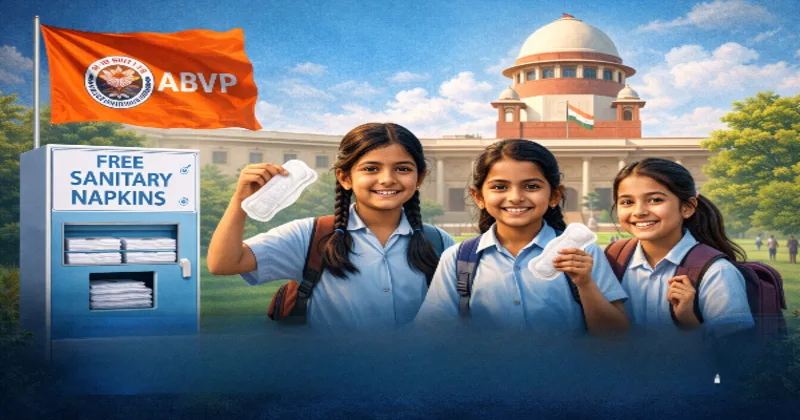
The Akhil Bharatiya Vidyarthi Parishad welcomes the directives issued by the Supreme Court to ensure the availability of free sanitary napkins in all schools across the country, functional toilets, and menstrual health awareness. By linking menstrual hygiene to the right to life under Article 21 and the right to education under Article 21(A), the Court’s perspective marks a historic and far-reaching decision in the direction of women’s health, dignity, and educational continuity.
For a long time, ABVP has clearly demanded that menstrual hygiene should not be viewed as a matter of social taboo or stigma, but rather as a responsibility involving health, respect, and the provision of essential facilities. Even today, in many parts of the country, the lack of sanitary facilities forces girl students to drop out of school or face serious health problems.
प्रेस विज्ञप्ति :https://t.co/4YWMcBVzZK
सभी विद्यालयों में नि:शुल्क सैनिटरी नैपकिन उपलब्ध कराने संबंधी माननीय सर्वोच्च न्यायालय का निर्देश स्वागतयोग्य: अभाविप
अभाविप का 'ऋतुमति अभियान' मासिक धर्म संबंधी जागरूकता के लिए दे रहा महत्वपूर्ण योगदानअखिल भारतीय विद्यार्थी परिषद… pic.twitter.com/610lhD2u5i
— ABVP (@ABVPVoice) February 2, 2026
The Supreme Court’s decision is a powerful constitutional intervention that will address all such barriers and further strengthen social justice and gender equality. It is noteworthy that ABVP’s ‘Ritumat Abhiyan’, conducted for several years in educational institutions and society to raise awareness about women’s health and menstruation, has made significant interventions toward widespread awareness on this issue.
Through this campaign, ABVP is not only increasing awareness about menstrual hygiene across the country but also reaching free sanitary napkins to millions of underprivileged women and girls. Under this campaign, nationwide surveys have been conducted from time to time, resulting in effective action plans based on ground realities. Through these initiatives, ABVP has consistently placed the installation of sanitary napkin vending machines in educational campuses, the availability of clean and safe toilets, and issues related to girls’ health and dignity at the centre of national discourse.
In this sequence, ABVP conducted a nationwide survey of girl students in February-March 2025, with 38,072 participating. This survey covered four key areas—education, health, safety, and self-reliance—to realistically assess these aspects of girls’ lives. Additionally, through the All India Girl Students’ Parliament organised in Delhi on March 10, 2025, ABVP held detailed discussions on issues related to women’s health, safety, education, and self-reliance, and submitted a memorandum to the Ministry of Women and Child Development. This memorandum prominently included demands for the mandatory installation of sanitary napkin vending machines in educational institutions and for the provision of clean, adequate toilets in schools, universities, and public places.
ABVP National Minister Kshama Sharma said, “Menstrual hygiene is not just a matter of health, but a question of girls’ dignity, self-respect, and continuous connection to education. The Hon’ble Supreme Court’s directive will bring positive change in the lives of millions of girls across the country and provides constitutional support to the efforts ABVP has been making for years.”
Payal Kinake said, “The Hon’ble Supreme Court’s directive recognizes a practical need in the daily lives of girls studying in schools. It will help remove unnecessary barriers in the path of education. As a student organization working at the grassroots level, ABVP has consistently experienced that the unavailability of menstrual hygiene places girls in unequal situations. Based on this experience, ABVP has been conducting awareness and collaborative initiatives for years. ABVP will play a constructive role in strengthening the necessary public awareness, institutional cooperation, and social sensitivity for the effective implementation of this decision.”