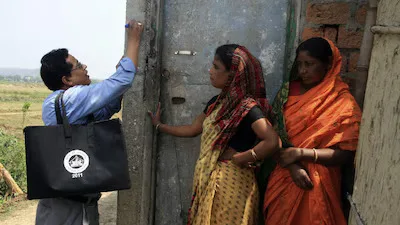
The upcoming Census 2027 will operate on a completely digital architecture, signalling a major transformation in how India collects, processes, and monitors population data. According to official circulars issued by the Registrar General and Census Commissioner of India, the exercise will rely on mobile platforms, centralised web portals, and real-time data transmission to streamline field operations and supervision.
The documents describe Census 2027 not as a digitised version of earlier exercises, but as a system designed natively for digital execution, integrating enumeration, training, geography, and monitoring into a single national framework.
As per the circular, data collection will be conducted through mobile applications used by enumerators, alongside provisions for Self-Enumeration by citizens. The entire process will be managed through the Census Management and Monitoring System (CMMS) and the Housing Listing Block Creation (HLBC) web portals.
These platforms will enable real-time data transmission, live monitoring of field progress, and centralised supervision at district, state, and national levels. Officials say this architecture is intended to reduce delays, minimise errors, and improve accountability across the census chain.
Alongside the digital rollout, a new nationwide location coding structure has been formalised to ensure uniform identification of every administrative and habitation unit in the country. The coding system assigns a simple yet unique numeric identifier to each area, which will serve as the primary reference point during data processing and analysis.
The framework maps identifiers hierarchically, starting from states and districts down to towns, villages, wards, and enumeration blocks, enabling seamless digital mapping and aggregation.
According to the circular, urban wards will be numbered in a continuous sequence beginning from “0001”, while outgrowth settlements adjoining statutory towns will receive incremental codes linked to their parent urban units.
To maintain consistency, existing administrative units from Census 2011 will retain their earlier identifiers. Newly created districts, states, and local bodies will be assigned incremental short codes generated through a centralised jurisdiction portal.
Separate numeric bands have been allocated for villages, forest villages, statutory towns, and census towns to prevent duplication and ensure clarity in classification across the national database.
The census circulars also lay out a comprehensive, standardised training framework aimed at preparing a digitally proficient workforce. Training will follow a cascade model, where national-level trainers prepare master trainers, who in turn train field trainers responsible for enumerators and supervisors.
The objective, according to the guidelines, is to build a “highly skilled and motivated workforce capable of executing a seamless, accurate, and trustworthy Census”, with a strong emphasis on digital tools, data integrity, and inclusive practices.
The house listing and housing phase has been identified as the foundation of Census 2027. The circular stresses the need for a clear and uniform understanding of census concepts, definitions, and questions across all levels of field staff.
Enumerators and supervisors are instructed to handle sensitive personal information with professionalism and “Seva Bhav”, underlining ethical conduct and public trust as core principles of the exercise.
The training circular prescribes detailed timelines and infrastructure requirements. Nationwide training is scheduled between April and September 2026, with all enumerator and supervisor instruction required to be completed at least one week before field operations begin.
Batch sizes, classroom duration, and venue facilities, including electricity supply, internet connectivity, and audiovisual equipment, have been standardised to ensure uniform training quality across states.
Attendance, progress, and performance will be tracked digitally through the CMMS portal, making training itself part of the real-time monitoring ecosystem governing Census 2027.