
How has the Bharat-EU trade deal economically shifted power from the unipolar West to the East? Why are Bharat’s neighbours, both on the East and West, miserable and scrambling for a mega deal? What transpired to have the deal consummated in 180 days that was initiated two decades ago?
Since 2014, Bharat has maintained neutrality and has been a helping hand to the entire world, whether that nation has been a friend or a foe in the past. However, in the recent 13 months, the world dynamics have been remodelled. Hence, Bharat has been swift in pursuing the wise words of Acharya Chanakya.
Europe, through the last century, relied heavily on two of the biggest power blocs, the United States and China. Relations between China and the EU began in 1975, post the Cold War era, when the EU consisted of merely nine member countries and gained strength by 1998. By the arrival of the 21st century, China started to emerge EU’s most favoured trading partner. By 2019, China became the second largest trading partner for the European Union, with a bilateral trade of a whooping $ (US Dollar) 717 billion. With this rising trade, challenges emerged for the EU with an even larger trade deficit, recording a mammoth 164 billion Euro deficit, which stood at 49 billion Euros at the beginning of the 21st century in 2000.
Pandemic: Beijing Marches Ahead
The result of this was that EU termed China as a cooperation partner, a negotiating partner, an economic competitor, and a systemic rival.
The ideology altered, but the outcome didn’t. In 2020, COVID-19 arrived worldwide, and China silently and smartly inched up from being second largest trading partner to the largest partner of the EU, creating a trade deficit of 249 billion Euros, up 50 per cent in a matter of just a couple of years. In 2025, the trade deficit between China and the EU bulged to nearly 400 billion Euros by 2022.
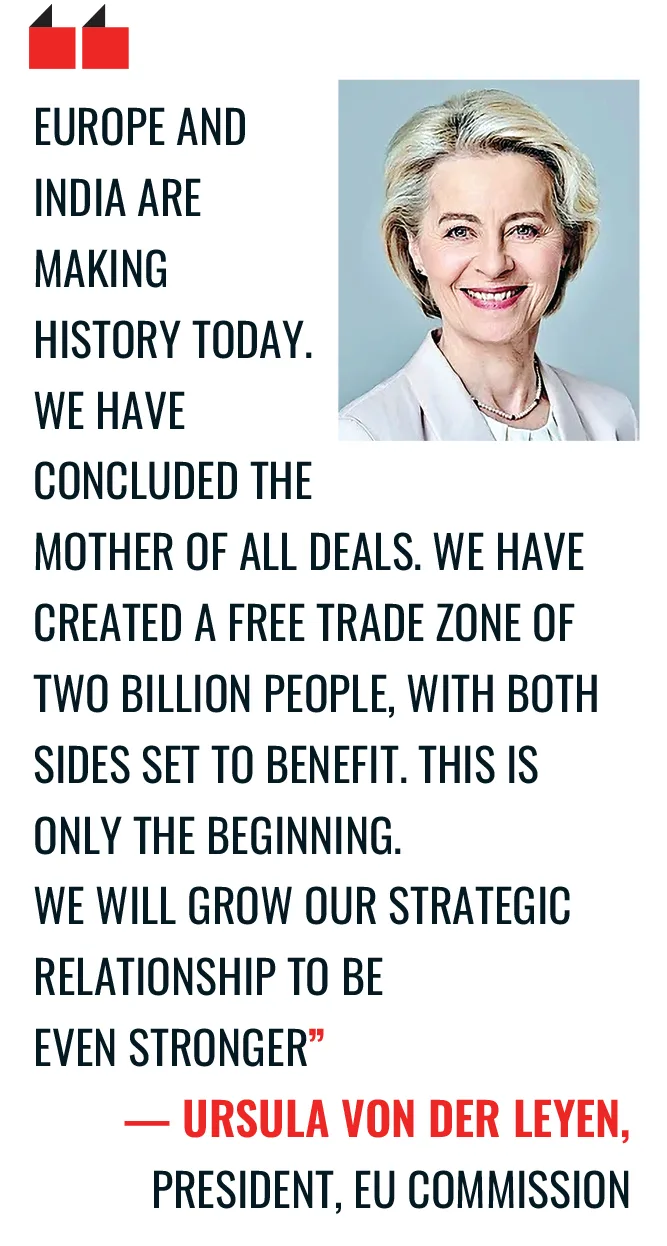
European Union reckoned the trade deficit and over dependence on Chinese imports, and rising non- consensus between EU and the US. Thus came the EU-Bharat deal with the EU moving with open strategic autonomy, adopting the de-risking strategy by playing China +1.
The foundation of the EU-Bharat Free Trade Agreement (FTA) was laid in 2004 during the 5th India-EU Summit at the Hague with a clear view of upgrading the relationship between the two to a relevant strategic partnership. Formal negotiations for the Broad-based Trade and Investment Agreement (BITA) could only begin in 2007.
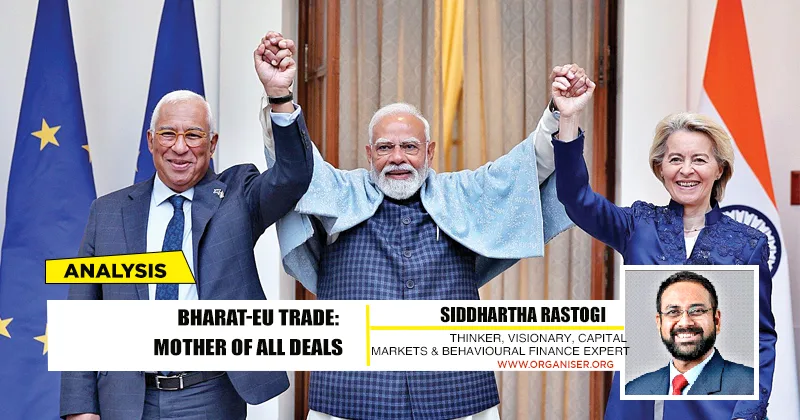
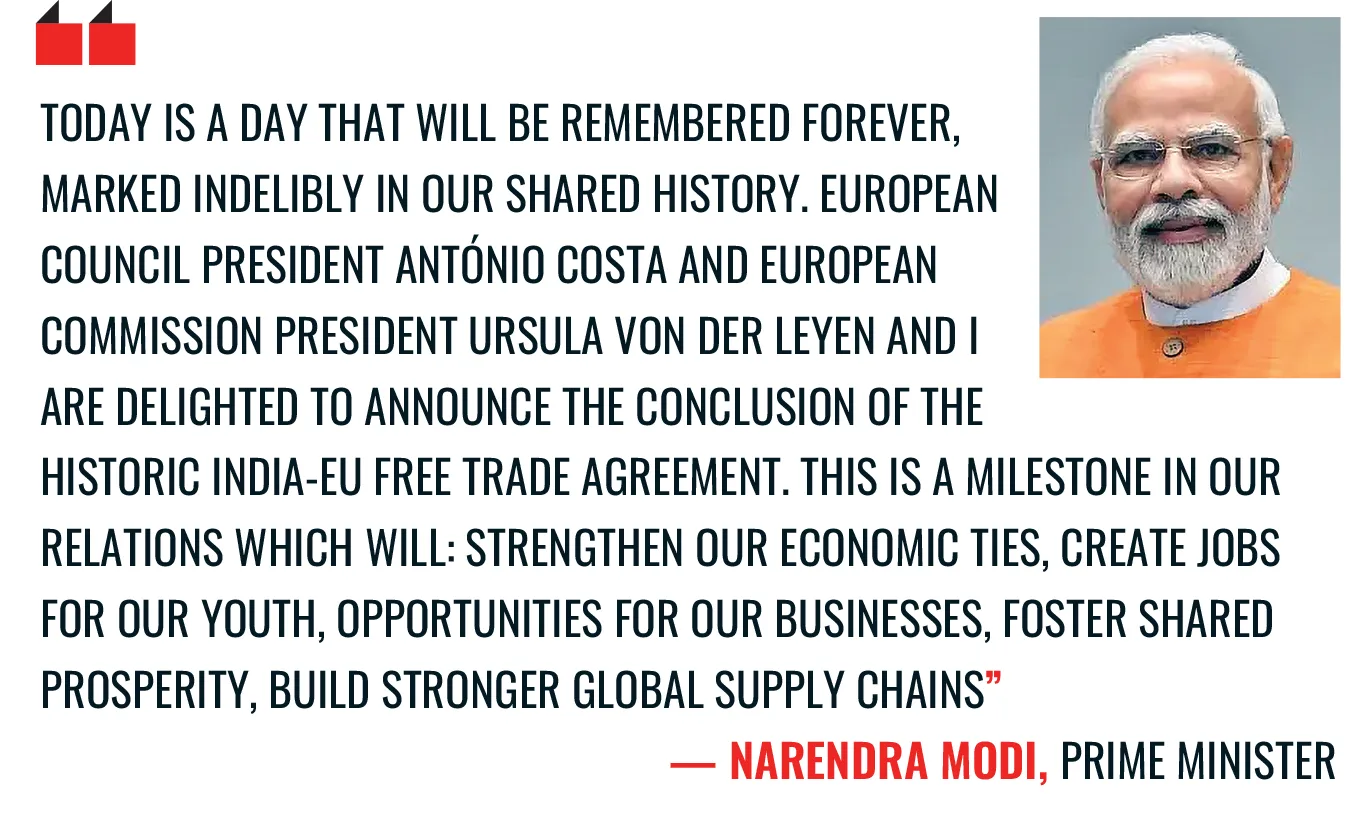
Disputes, doubts and digital trade kept the negotiations and trade agreements in abeyance. Finally, on Bharat’s 77th Republic Day, the mega – mother of all deals – was announced between the two allies.
Beyond diversification out of China, the Trump threat of tariffs, the heightened uncertain geo-political environment, and the slowing down of the EU economy prompted them to move fast and close the deal with Bharat.
Historic Mega Deal
The combined market size and opportunity between the EU and Bharat is estimated at over Rs 2092 lakh crores or USD 24 trillion, nearly 5.5 times the size of Bharat’s current economy. The size of the deal itself is unparalleled, as it impacts and benefits over 2 billion people or nearly one fourth of the world population.
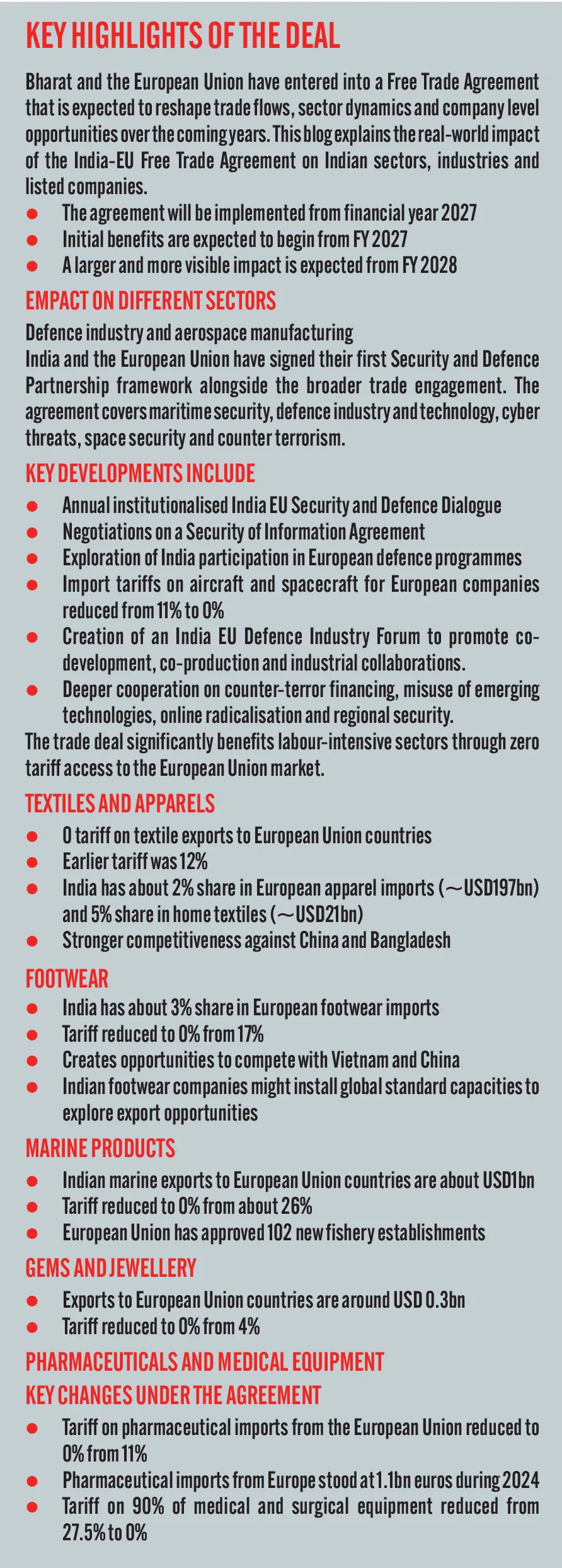
Since August 2025, 50 per cent tariffs (including the reciprocal tariffs) from the US impacted Bharat’s labour intensive industries including textiles, apparel, gems, jewellery, sea food, chemicals, leather products, auto components etc. With the Bharat EU trade deal, 70.4 per cent tariff lines covering 90.7 per cent of Bharat’s exports will have immediate duty elimination for the above-mentioned labour-intensive products, including textiles, leather and footwear, tea, coffee, spices, sports goods, toys, gems and jewellery and certain marine products.
- Furthermore, sectors such as textiles, apparel, marine, leather, footwear, chemicals, plastics/rubber, sports goods, toys, gems, and jewellery that comprises more than Rs 2.87 lakh crore (USD 33 billion) of exports that are currently subjected to import duty between 4 per cent to 26 per cent in the EU and are critical for employment creators, will enter zero duty zone. *Through this FTA, Bharat has secured access to 144 EU service sub-sectors, including Information Technology (IT), IT-enabled services (ITeS), professional services, education, financial services, telecommunications, tourism, and construction, etc. The deal also includes a mobility framework that simplifies visas and temporary stay for Indian professionals (IT, R&D, education) and their families.
- EU-Bharat FTA will give a fillip to the pharmaceutical sector in the country, with zero duties on most chemicals and medicines, strengthening Bharat’s role as the “Pharmacy of the World.”
- Bharat also secured a “Most-Favoured-Nation” assurance regarding the EU’s Carbon Border Adjustment Mechanism (CBAM), ensuring any flexibilities granted to other countries also apply to it, alongside EURO 500 million in EU support for greenhouse gas reduction.
- AYUSH practitioners (Ayurveda, Yoga & Naturopathy, Unani, Siddha, and Homoeopathy) will now be able to provide their services in many EU Member States using their Bharatiya qualifications.
The biggest issue of Bloody Milk and Genetically modified Seeds, which were a direct attack on Bharat’s culture and belief system and were an essential cause of conflict and negotiation between the US and Bharat, have been kept out of the Bharat EU trade deal. Thus, dairy, cereals, and poultry remain outside the contours of the agreement.
From Europe’s perspective, car manufacturers get a large young aspiring population who are interested in buying luxury cars, where the tariffs have been cut from 110 per cent to a mere 10 per cent. European wines and whiskey will get cheaper with duty cuts on liquor and premium brands.
Burgeoning Benefit
Bilateral trade in 2025 between the two regions was USD 140 billion. Through this FTA, the trade can take a leap by over 55 per cent to USD 220 billion by 2030.
- Through the years, exports from Bharat can expand to the EU by over 50 per cent.
- The deal itself can add 0.15 per cent to the nation’s GDP.
- Bharatiya students in the EU are guaranteed post-study work rights of 9 to 12 months.
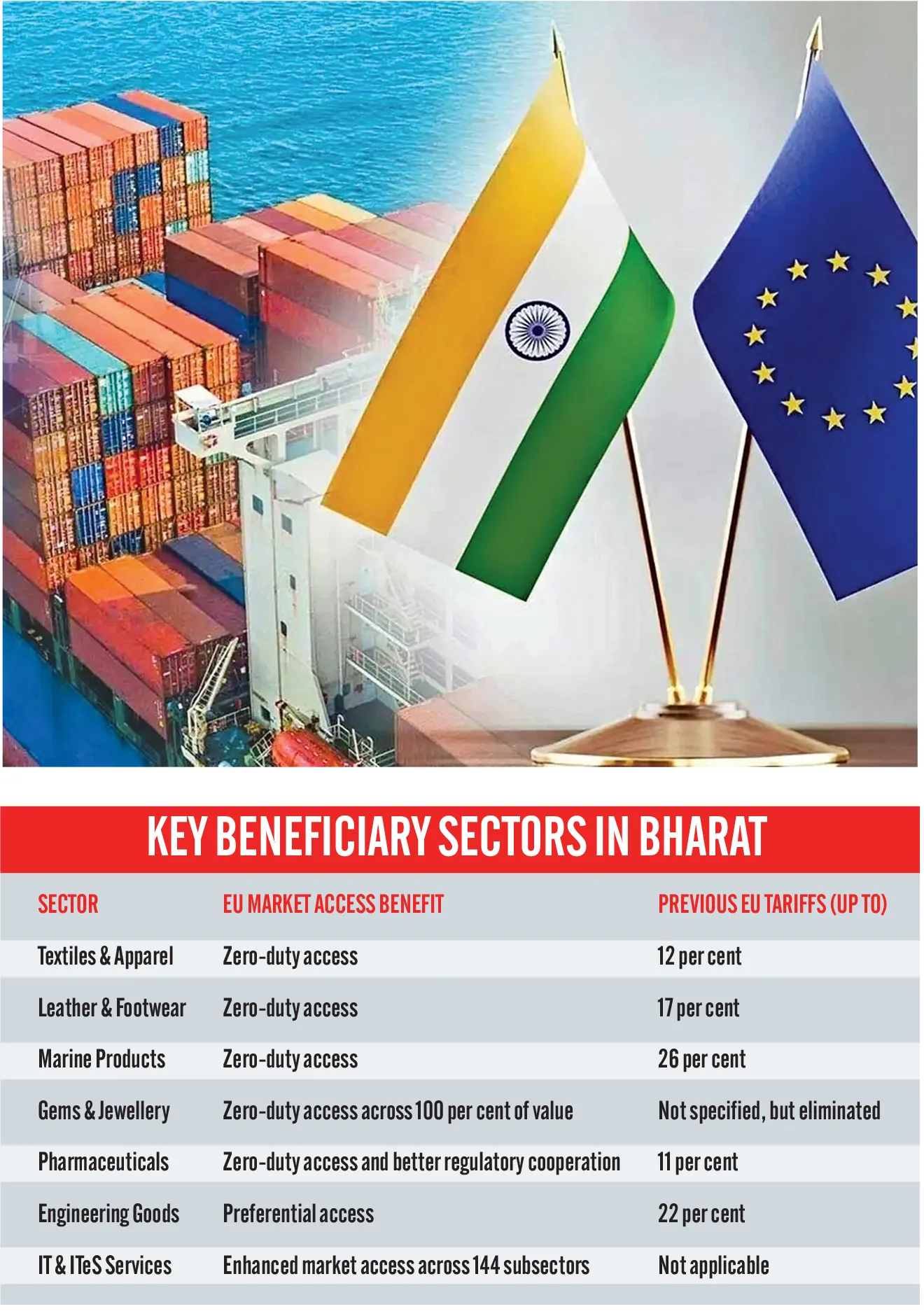
Below table shows how the EU Bharat deal is enabling multiple sectors. With this trade deal, Bharat has shown the world that every calamity, catastrophe calls out loud, “There is an opportunity that is emerging, step in the chaos and step up the game.”