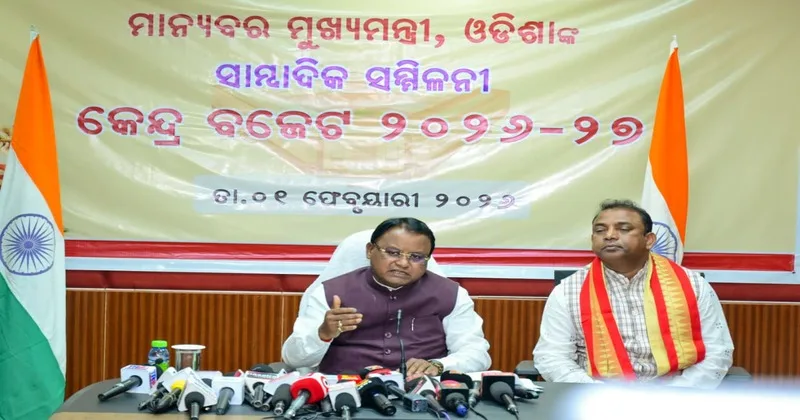
BHUBANESWAR: Odisha Chief Minister Mohan Charan Majhi on February 1 described the Union Budget 2026–27 as a growth-oriented, inclusive and forward-looking budget that places strong emphasis on youth empowerment, infrastructure development and balanced socio-economic progress. Reacting to the budget presented by Union Finance Minister Nirmala Sitharaman on the auspicious occasion of Magha Purnima, the Chief Minister said the provisions would significantly accelerate the vision of Atmanirbhar Bharat and Viksit Bharat.
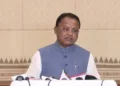
Addressing the media at a press meet in Sonepur, CM Majhi said the budget focuses on the development of all sections of society, with special attention to youth, farmers, rural households and emerging sectors of the economy. He termed it a “true youth power budget”, noting that special emphasis has been laid on skill development, employability and global competitiveness of India’s young population.
The Chief Minister pointed out that this is Finance Minister Nirmala Sitharaman’s ninth consecutive Union Budget, and instead of vague promises, it prioritises clarity, execution and measurable outcomes. “The budget reflects continuity in reforms and a clear roadmap for implementation. It strengthens confidence among the youth and enables them to contribute meaningfully to national development,” he said.
CM Majhi highlighted that under the leadership of Prime Minister Narendra Modi, the central government has implemented over 350 structural reforms so far, a rare milestone in India’s economic history. These reforms, he said, have ensured macroeconomic stability, sustained growth and low inflation, even amid global uncertainties. The Union Budget 2026–27 further strengthens this reform-driven approach by allocating ₹12.2 lakh crore for public capital expenditure (CAPEX), significantly boosting infrastructure development across sectors.
Expressing gratitude to the Union Government, the Chief Minister said Odisha has received special focus in the current budget through several strategic initiatives. One of the most significant announcements is the establishment of a dedicated Rare Earth Corridor in Odisha. This corridor will support mining, processing, research and manufacturing capacities for critical minerals, reduce import dependence, strengthen local industries and support high-tech sectors such as electronics and renewable energy.
The budget also envisages the development of the East Coast Development Corridor, under which Odisha is expected to benefit substantially due to its strategic coastal location and economic connectivity. As part of the Purvodaya initiative, five eastern states—Bihar, Jharkhand, West Bengal, Odisha and Andhra Pradesh—will see the development of key tourism destinations, along with the deployment of 4,000 electric buses to strengthen public transport and promote sustainable mobility.
Another major boost for Odisha is the expansion of inland water transport. CM Majhi said that 20 new national waterways will become operational over the next five years, with National Waterway-5 (NW-5) being implemented in the first phase. NW-5 will connect the mineral-rich regions of Talcher and Angul with major industrial and port hubs such as Paradip and Dhamra. This will enable efficient and cost-effective cargo transportation, ease pressure on road and rail networks, and reinforce Odisha’s role as a logistics and industrial hub along the eastern coast.
On the auspicious occasion of Magha Purnima and the birth anniversary of Santh Guru Ravidas Ji, I extend my greetings for the presentation of the Union Budget 2026 – 27 by Hon’ble Union Finance Minister @nsitharaman Ji under the visionary guidance of Hon’ble Prime Minister Shri…
— Mohan Charan Majhi (@MohanMOdisha) February 1, 2026
The Chief Minister also welcomed the introduction of “City Economic Regions” (CERs), a new initiative aimed at promoting integrated urban-led economic growth. Under this initiative, an allocation of ₹5,000 crore per CER has been proposed over the next five years. These regions will function as coordinated urban growth zones by strengthening infrastructure, services and investment linkages. CM Majhi said the initiative will be instrumental in operationalising the proposed Bhubaneswar–Cuttack–Paradip–Puri urban corridor.
On the environment and tourism front, the Chief Minister said the budget’s focus on wildlife tourism and ecological conservation is particularly relevant for Odisha. Under the new initiative, “Turtle Trails” will be developed near major turtle nesting sites in Odisha, Karnataka and Kerala. This nature-based tourism model will promote eco-friendly infrastructure, environmental awareness and sustainable livelihoods for local communities.
The Chief Minister termed the revamp of the rural employment framework as a landmark reform. Under the newly introduced Viksit Bharat–Rozgar Guarantee and Livelihood (Rural) scheme, the statutory employment guarantee has been enhanced from 100 to 125 days per rural household. The Centre–State sharing ratio will remain 60:40. For 2026–27, the total estimated requirement is Rs 1.51 lakh crore, of which the Centre’s share is Rs 95,692 crore. To ensure a smooth transition, separate allocations have been made for the outgoing MGNREGA and the new scheme.
Welcoming the budget’s agricultural focus, CM Majhi said coastal states like Odisha will benefit from special schemes promoting high-value agriculture, including coconut, cashew and sandalwood cultivation. A dedicated Coconut Promotion Scheme has been announced to improve productivity and farmers’ incomes by replacing old, low-yielding trees with high-yielding varieties.
The Chief Minister also highlighted the National Critical Mineral Mission, under which Rs 34,300 crore will be invested over seven years to secure critical minerals such as lithium. The mission includes investments in value chains, new rare earth corridors and incentives for coal gasification, strengthening India’s energy security and industrial base.
Listing key schemes with enhanced allocations, CM Majhi cited Agriculture Development Scheme, Jal Jeevan Mission, Samagra Shiksha, PM Awas Yojana (Urban and Rural), National Health Mission and National Rural Livelihood Mission. Among major centrally sponsored schemes with higher allocations are PM-KISAN, PM Garib Kalyan Anna Yojana, PM Surya Ghar Muft Bijli Yojana and PM Viksit Bharat Rozgar Yojana. Several new initiatives have also been announced, including PM Setu, the Allied Healthcare Professionals scheme, electronics manufacturing support, the biopharma mission, chemical parks, the infrastructure risk guarantee fund, and an MSME growth fund.
Responding to media queries, the Chief Minister said the Odisha government is focusing on 16 priority sectors to drive industrial development across all districts. Special emphasis is being laid on setting up textile units in cotton-growing districts such as Balangir, Kalahandi and Subarnapur. “Industries will be promoted based on district-specific potential to ensure balanced regional development,” he said.
Expressing confidence, CM Majhi said the provisions of Union Budget 2026–27 will play a decisive role in achieving the goals of a prosperous Odisha and a developed India. “From every perspective, this is a historic budget that lays a strong foundation for inclusive and sustainable growth,” he added.