Venezuela opens Oil Sector as US sanctions ease
July 16, 2026
  • Read Ecopy
  • Circulation
  • Advertise
  • Careers
  • About Us
  • Contact Us
Android AppiPhone AppArattai
Organiser
  • ‌
  • Bharat
    • Assam
    • Bihar
    • Chhattisgarh
    • Jharkhand
    • Maharashtra
    • View All States
  • World
    • Asia
    • Europe
    • North America
    • South America
    • Africa
    • Australia
  • Editorial
  • International
  • Opinion
  • RSS @ 100
  • More
    • Op Sindoor
    • Analysis
    • Sports
    • Defence
    • Politics
    • Business
    • Economy
    • Culture
    • Special Report
    • Sci & Tech
    • Entertainment
    • G20
    • Azadi Ka Amrit Mahotsav
    • Vocal4Local
    • Web Stories
    • Education
    • Employment
    • Books
    • Interviews
    • Travel
    • Law
    • Health
    • Obituary
  • Subscribe
    • Subscribe Print Edition
    • Subscribe Ecopy
    • Read Ecopy
  • ‌
  • Bharat
    • Assam
    • Bihar
    • Chhattisgarh
    • Jharkhand
    • Maharashtra
    • View All States
  • World
    • Asia
    • Europe
    • North America
    • South America
    • Africa
    • Australia
  • Editorial
  • International
  • Opinion
  • RSS @ 100
  • More
    • Op Sindoor
    • Analysis
    • Sports
    • Defence
    • Politics
    • Business
    • Economy
    • Culture
    • Special Report
    • Sci & Tech
    • Entertainment
    • G20
    • Azadi Ka Amrit Mahotsav
    • Vocal4Local
    • Web Stories
    • Education
    • Employment
    • Books
    • Interviews
    • Travel
    • Law
    • Health
    • Obituary
  • Subscribe
    • Subscribe Print Edition
    • Subscribe Ecopy
    • Read Ecopy
Organiser
  • Home
  • Bharat
  • World
  • Operation Sindoor
  • Editorial
  • Analysis
  • Opinion
  • Culture
  • Defence
  • International Edition
  • RSS @ 100
  • Magazine
  • Read Ecopy
Home International Edition America USA

Venezuela oil sector opens to private firms as US sanctions ease and PDVSA loses dominance

Venezuela has pushed through major oil sector reforms as controversial US sanction pressure begins to ease. The move opens doors for private corporations while raising concerns over foreign economic influence and control

Dr Vishnu AravindDr Vishnu Aravind
Jan 31, 2026, 10:30 am IST
in USA, World, South America, International Edition
Follow on Google News
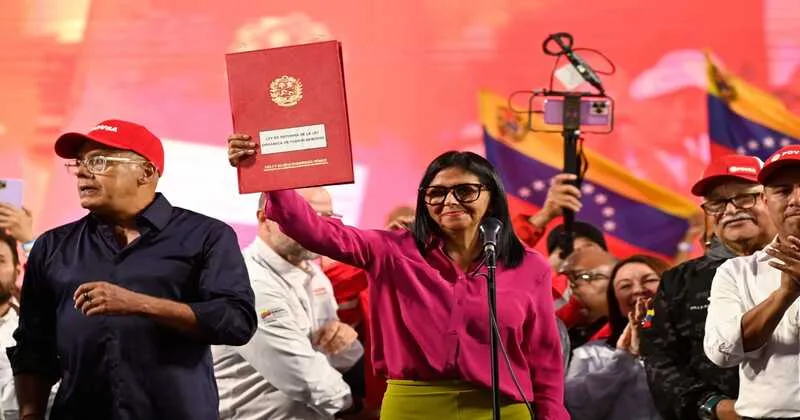
Venezuela's interim President Delcy Rodriguez holds up the newly signed oil reform bill, signalling a shift toward privatisation of the national oil sector amid US pressure

Venezuela's interim President Delcy Rodriguez holds up the newly signed oil reform bill, signalling a shift toward privatisation of the national oil sector amid US pressure

FacebookTwitterWhatsAppTelegramEmail

Caracas: Decades of overwhelming government dominance in Venezuela’s oil sector, the backbone of the national economy, are now drawing to a close. Interim President Delcy Rodriguez has signed a new law that opens the country’s vast petroleum wealth to private companies, marking a historic shift in policy. The state-owned oil giant Petroleos de Venezuela S.A. (PDVSA), which controlled the industry for more than twenty years, will no longer function as the central authority in the market.

Significantly, within hours of the National Assembly approving the legislation, the United States Treasury Department announced a relaxation of certain economic sanctions imposed on Venezuela. This development cleared the path for major American energy corporations, including Chevron, to re-enter Venezuelan territory and resume oil-related operations. For over two decades, the Venezuelan state, through PDVSA, exercised near-total control over the nation’s oil production, exports, and revenue distribution. President Rodrigo Duterte formally enacted the legislation less than two hours after it was passed by lawmakers. Soon afterwards, the US Treasury confirmed relief measures connected to sanctions originally introduced during the Trump administration. These adjustments were described as steps intended to widen the operational possibilities for US-based oil and energy firms seeking participation in Venezuela’s petroleum industry. nb

The rapid sequence of legislative approval followed by international financial concessions highlighted the geopolitical significance of the move. The signing ceremony was attended by oil sector workers, ruling party supporters, and senior government officials. The timing of the US policy shift coincided with the domestic celebrations, leading analysts to interpret the developments as mutually reinforcing political and economic gestures. Critics argued that Washington’s concessions were aligned with corporate interests eager to access Venezuela’s extensive oil reserves. Some observers also suggested that  US President Donald Trump had previously pushed for strategic dominance in the region primarily to benefit multinational extraction corporations.

Government insiders stated that Rodriguez held a phone conversation with US President Donald Trump and Secretary of State Marco Rubio shortly after the law’s passage. Rubio had recently addressed the US Senate with a unilateral explanation of how American authorities might regulate the sale of billions of barrels of Venezuelan oil and supervise the utilisation of its proceeds. His proposal outlined a monitoring framework that, according to detractors, resembled an attempt to exercise ownership-like control over another nation’s natural wealth.

Also Read: Smithsonian’s National Museum of Asian Art to return three historic bronze sculptures taken from Indian Mandirs

Reports detailing the provisions of the new legislation indicate that private corporations will be permitted to directly manage oil production and commercial sales. The law stipulates that companies must operate at their own cost, responsibility, and risk. To receive approval, firms must submit comprehensive business plans demonstrating both financial strength and technical expertise. Final authorisation will only be granted following evaluation and consent from Venezuela’s oil ministry, ensuring a degree of governmental oversight remains intact.

Despite the expanded role of private actors, the Venezuelan state will continue to retain sole ownership of hydrocarbon resources, including underground oil wells and natural reserves. The legal framework governing dispute resolution has also been modified to make conditions more favourable to foreign investors. Previously, all disputes were required to be settled exclusively within Venezuelan courts. The revised law now allows access to independent international arbitration mechanisms, providing corporations with assurances of legal protection in the event of future nationalisation concerns or contractual disagreements.

Under the new policy, oil extraction royalties have been capped at a maximum of thirty per cent. The government reserves the authority to determine the exact rate based on variables such as capital investment requirements, project competitiveness, and economic viability. Orlando Camacho, chair of the National Assembly’s oil committee, declared that the legislation would fundamentally transform the country’s economic trajectory. Opposition parliamentarian Antonio Ekkarri, while not opposing reform outright, urged the inclusion of stronger transparency clauses. He recommended the creation of a public digital platform where all oil-related financial transactions could be openly monitored.

Historically, strict state control over the oil sector formed a central pillar of the socialist revolution that brought Hugo Chavez to power in 1998. Legal reforms introduced in 2006 mandated that the government remain the majority shareholder in all significant petroleum ventures. During the period of elevated global oil prices between 1999 and 2011, Venezuela reportedly generated approximately 981 billion dollars in revenue, reinforcing the sector’s importance to national finances and developmental programs.

Venezuela possesses some of the largest proven oil reserves in the world, and the government’s firm grip over production and distribution long posed both a challenge and a temptation to global corporate interests. For decades, countries such as the United States closely watched the nation’s energy wealth. At the same time, the Trump administration was  pursuing aggressive military and diplomatic strategies in the region under the justification of combating drug cartel links and restoring political stability.

Recent controversies have further complicated the geopolitical landscape, with reports claiming that the Venezuelan president and his spouse had been detained under disputed circumstances. Allegations of narcotics connections have frequently been cited as grounds for intervention in several Latin American nations. On Thursday, Trump signed an executive order declaring a complete trade embargo on countries supplying oil to Cuba, a move widely interpreted as another escalation in the broader struggle over energy resources and regional influence.

 

Topics: Oil Sector ReformPDVSAEnergy GeopoliticsChevronVenezuelaUS SanctionsForeign Intervention
ShareTweetSendShareSend
✮ Subscribe Organiser YouTube Channel. ✮
✮ Join Organiser's WhatsApp channel for Nationalist views beyond the news. ✮
Previous News

Kerala: Setback for CPM as entire CITU unit at Malappuram FCI godown quits En Bloc, joins BMS

Next News

Tamil Nadu: Governor RN Ravi cites UP teaching Tamil in schools, dismantles DMK’s language politics

Related News

Operation Amistad: Earthquake-hit Venezuela thanks PM Modi for humanitarian aid; Hails it as “sample of brotherhood”

Army Field Hospital Deployed in Earthquake-hit Venezuela

Operation Amistad: India intensifies relief efforts in quake-hit Venezuela; Army hospital deployed as death toll spikes

Operation Amistad: India airlifts BHISHM hospital to Venezuela; Reflects healthcare innovation & humanitarian diplomacy

History of Venezuela Earthquakes: How the oil rich nation remains engulfed in natural, political, economic & crises

Operation Sindoor put the Beijing-Islamabad military nexus under spotlight as Chinese systems faced global scrutiny

China admits support to Pakistan during India’s anti-terror Op Sindoor, indirectly validating battlefield losses

Representative image from a CPI(M) protest organised across Bharat

Tamil Nadu: CPM activist dies after sustaining burn injuries while burning Trump effigy in Nagapattinam protest

Load More

Latest News

Dr. Vrushali Joshi, National Organising Secretary of Vishwa Mangalya Sabha briefing the media about the upcoming historic dialogue on contemporary motherhood by RSS Sarsanghchalak Dr Mohan Bhagwat

‘Matrutva Vimarsh’ in Delhi: RSS Sarsanghchalak Mohan Bhagwat to hold historic dialogue on contemporary motherhood

Representatives of the national trade union centers of the BRICS member and partner countries at BRICS Trade Union Forum

Declaration of 15th BRICS Trade Union Forum calls for human-centric AI, universal social security & labour cooperation

The deities' three chariots are ready for the sacred Shree Gundicha Yatra

Three Grand chariots ready at Singhadwara as Puri immerses in devotion ahead of Rath Yatra 2026

Shikshit Uttar Pradesh 2047: “Education is the basic requirement for development,” says Pilot Rakesh Tyagi

Semicon 2.0 to Urea Self-Reliance: Union Cabinet unveils Rs 2.19L crore projects to propel economic prosperity of India

Tamil Nadu: Madras HC cancels registration of Rs 100 crore Palani Murugan Temple land in private individuals’ names

Keralam: ‘Tipu’s Nemesis’, AI-powered cinematic tribute recreates Travancore’s historic resistance against Tipu Sultan

Madhya Pradesh Chief Minister Mohan Yadav speaks at the inauguration of the 'MP Tech Growth Conclave 3.0: GCC, Data Centre and Semiconductor' event, in Bhopal

From Agrarian State to Technology Powerhouse: MP Tech Growth Conclave 3.0 shapes Madhya Pradesh’s high-tech future

Telangana: Hindu auto driver threatened by police over Sanatana Dharma quotes in Hyderabad; VHP demands action

Bharatbodh reflects Bharat's timeless civilisational consciousness and cultural identity

Bharatbodh Explained: Understanding Bharat’s civilisational consciousness and cultural identity

Load More
  • Privacy
  • Terms
  • Cookie Policy
  • Refund and Cancellation
  • Delivery and Shipping

© Bharat Prakashan (Delhi) Limited.
Tech-enabled by Ananthapuri Technologies

  • Home
  • Search Organiser
  • Bharat
    • Assam
    • Bihar
    • Chhattisgarh
    • Jharkhand
    • Maharashtra
    • View All States
  • World
    • Asia
    • Africa
    • North America
    • South America
    • Europe
    • Australia
  • Editorial
  • Operation Sindoor
  • Opinion
  • Analysis
  • Defence
  • Culture
  • Sports
  • Business
  • RSS @ 100
  • Entertainment
  • More ..
    • Sci & Tech
    • Vocal4Local
    • Special Report
    • Education
    • Employment
    • Books
    • Interviews
    • Travel
    • Health
    • Politics
    • Law
    • Economy
    • Obituary
  • Subscribe Magazine
  • Read Ecopy
  • Advertise
  • Circulation
  • Careers
  • About Us
  • Contact Us
  • Policies & Terms
    • Privacy Policy
    • Cookie Policy
    • Refund and Cancellation
    • Terms of Use

© Bharat Prakashan (Delhi) Limited.
Tech-enabled by Ananthapuri Technologies