
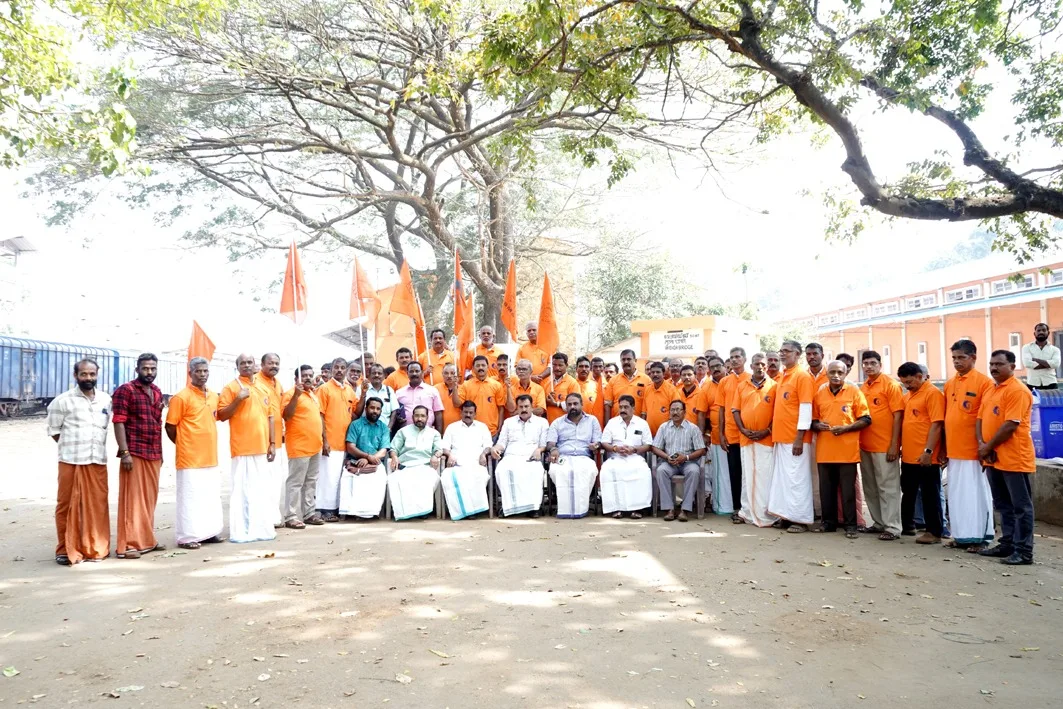
In a significant development, the entire CITU unit of the Angadippuram FCI (Food Corporation of India) Godown has quit the organisation and formally joined BMS (Bharatiya Mazdoor Sangh). The message emerging from this collective shift is unambiguous: Kerala is witnessing perceptible changes in its political and trade union landscape, prompting a broader rethink within the state.
Following the mass resignation and switch to BMS, CITU, the trade union wing of the CPM, has been left stunned. Labourers allege that CITU leaders have been misguiding and cheating poor workers for several decades, running the unit by keeping them under their control. This pattern, they say, has continued since the very inception of the FCI godown at Angadippuram. Once the labourers realised that they had been misled and exploited, they decided to leave the organisation en bloc and join BMS.
Leaders including Sudhakaran, who had been heading the CITU-controlled FCI Workers Association, along with K. Abu Thahir and P. Abdul Razak, resigned from CITU with their colleagues and accepted BMS membership.
The labourers’ collective exit from CITU and entry into BMS was preceded by repeated representations to the CITU leadership regarding the transfer of contract labourers to faraway locations.
According to the workers, the organisation failed to take any action. Senior labourers are entitled to payment under the Direct Payment System (DPS), which includes a minimum salary guarantee in addition to payment for the actual work performed. If transferred, they would be replaced by fresh contract workers and consequently deprived of DPS benefits. The labourers allege that this situation arose due to an unholy alliance between top CITU leaders and contractors.
Discontent deepened further when CITU leaders, who had promised to attend the Angadippuram CITU unit meeting scheduled for September 14, 2025, withdrew a few hours before the meeting.
Subsequently, when the unit office-bearers sent a list of 17 delegates to attend the state conference scheduled for December, the state leadership refused to accept it.
These developments, closely linked to the unit’s growing alienation from CITU, prompted the labourers to initiate discussions with the BMS leadership.
Meanwhile, CITU leaders allegedly made adjustments with contractors, ensuring that their preferred individuals were transferred to favourable units. Letters sent by the labourers to M. V. Govindan and senior CITU leaders Ilamaram Kareem and T. P. Ramakrishnan reportedly went unanswered.
The consequences of these actions were particularly severe for older workers. Most labourers at the Angadippuram FCI godown are above fifty years of age and have worked there for over 20 years under CITU. Transfers to distant locations would effectively force many headload workers to give up their livelihoods.
Despite this, CITU did not initiate any action against officials responsible for these anti-labour measures. Instead, the union leadership is accused of adopting an escapist approach by diverting criticism towards the Union government.
In contrast, talks with BMS leaders following the en bloc resignation proved productive. BMS national secretary V. Radhakrishnan and other leaders assured the labourers that the issue would be immediately taken up with the Railway Ministry and the Kerala Manager of the FCI.
Reinforcing the labourers’ decision to join BMS, V. Radhakrishnan inaugurated the BMS unit formation meeting and oversaw the distribution of membership. The event was attended by Fazal Rehman, Sethu Thiruvenkitam, Balachandran, and B. Rateesh.
Speaking to Organiser in the context of the CITU unit’s mass defection to BMS, V. Radhakrishnan stated that BMS has written to the General Manager of the FCI at Tiruvananthapuram, urging an end to the exploitation of labourers through the contract system in godowns.
The episode has wider political implications beyond Angadippuram. The CPM is often described as the largest and strongest political party in Kerala, with its trade union wing CITU enjoying comparable dominance among central trade unions in the state.
However, in recent months, several party cadres have been leaving the CPM. Many of them have joined the BJP, RSS, and other Sangh-inspired or nationalist movements.
Notably, several senior CPM leaders, spokesmen, and former MLAs have recently joined the BJP and are actively working to strengthen the BJP and other Sangh inspired organisations.