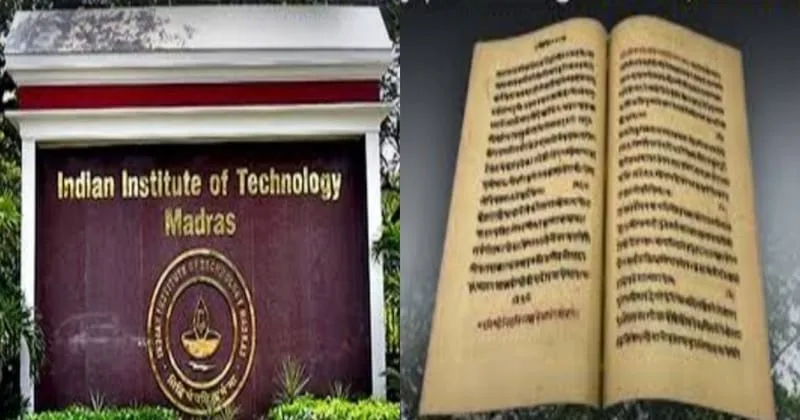
Chennai: In a landmark moment for both artificial intelligence and classical Indian scholarship, India’s first native Sanskrit Large Language Model (LLM) is being developed in Chennai. The initiative brings together the 118-year-old MDS Sanskrit College in Mylapore, IIT Madras, and scholars from the Kuppuswami Sastri Research Institute, marking a rare and powerful collaboration between traditional knowledge systems and modern computational science.
🚨 BIG! India’s first native Sanskrit Large Language Model is being built in Chennai.
A historic collaboration between 118-year-old MDS Sanskrit College (Mylapore) & IIT Madras, with scholars from Kuppuswami Sastri Research Institute, aims to teach AI Sanskrit logic, sandhi and… pic.twitter.com/3iyndsJoVV
— Megh Updates 🚨™ (@MeghUpdates) January 29, 2026
Unlike previous efforts that treated Sanskrit as a translated or auxiliary language, this project aims to build an AI model that understands Sanskrit on its own terms, its logic, grammar, and structure, by directly learning from original texts. At the core of the initiative is the processing of over 110,000 rare Sanskrit manuscripts, many of which have never been computationally analysed before.
Sanskrit is not merely an ancient language but one of the most rigorously structured linguistic systems in the world. Its grammar, formalised by Paṇini more than two millennia ago, is rule-based, generative, and remarkably precise—qualities that align naturally with modern computational models. Yet, despite this compatibility, Sanskrit has remained underrepresented in contemporary AI systems, largely due to the complexity of its structure and the lack of curated digital corpora.
This Chennai-based project seeks to change that reality. The model is being trained to grasp Sanskrit logic, sandhi (euphonic combinations), morphology, syntax, and semantic frameworks, allowing it to process meaning in ways that reflect classical Sanskrit thought. Instead of relying on English translations or modern linguistic shortcuts, the AI is being designed to “think” within Sanskrit’s own epistemological and grammatical traditions.
A critical pillar of the initiative is the involvement of scholars from the Kuppuswami Sastri Research Institute, one of the world’s most respected centres for Sanskrit research. Their role extends far beyond digitisation. Scholars are carefully curating, annotating, and contextualising manuscripts spanning philosophy, grammar, logic, astronomy, medicine, ritual literature, and commentarial traditions. This ensures that the AI learns from authoritative sources and preserves the intellectual integrity of the texts.
On the technological front, IIT Madras is providing advanced expertise in machine learning and natural language processing. Sanskrit poses unique challenges for AI: high inflectional density, free word order, extensive use of compounds, and meaning that often depends on context and tradition. To address this, researchers are developing specialised architectures capable of handling the language’s structural and semantic depth, pushing the boundaries of current NLP research.
A native Sanskrit LLM could transform Sanskrit education, assist in advanced manuscript research, enable more accurate translations, and support automated cross-referencing of vast textual traditions. Beyond academia, it could influence the development of logical reasoning systems, ethical AI frameworks, and computational models inspired by classical philosophy. That this historic effort is unfolding in Chennai, particularly in Mylapore, is deeply symbolic. The city has long served as a meeting point of tradition and modernity.