NQAS: Quality at the core and universal health care
August 4, 2026
  • Read Ecopy
  • Circulation
  • Advertise
  • Careers
  • About Us
  • Contact Us
Android AppiPhone AppArattai
Organiser
  • ‌
  • Bharat
    • Assam
    • Bihar
    • Chhattisgarh
    • Jharkhand
    • Maharashtra
    • View All States
  • World
    • Asia
    • Europe
    • North America
    • South America
    • Africa
    • Australia
  • Editorial
  • International
  • Opinion
  • RSS @ 100
  • More
    • Op Sindoor
    • Analysis
    • Sports
    • Defence
    • Politics
    • Business
    • Economy
    • Culture
    • Special Report
    • Sci & Tech
    • Entertainment
    • G20
    • Azadi Ka Amrit Mahotsav
    • Vocal4Local
    • Web Stories
    • Education
    • Employment
    • Books
    • Interviews
    • Travel
    • Law
    • Health
    • Obituary
  • Subscribe
    • Subscribe Print Edition
    • Subscribe Ecopy
    • Read Ecopy
  • ‌
  • Bharat
    • Assam
    • Bihar
    • Chhattisgarh
    • Jharkhand
    • Maharashtra
    • View All States
  • World
    • Asia
    • Europe
    • North America
    • South America
    • Africa
    • Australia
  • Editorial
  • International
  • Opinion
  • RSS @ 100
  • More
    • Op Sindoor
    • Analysis
    • Sports
    • Defence
    • Politics
    • Business
    • Economy
    • Culture
    • Special Report
    • Sci & Tech
    • Entertainment
    • G20
    • Azadi Ka Amrit Mahotsav
    • Vocal4Local
    • Web Stories
    • Education
    • Employment
    • Books
    • Interviews
    • Travel
    • Law
    • Health
    • Obituary
  • Subscribe
    • Subscribe Print Edition
    • Subscribe Ecopy
    • Read Ecopy
Organiser
  • Home
  • Bharat
  • World
  • Operation Sindoor
  • Editorial
  • Analysis
  • Opinion
  • Culture
  • Defence
  • International Edition
  • RSS @ 100
  • Magazine
  • Read Ecopy
Home Bharat

National Health Policy: Quality at the core and universal health care through NQAS

India has achieved a major public healthcare milestone by accrediting over 50,000 facilities under National Quality Assurance Standards, reflecting a sustained shift towards safe, patient-centric and standardized healthcare aligned with the vision of the National Health Policy 2017

Vivek KumarVivek Kumar
Jan 30, 2026, 08:00 am IST
in Bharat, Health
Follow on Google News
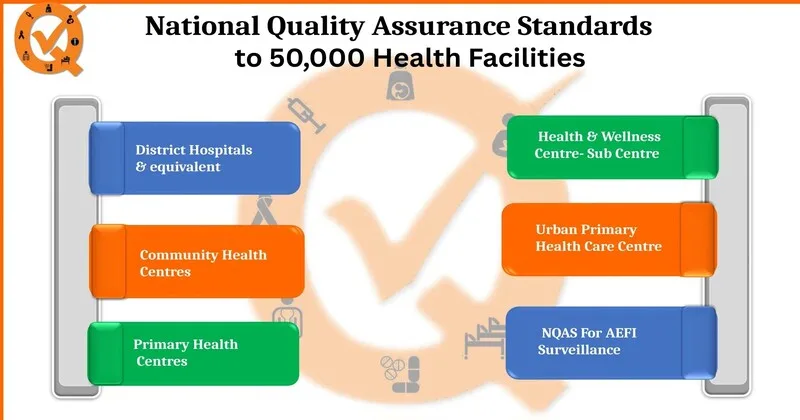
Representative Image of NQAS to 50,000 Health Facilities

Representative Image of NQAS to 50,000 Health Facilities

FacebookTwitterWhatsAppTelegramEmail

In India, public health reforms began with the National Health Policy 2017, which places strong emphasis on UHC. The policy stipulates that healthcare should be accessible, affordable and of assured quality, without causing financial hardship to citizens. It underlines the need to strengthen primary healthcare, improve patient safety, reduce extra expenditure and ensure standardised services across the country.

While elaborating policy, the government has not treated only quality as an optional goal but as an overall change. The mere improvement in infrastructure will not suffice unless services are safe, reliable, and patient-centric. In this context, quality assurance mechanisms such as the National Quality Assurance Standards play a crucial role in translating policy intent into action at the ground level.

What is NQAS and Why It Matters

The National Quality Assurance Standards (NQAS) is a quality framework that was developed by the Ministry of Health and Family Welfare, aiming to enhance the performance of public healthcare facilities. The NQAS project was rolled out in 2015, aiming at ensuring that the standards of public health institutions in regards to quality, safety, cleanliness and patient satisfaction were met.

When the program began, only 10 healthcare facilities were NQAS-accredited. Today, this dataset includes 10 NQAS-accredited healthcare facilities. Over the years, the categories of healthcare facilities included in NQAS membership have increased. These categories include District Hospitals (DH), Sub-District Hospitals (SDH), Community Health Centres (CHC), Primary Health Centres (PHC), Urban Primary Health Centres (UPHC) and Sub-Health Centres (SHC).

As of December 31, 2025, the country has reached a significant milestone, with 50,373 public health institutions accredited under NQAS across all States & Union Territories of India. This not only indicates the Government’s focused effort to make quality an integral part of healthcare delivery systems, but also to adopt a move-on attitude.

The NQAS Framework: How Quality is Assessed

The NQAS system is founded on a clear set of measurable standards. It focuses on broad categories and views key areas in terms of service delivery, patient rights, inputs, supporting services, care delivery, infection control, and outcomes. Measures are based on the presence or absence of systems and the adherence to those systems.

One of NQAS’s greatest strengths is its structured assessment process. The facilities undergo internal assessments to identify deficiencies. After that, they are referred to external assessments by trained personnel. Virtual assessments began, and these steps reduce the time for certification.

The framework emphasises the importance of quality improvement and its ongoing daily maintenance. In turn, the objective of the described quality system for healthcare institutions will not end with certification but continue with continuous daily quality improvement.

There has been a significant increase in the number of NQAS certifications over a short period. As of December 2023, India had 6,506 NQAS-certified facilities. It further increased to 22,786 in December 2024 and then surged to 50,373 in December 2025.

This phenomenal growth in one year draws attention to the effects of digital tools and the capacity development of assessor resources, as well as to the collaborative efforts of the Centre and States.

Of the total accredited facilities, 48,663 are Ayushman Arogya Mandirs, including Sub-Health Centres, Primary Health Centres, and Urban Primary Health Centres, while the remaining 1,710 are secondary care facilities, including Community Health Centres, Sub-District Hospitals and District Hospitals. The data reveal that quality assurance and improvement are no longer confined to large hospitals and are extended down to the grassroots level for providing healthcare services.

Role of Ayushman Arogya Mandirs and Primary Healthcare

The presence of many Ayushman Arogya Mandirs accredited under NQAS is an encouraging aspect of India’s healthcare infrastructure. It is also quite true that these are generally the first points of contact for many people, mostly in rural areas. All in all, it is an added strength in preventive care services, early diagnosis, non-communicable diseases, MCH programs, and basic emergency care.

Quality improvements at the primary level decrease pressure on hospitals at higher levels, which is consistent with a primary healthcare strengthening with a vision articulated in the country’s National Health Policy, which will support in achieving Universal Health Coverage.

Governance Readiness for the Future

The crossing of 50,000 in NQAS certification represents good coordination between the central government and the States and Union Territories. Despite health being a State subject for legislation, it was expected that most States would not adhere to NQAS; however, since its adoption is widespread, it represents a good effort towards common quality standards. It promotes equity by providing equal access to healthcare for all citizens, regardless of location.

The government has an interim target to ensure that at least 50 per cent of its health facilities attain NQAS by March 2026. This will require continuous training, monitoring, and support for health providers. NQAS is turned out to be a useful instrument in achieving the vision of the National Health Policy 2017. With the integration of quality, safety, and patient care in public health care, the nation is moving towards a better, patient-oriented health care delivery system.

Topics: Ayushman Arogya MandirsNational Health PolicyNQAS
ShareTweetSendShareSend
✮ Subscribe Organiser YouTube Channel. ✮
✮ Join Organiser's WhatsApp channel for Nationalist views beyond the news. ✮
Previous News

Uttar Pradesh: ODOP emerges as a national blueprint for grassroots-led economic growth

Next News

CM Majhi inaugurates silver jubilee edition of enterprise in Rourkela; Rs 8,884 crore worth of projects launched

Related News

Chief Minister Yogi Adityanath Promoting Doctors Faternity through Awards

World Health Day| Yogi Adityanath writes ‘Yogi Ki Paati’: How UP rewrote its health story in 9 years

How PM Modi’s reforms taking Bharat to new heights amid global instability

A representative image

How India’s Rs 64,180 crore health infrastructure mission, PM-ABHIM is shaping a pandemic resilient future

Ayushmaan Arogya Mandir

1.78 Lakh Ayushman Arogya Mandir leading the wellness drive in Bharat; Primary health care gets boost

Exterior of AIIMS

How vision of PM Modi transformed J&K: Nine landmark healthcare projects erase decades of neglect (2014-2025)

PM Narendra Modi hails Ayushman Arogya Mandirs

PM Modi Highlights Importance of Ayushman Arogya Mandirs: A lesser-known temple transforming Indian villages

Load More

Latest News

formal launch of Sangh Prarthana: Gita Ke Pariprekshay Mein, authored by Dr Markandeya Ahuja and published by Suruchi Prakashan, was held at the Vichar Vinimay Nyas Auditorium, Keshav Kunj, Jhandewalan, New Delhi, on August 3, 2026

‘Sangh Prarthana: Gita Ke Pariprekshay Mein’ unveiled by RSS Sah-Sarkaryavah Dr Krishna Gopal in Delhi

Protestors at Jantar Mantar in Delhi

Delhi Police probes digital campaign around Jantar Mantar protests; 400 Pak-linked social media handles under scanner

Jagannath Puri Rath Yatra

Odisha CM Mohan Majhi seeks centre’s support for UNESCO Heritage tag for Puri Rath Yatra

Rain, Hunger Strike and Tarpaulin Shelters: Why Jharkhand's Student Protest Stands Apart

Days under tarpaulins, nights in rain: No violence, no abuse, no ‘Azadi’ slogans – How Jharkhand protest is different

PoJK bloodshed raises questions over Western media's selective coverage; India seeks global scrutiny

PoJK bloodshed exposes questions over Western media’s selective coverage of human rights crisis

Zuckerberg must apologise for blocking PM Modi's video, says MPs' panel chief

Parliamentary panel seeks Zuckerberg’s public apology over PM Modi video removal, warns of safe harbour review

Keralam BJP VP KS Radhakrishnan alleges two Christian Bishops mobilised youths for CJP agitation

DRDO calls MSMEs to build swarm drones; The game-changing tech to consolidate India’s capabilities in next-gen warfare

Balochistan & Enthno-Nationalist Armed Resistance: A nightmare for the Pakistani Army

Tamil Nadu: Supreme Court refuses to stay HC order on Thiruparankundram Deepam; TVK govt faces legal setback

Load More
  • Privacy
  • Terms
  • Cookie Policy
  • Refund and Cancellation
  • Delivery and Shipping

© Bharat Prakashan (Delhi) Limited.
Tech-enabled by Ananthapuri Technologies

  • Home
  • Search Organiser
  • Bharat
    • Assam
    • Bihar
    • Chhattisgarh
    • Jharkhand
    • Maharashtra
    • View All States
  • World
    • Asia
    • Africa
    • North America
    • South America
    • Europe
    • Australia
  • Editorial
  • Operation Sindoor
  • Opinion
  • Analysis
  • Defence
  • Culture
  • Sports
  • Business
  • RSS @ 100
  • Entertainment
  • More ..
    • Sci & Tech
    • Vocal4Local
    • Special Report
    • Education
    • Employment
    • Books
    • Interviews
    • Travel
    • Health
    • Politics
    • Law
    • Economy
    • Obituary
  • Subscribe Magazine
  • Read Ecopy
  • Advertise
  • Circulation
  • Careers
  • About Us
  • Contact Us
  • Policies & Terms
    • Privacy Policy
    • Cookie Policy
    • Refund and Cancellation
    • Terms of Use

© Bharat Prakashan (Delhi) Limited.
Tech-enabled by Ananthapuri Technologies