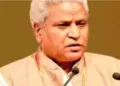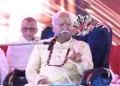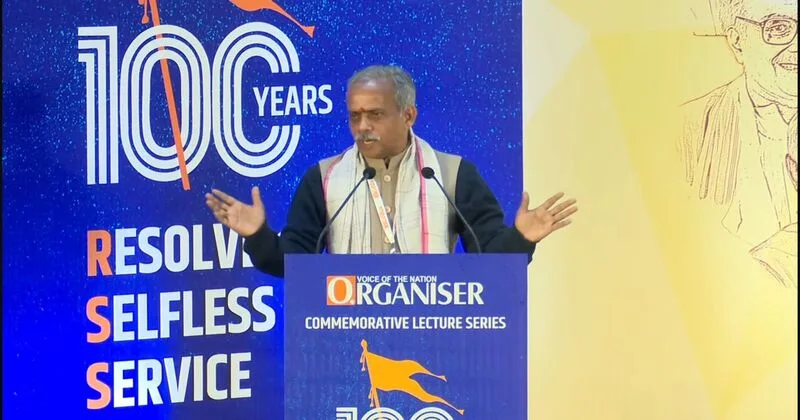
Nandakumar ji said that the theme of this lecture series, “Resolve for Selfless Service,” is, in itself, an abbreviated form of RSS. He recalled an incident from 1897, when Swami Vivekananda, after touring Western nations and emerging victorious in intellectual debates, returned to Bharat. From Colombo, he set out again and reached Chennai. Those fighting for independence wrote in their invitation letters, welcoming him as the seer of a Hindu Rashtra.
Narrating an incident, he said that in one of his speeches on Bharat’s independence, Swami Vivekananda said that for the next 50 years, our only deity should be Bharat Mata. In that speech, he addressed the brothers and sisters of Bharat and spoke with deep emotion rooted in devotion, melting the audience. At that time, a young man asked Swami Vivekananda, “You have explained everything, but I have one doubt: if you speak so strongly about independence, why do you not provide leadership for it?” Swamiji smiled and replied, “I will come and give you independence tomorrow, and asked him whether the people would be able to preserve it, take Bharat forward, and keep it safe”.
He said that behind every society, there is an idea, behind England, there is trade, behind France, there is politics, and behind a Bharat Rashtra, there is a guiding thought. He stated that if one wants to strengthen this nation and work decisively for it, the responsibility lies with the Rashtriya Swayamsevak Sangh.
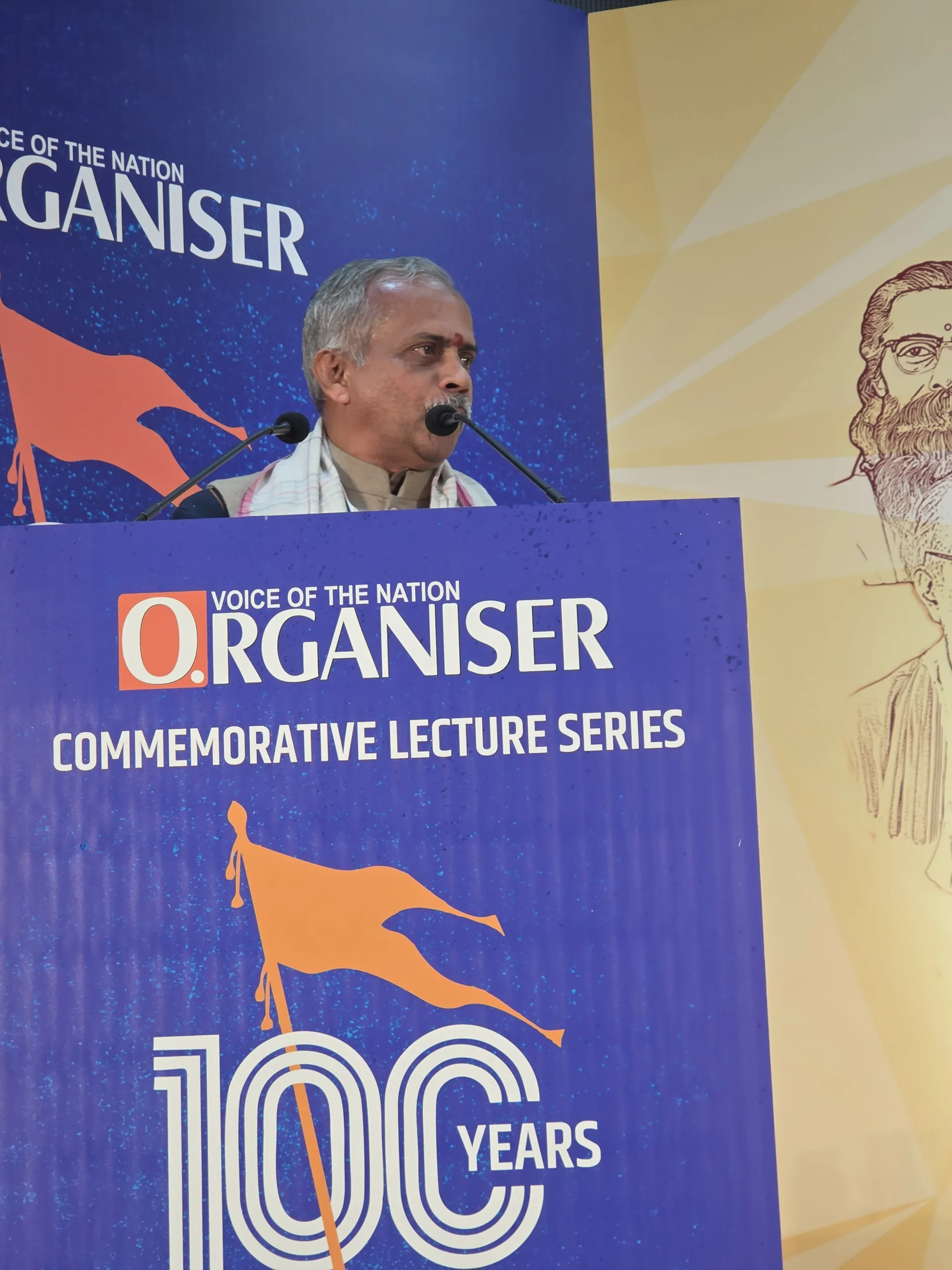
He further said that there are two core sentiments behind the formation of a Rashtra—tyag (sacrifice) and seva (service). Selflessness arises from the spirit of sacrifice, and he clarified that renunciation and sacrifice are two distinct concepts. He added that one may speak to anyone, and they will debate on RSS, but no one is able to answer how the Sangh continues to function steadily even after 100 years.
Generally, when an organisation is formed, it has an office, a name, defined posts, and formal structures. But RSS had none of these. When RSS began, it had no name, no office, and no membership register, and even today, it does not have one. It was simply an evolution in the life of this great Hindu nation, he said.
Referring to Dadarao Parmarth, an RSS pracharak from Maharashtra who also served as a pracharak in Tamil Nadu, he narrated that once someone asked him to define RSS. Dadarao replied that RSS is an evolution of the Hindu Rashtra. He said that the life aim of the Hindu rashtra is to uplift the entire world and ensure happiness across the entire universe. In between, many divisions emerged, and their solution was provided by Bharat Mata herself. An evolution took place, and that evolution is RSS.
Explaining the functioning of the Sangh, he said that the nitya shakha is its core working method, and it is a form of spiritual discipline. One must observe a shakha to understand its significance, where a person is observed in totality. When one becomes deeply involved in the Sangh shakha, one experiences a sense of samadhi. There are no distractions like checking the time; one programme flows seamlessly into another. Mutual affection is built, and finally, standing before the Bhagwa Dhwaj during the prarthna brings a profound transformation and instils a sense of dedication towards the entire Rashtra.
He quoted the Sangh song, which says, “Desh hume deta hai sab kuch, hum bhi to kuch dena seekhein.” This, he said, is the core work of an RSS swayamsevak. Sangh swayamsevaks, while dedicating their time to Sangh, do not think of political advantage; this is their basic mindset. They always think in terms of seva.
He further said that later, many organisations inspired by RSS came into existence. Under the leadership of Dattopant Thengadi, the Bharatiya Mazdoor Sangh was formed, emphasising work in the national interest. There, the discourse shifted from rights to duties.
He said that when RSS was founded in 1925, even calling oneself a Hindu was considered shameful. People would say, “Call us anything, but do not call us Hindu.” Unfortunately, the son of such a person even went on to become the Prime Minister of the country, and that son stated, “By my looks I am Christian, by culture Muslim, and accidentally Hindu.” It was in such a social atmosphere that Dr Hedgewar founded RSS and showed the path to those who could proudly say, “We are Hindus.”
He narrated an incident where, during a programme, a person tried to ridicule Dr K.B. Hedgewar by asking, “Who is the fool who called this nation a Hindu Rashtra?” Dr Hedgewar stepped forward and replied that if calling Bharat a Hindu Rashtra is foolish, then he himself is that fool, and he firmly asserted that this is a Hindu Rashtra. Dr Saheb had clearly stated that this country was, is, and will remain a Hindu Rashtra.
He said that RSS has been engaged in service activities across different regions. At one time, service was considered the work of missionaries, but people forgot that a thousand years ago, Maharishi Dadhichi gave his bones for the welfare of society; this is the essence of Hindu society. When RSS was formed, a paradigm shift occurred in the field of service as well. RSS swayamsevaks, along with their families, mothers and sisters, serve society in various areas.
Narrating an incident, he recalled the devastating earthquake in Gujarat, where there was a massive loss of life. RSS swayamsevaks reached the area to serve the affected families. To provide food to the victims, they collected sukri (dry rations commonly stored for long use) from Gujarati households and distributed it through Seva Bharati centres. At one such place, a swayamsevak noticed an elderly woman whom he initially thought had come to beg, but in reality, she had come to contribute. She wished to contribute but had nothing. She went out, begged, purchased groceries with that money, cooked food, and brought it to offer for service. Inspired by RSS, a thought arose in her that she, too, must give something to society.
J Nandakumar said that this transformation in people’s lives and mindsets is the change brought about by the RSS. This is not merely a celebration of 100 years of RSS; it is an opportunity for introspection.
Prof Narendra Kumar Taneja, Sah-Kshetra Sanghchalak of RSS Western Uttar Pradesh and former Vice-Chancellor of CCS University, Meerut, who chaired the lecture, said that when someone says Bharat is a Hindu Rashtra, so-called intellectuals assume that RSS talks only about Hindus. He said that to understand this, one must first understand the meaning of Hindu and Rashtra.
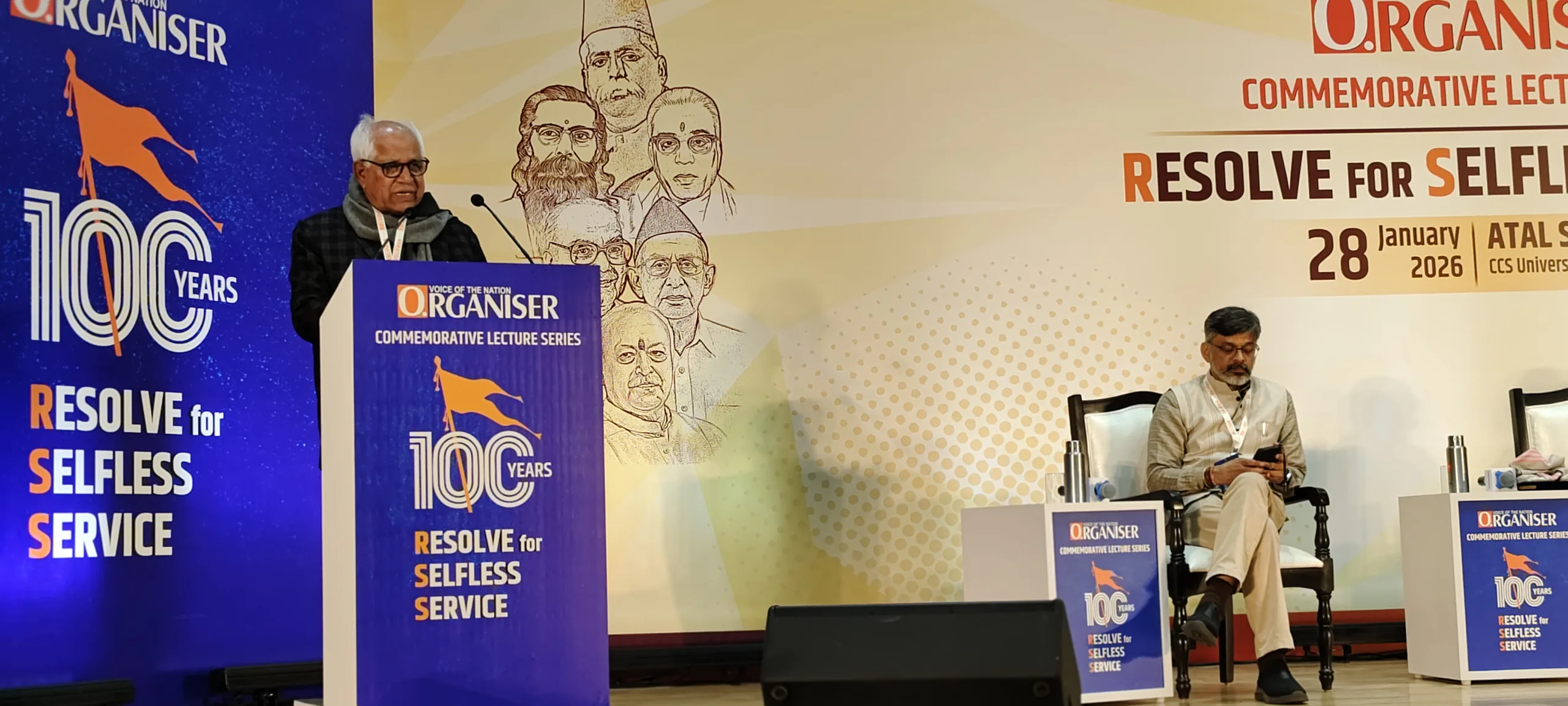
He explained that many people confuse the idea of a nation with Rashtra. The concept of Rashtra in Bharat is different. It refers to a collection of people who consider Bharat as their janmabhoomi and their mata. One may call a building made of bricks a house, but when one calls it “apna ghar,” it becomes sacred and filled with reverence. The same emotion applies to the idea of Rashtra.
Explaining the meaning of Hindu, he said that a Hindu is one who sees the presence of Ishwar in everyone, what exists within me exists within all, and who remains sensitive towards one’s duties across the entire universe. A Hindu believes that there are many paths to attain God and truth. However, defending oneself against continuous attacks is also our dharma.
He stated that the work RSS does was earlier carried out by Swami Vivekananda and Rishi Aurobindo as well; only the method is different. RSS does not take pride in its methods, but its swayamsevaks have been involved in transforming society. Unfortunately, much is said against RSS. He recalled that once a judge remarked that RSS talks about the past, but in reality, those who are grateful care for their history, society, family, nation, and the universe. RSS has many pracharaks, but it is the countless swayamsevaks who run households and still carry out all the work selflessly.
He also spoke about five transformationsm social harmony, Swa, family awakening, civic duties, and environmental responsibility.
In his address, Prafulla Ketkar, Editor, Organiser, said that in 1925 a journey began, during a time when the dominant narrative was, “Call us anything, but do not call us Hindu.” Various movements were underway, from capitalism to socialism. It was in such a period that Dr Hedgewar founded RSS. At that time, two streams of ideology were emerging—one that spoke of building a nation, and another, Communism, which denied Bharat as a nation and described it as a conglomeration of many nationalities.
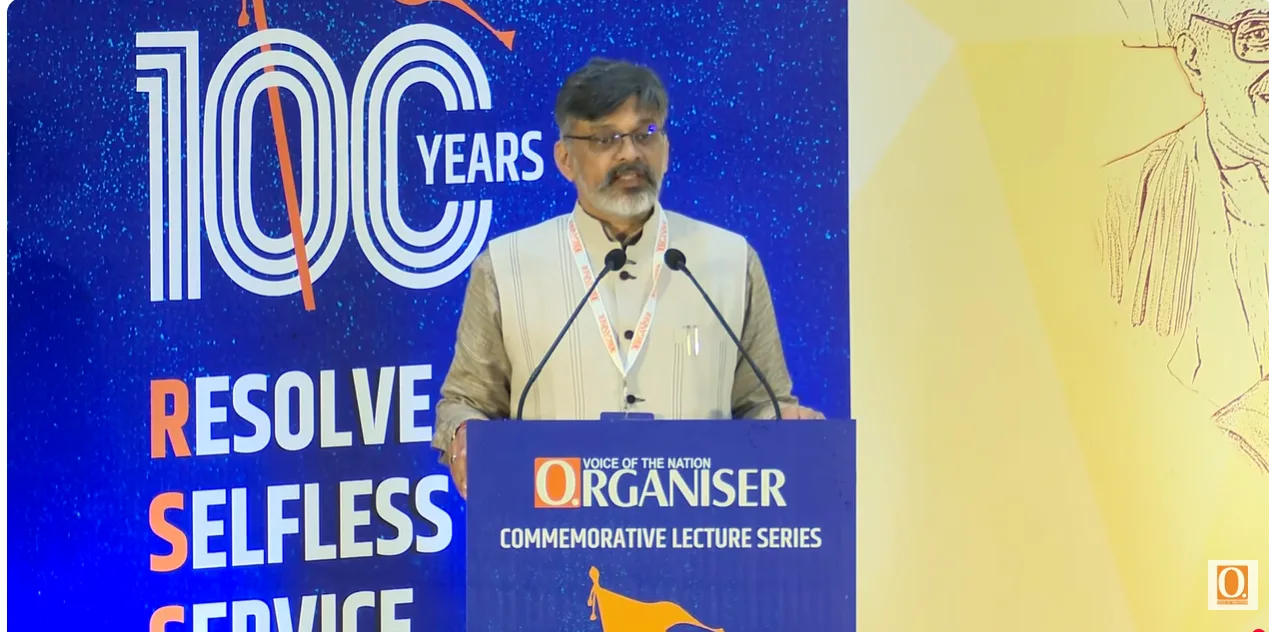
To take the Sangh’s thought to the intellectual class, Organiser also assumed a crucial role, especially during the time of Partition. He said that Organiser, started on July 3, 1947, became the first media house to work on the idea of Bharat. For the last 79 years, Organiser has continued this work, and to commemorate the 100 years of Sangh, this lecture series has been organised. Today, the concept of Bharat has been accepted by society.
He noted that Organiser received guidance from M.S. Golwalkar (Guruji) and Pandit Deendayal Upadhyaya. In independent India, the first instance of censorship was imposed on Organiser, and the magazine won that case. Subsequently, the first constitutional amendment was introduced, placing restrictions on freedom of speech. At that time, Organiser was publishing the stories of Hindus who came from across the Partition border and reports on atrocities against Hindus living in Pakistan.
During the Emergency of 1975, KR Malkani, the then Editor of Organiser, was the first journalist to be arrested. Through this lecture series, Organiser will present Sangh and its ideology as it truly is. The series will be held at four more locations in Uttar Pradesh, more than ten locations in South India, and across the country. He also thanked all participants and dignitaries present at the event.
At the event, the book National Selfhood in Science: A Saga of Struggles by Bharatiya Scientists to Counter Colonial Apartheid by J. Nandakumar was released.
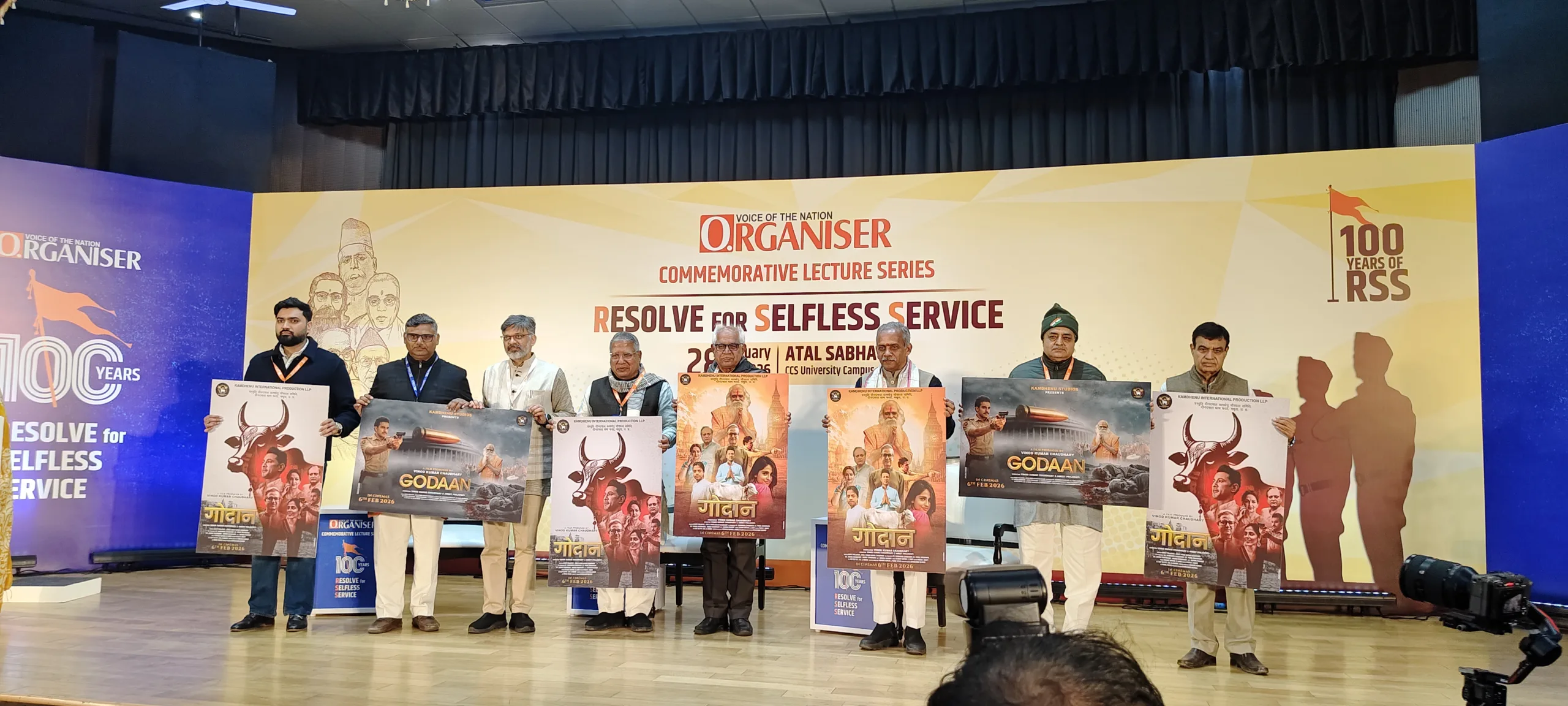
A poster of the film ‘Gaudan’, produced by CCS University, was also unveiled. The film will be released on February 6, 2026. Another book, Resolve for Selfless Service, edited by Prafulla Ketkar, was also released.
Braj Bihari Gupta, Director, Bharat Prakashan Delhi Limited, felicitated J. Nandakumar and Prof. Narendra Kumar Taneja.