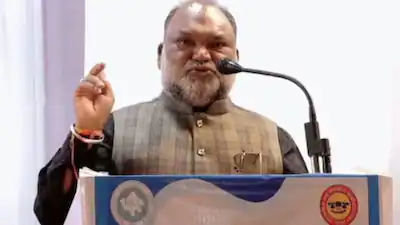
A controversy has erupted in Rajasthan after the principal of Samrat Prithviraj Chauhan Government College, Ajmer, referred to Pakistan as India’s “big brother” during an academic conference, a remark that quickly went viral and drew widespread criticism on social media. The principal, Manoj Beharwal, later issued a clarification claiming that the statement was made sarcastically and had been misinterpreted, but the explanation has done little to quell questions about the intent and judgment behind the comment.
The remarks were made during the 31st International Conference of the Rajasthan Sociological Association, held on January 23 and 24 at Sanatan Dharma Government College in Beawar. Addressing scholars and delegates, Beharwal stated that Pakistan attained independence on August 14, 1947, while India emerged on the morning of August 15, making Pakistan “12 hours older” and therefore a “big brother.” A video clip of the statement began circulating online soon after, sparking outrage and accusations of insensitivity and glorification of Pakistan in an Indian academic setting.
Following the backlash, Beharwal spoke to reporters and defended himself by asserting that the remark was purely sarcastic. He emphasised that India is an ancient Sanatan civilisation and questioned the logic of any comparison between India and Pakistan. “What does being ‘big’ even mean? Look at India’s achievements today. Compare where India stands globally and where Pakistan stands,” he said, adding that India’s progress and stature speak for themselves. He also praised former Prime Minister Jawaharlal Nehru and other freedom fighters, underscoring India’s journey since Independence.
However, the issue goes beyond sarcasm or semantics. They point out that the comment was made not in a casual setting, but at a formal academic conference attended by participants from seven states, over 20 districts of Rajasthan, and three countries. The central theme of the conference was Indian knowledge traditions and society, making the reference to Pakistan, particularly as a “big brother” appear jarring and out of place to many observers.
Several organisations and individuals have questioned why such a comparison was introduced at all, especially given Pakistan’s history of hostility towards India, including wars, terrorism, and sustained anti-India activities. They argue that even a sarcastic remark by a principal of a government college carries institutional weight and can send confusing or problematic signals, particularly to students and young scholars.
While no official disciplinary action has been announced so far, the episode has reignited debate over academic responsibility, national sensitivity, and the boundaries of expression in publicly funded educational institutions.