Bharat celebrated its 77th Republic Day on Monday with a majestic parade along Kartavya Path, presenting a powerful visual narrative that seamlessly intertwined the nation’s freedom-era cultural legacy with its rapidly evolving military capabilities. The event stood out for its thematic focus on the 150th anniversary of Vande Mataram, the iconic national song that became a rallying cry during the freedom movement, while simultaneously showcasing India’s preparedness for modern, technology-driven warfare.
President Droupadi Murmu presided over the ceremony, while the presence of European Commission President Ursula von der Leyen and European Council President Antonio Costa as chief guests underscored India’s growing global stature and strategic engagement with the European Union. Prime Minister Narendra Modi was seen interacting with the visiting dignitaries during the parade, reflecting the diplomatic significance attached to the occasion.
Tribute Rooted in Freedom and Unity
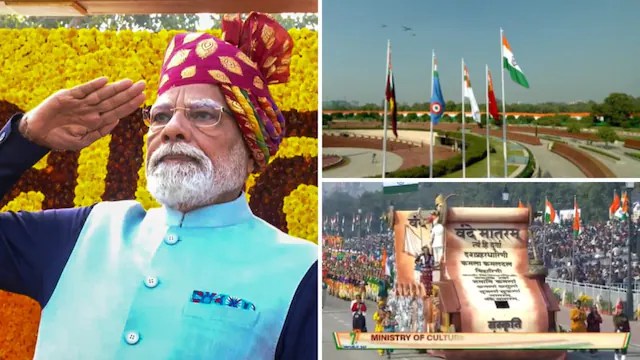
The central emotional and thematic anchor of the 2026 Republic Day parade was the commemoration of 150 years of Vande Mataram, composed by Bankim Chandra Chattopadhyay. Kartavya Path was artistically transformed with visual interpretations of the song’s verses, evoking memories of India’s freedom struggle and the sacrifices made by generations of nationalists.
As thousands of spectators gathered along the ceremonial boulevard, the atmosphere resonated with cultural pride and historical remembrance. The enduring power of Vande Mataram, which inspired countless freedom fighters was symbolically woven into the fabric of the parade, reminding the nation of the emotional and spiritual foundations of India’s independence.
The broader theme of “Unity in Diversity” came alive through performances by nearly 2,500 artists, including classical dancers, folk performers, marching bands and cultural troupes. Their performances reflected India’s pluralistic identity, civilisational continuity and shared national aspirations.
New Era of Military Display
One of the most striking features of the 77th Republic Day parade was the renewed emphasis on India’s military modernisation and operational readiness. For the first time, a phased Battle Array Format was presented on Kartavya Path, offering a battlefield-style depiction of coordinated combat operations.
This innovative presentation moved beyond ceremonial marching to showcase a realistic sequence of deployment, from cavalry and reconnaissance units to artillery, unmanned systems and advanced air defence platforms. The format provided spectators with a glimpse into how modern warfare is envisioned and executed in an integrated operational environment.
At the heart of the military display was the Tri-Services tableau titled “Operation Sindoor: Victory Through Jointness”, which highlighted a coordinated Indian military operation targeting terror infrastructure. The tableau underscored the seamless integration of the Army, Navy and Air Force in planning, intelligence-sharing and execution of precision strikes.
The display featured representations of key strategic assets, including BrahMos supersonic cruise missiles, S-400 air defence systems, and advanced combat aircraft. Together, these elements illustrated India’s evolving doctrine of jointness and its ability to respond decisively to security threats using indigenous and cutting-edge technology.
Modeled as an Operational Integrated Display, the tableau demonstrated how long-range assets, surveillance systems and strike capabilities work in tandem. It highlighted the increasing importance of synergy among the three services in an era where speed, precision and coordination define battlefield success.
Spectacular Aerial and Naval Show
Adding to the grandeur was an aerial spectacle by the Indian Air Force and Army Aviation Corps. Mi-17 helicopters flew in a distinctive “Dhwaj Formation,” showering flower petals over Kartavya Path in a tribute to the Tricolour.
The flypast that followed was among the most visually striking moments of the parade. A total of 29 aircraft—including Rafale, Su-30, MiG-29 and Jaguar fighter jets—soared across the Delhi sky in carefully choreographed formations, symbolising the Indian Air Force’s precision, technological edge and combat readiness.
The naval contingent, meanwhile, paid homage to India’s maritime heritage while emphasising its modern seafaring capabilities. The tableau featured representations of ancient stitched vessels alongside models of indigenous warships such as INS Vikrant and INS Udaygiri, highlighting the Navy’s journey from tradition to technological self-reliance.
Honouring Courage and Service
As per tradition, gallantry awardees and veterans occupied a place of honour in the march-past. Decorated heroes such as Subedar Major (Honorary Captain) Yogendra Singh Yadav and Subedar Major Sanjay Kumar marched alongside other distinguished personnel, drawing applause from the crowd.
This year’s parade also recognised exceptional achievements beyond conventional battlefields. Group Captain Shubhanshu Shukla, who made history as the first Indian to serve on the International Space Station, was awarded the Ashoka Chakra, India’s highest peacetime gallantry award. In total, 70 awardees were honoured for extraordinary courage, dedication and service to the nation.
Panorama of National Progress
The parade featured contingents from the Indian Army, Navy, Air Force and Central Armed Police Forces, reflecting discipline, professionalism and national resolve. Adding colour and context were tableaux from 17 states and Union Territories and 13 Union government ministries, each highlighting developmental initiatives, cultural heritage and social progress.
Together, these displays presented a panoramic view of India’s journey—celebrating its diversity, democratic strength and collective aspirations for the future.
From the stirring strains of Vande Mataram echoing across Kartavya Path to the thunderous roar of fighter jets overhead, the Republic Day 2026 parade offered a compelling narrative of India as a nation rooted in sacrifice yet oriented towards strength and self-reliance.
The ceremony captured India’s dual identity as a civilisation shaped by history and values, and as a modern state prepared to safeguard its sovereignty in an increasingly complex global environment. As the final formations marched past and the flypast concluded, the message was unmistakable: India’s journey forward remains anchored in its past, empowered by unity, and driven by confidence in its future.