Bharatiya Defence Forces seeks to achieve a technologically advanced, self reliant and integrated military by 2047. The focus would be on indigenous production, Artificial Intelligence, unmanned systems, jointness across services, and dominance in cyber/space domains. It aims to be transformed into a fully digitised, network centric force with increased budget and Research and Development for Next Generation Warfare, ensuring “Viksit Bharat” by 2047. By then the defence role of Bharat must be to become a self-reliant, technologically advanced, globally respected military power, focusing on defence manufacturing, fostering AI/Cyber/ Quantum innovation, achieving integrated joint force operations, and projecting leadership in a complex security environment. For that India must move beyond traditional defence to become a key security contributor in the Indo Pacific and beyond, supporting her economic rise.
Basic features of Defence Vision 2047
- Reduce import dependence by resorting to indigenous manufacturing and boosting domestic production, involving private sector and academia to achieve Aatmanirbharta *Master critical technologies in space, cyber, AI, and autonomous systems through technology absorption
- Develop doctrines and capabilities for cyber, space, conventional multidomain warfare by resorting to technological empowerment to create a future ready force.
Pragmatic Vision
Along with this the aim of Bharatiya defence manufacture sector would have to be to transform from primarily a large importer and regional security guarantor to a leading defence manufacturer, technological innovator and strategic power, capable of projecting influence and ensuring National Security in a dynamic geopolitical environment, aligning defence strength with its economic vision for a developed India by 2047.
Under “Viksit Bharat @ 2047 Vision”, a multi-phase roadmap to build one of the World’s Strongest, fully Self-reliant and Technologically Advanced Defence Force through a structured three-phase plan to achieve “Multi domain Readiness” by 2047. Transformation of Defence Forces would be completed by 2047 in three-phases and would strive to achieve following Strategic Goals: a) Become a major Global Defence Exporter; b) Build one of the world’s strongest, most empowered defence forces and c) Ensure National Security through technological superiority and self-reliance. It would be ensured that there is sufficient investment & budgeting with a proposed five-fold increase in Defence Budget to be around Rs 31.7 lakh crore by 2047.
A structured roadmap to a future ready force has been laid out to be achieved by 2047 encompassing coordinated reforms, jointness and the systematic development of cutting edge capabilities. Aim is to ensure a technologically empowered force maintaining its operational efficiency to make India a modern, self-reliant Defence Power. The transformation is scheduled to be achieved in Three-phases as under; a) Phase 1 by 2032. It would involve Rapid Organisational Restructuring by introducing Doctrinal Reforms for Multi-domain Warfare through early absorption of Indigenous Technologies. This phase seeks to Modernisation of core combat units and enhance quick reaction capability would be/is the key word of this phase; b) Phase 2 by 2037. It would focus on Consolidation of reforms carried out in Phase 2 into an Integrated Operational Framework. Main focus would be on Structural readiness, wider Training Reforms and improved Inter-service Synergy to ensure smooth integration of New platforms and Joint Command Structures; c) Phase 3 by 2047. On completion it would deliver a Fully digitised, Self-reliant and Network enabled Force. By 2047, Seamless Integration of AI, Autonomous Systems and Battlefield Digitisation would be completed. It would be in consonance with India becoming a developed nation by 2047 and d) Transform Indian Air Force into Indian Air and Space Force to establish credible aerospace power. Embracing the potential of space and fostering collaborations with strategic partners, IAF aims to fortify India’s readiness for future challenges in the Air and Space Domains.
Making Bharat Self-reliance in Defense
- Record defence production – Defence production has surged 174 per cent since 2014, reaching Rs 1.27 lakh crore in 2023-24
- Defence exports – EAxports have grown 34-fold, reaching Rs 23,622 crore in 2024-25. Bharat now exports defence equipment to over 85 countries, including the US, France and Armenia
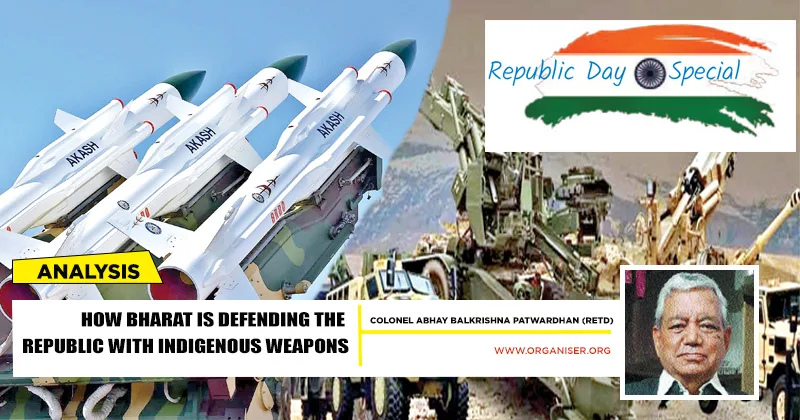
- Indigenous defence systems – The operation utilised indigenous systems, such as the Akash surface-to-air missile platform, BrahMos missiles and loitering munitions, showcasing India’s advancements in defence technology
- The government has promoted the development of indigenous technologies, including the BrahMos missile system, Light Combat Helicopters (LCH) Prachand and Advanced Medium Combat Aircraft (AMCA)
- Defence industrial corridors – Two dedicated defence industrial corridors have been established in Uttar Pradesh and Tamil Nadu, attracting investments worth over Rs 8,658 crore and signed 253 MoUs with an estimated investment potential of Rs 53,439 crore
Key Pillars of India’s Defence Vision 2047 will have to include; a) Reducing dependency on foreign arms through massive growth in indigenous defence manufacture, aiming to become a major global exporter of military hardware by following dictum of Aatmanirbhar Bharat; b) Integrating cutting-edge tech like AI, cyber warfare, and space capabilities into all branches of the armed forces through Technological Advancements; c) Developing future-ready forces with new doctrines for multi-domain, network-centric warfare, focusing on jointness across Army, Navy, and Air Force; d) Deepening collaborations with technologically advanced nations to enhance Strategic Capabilities; e) Leveraging Defence Research and Development and Innovation to drive broader economic growth and create a thriving defence industrial ecosystem.
A solid Defence Industrial Vision; “Aatmanirbhar, Agrani, and Atulya Bharat” has been formulated to have a shift from being a top importer to a leading global exporter of defence equipment. The endeavour would to achieve maximum indigenisation to eliminate dependence on foreign suppliers for critical platforms. India aims to be among the Top Five Global Defence Exporters with an Export Target projected to reach 2.8 lakh crore rupees annually by 2047. India will become a World Leader in niche Technologies such as Hypersonic Missiles, Quantum Communications, and Advanced Aero-engines. Defence spending is expected to account for 4 to 5% of the National GDP.Massive Intellectual Investments is expected in AI, Robotics, and Electronic Warfare to ensure Spectrum Supremacy. Public Private Synergy is being ensured through “iDEX: Innovations for Defence Excellence Framework” and the establishment of Two Defence Industrial Corridors. The Government has simplified the Regulatory Framework, adopted an Adaptive Policy making Approach, Strengthened DPSUs and broke Procedural Shackles to make them Globally Competitive. To this effect, the Government has sought Deep International Collaborations with technologically advanced countries like America,Israel, Japan, and European Nations. As far as ongoing integration of the three Armed Forces, Eight Verticals have been identified, encompassing 196 Specific Tasks. Key short-term goals include improving Operational efficiency in Communications,
Air Defence, and Intelligence/Surveillance/ Reconnaissance. An Integrated Capability Development Plan is in progress. A Future Technology Roadmap is being developed, focusing on Space Warfare, Quantum Technologies, Artificial Intelligence and Lethal Autonomous Systems.The importance of creating Integrated Theatre Commands, which would consolidate all Warfighting Assets within a defined geographical area under a Single Commander is requirement of the day because emerging and disruptive technologies are reshaping Conflict Dynamics. The Armed Forces have divided the technology adaptation into three verticals: First,Upgradation of Existing systems, such as making tanks lighter while maintaining their capabilities; Second, Incorporating emerging technologies like Artificial Intelligence, expecting to Impact Warfare in 5-10 years and Third, focussing on Dual use,Disruptive Technologies, which will fundamentally alter warfare. Emphasis would have to be given for Space Warfare, Quantum Technologies, Artificial Intelligence and Lethal Autonomous Systems.
India’s Defence Strategic Vision emphasises self-reliance, use of modern technologies like AI/Cyber, Jointness of Services, and Multi Domain Preparedness, aiming to create a fully equipped, digitised, and AI-based Defense Force by 2047. This includes increasing indigenous production to reduce dependence on imports and emerging as a Reliable Global Defense Power.
This would help Bharat to create a fully digitised, AI-driven, and Network enabled military by 2047, encourage private sector in Defense Research and Development and strengthen defense industrial base to make Bharat a global hub for defense manufacturing.