
“What does social democracy mean? It means a way of life which recognises liberty, equality, and fraternity as the principles of life. These principles of liberty, equality, and fraternity are the principles of life. These principles of liberty, equality, and fraternity are not to be treated as separate items in a trinity. They form a union of trinity in the sense that to divorce one from the other is to defeat the very purpose of democracy. Liberty cannot be divorced from equality; equality cannot be divorced from liberty. Nor can liberty and equality be divorced from fraternity.”
– Dr Babasaheb B R Ambedkar, in his last speech addressing the Constituent Assembly on November 25, 1949
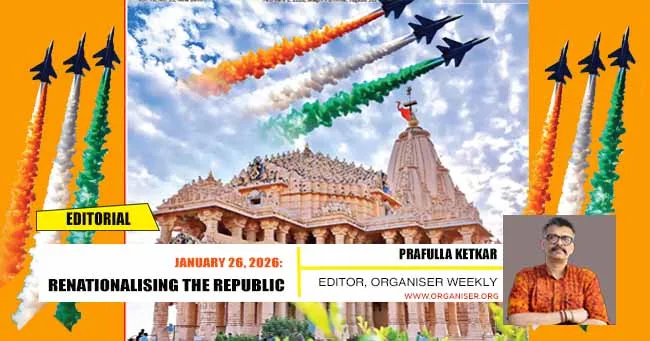
While addressing a media leadership conclave, Prime Minister Modi gave a clarion call that every nook and corner of the country should be rid of the colonial mindset. Not that he talked about getting rid of the reminiscence of colonialism from every ounce of national life, the significant difference was the way he set the timeline for this target. Noting that Bharat is completing 200 years of colonialism through education in 2035, he addressed the root of enslavement for the first time with reference to Macaulay’s minutes. A few days later, while launching the Swabhiman Parv at Somnath, he talked about the symbols of strength, resistance, and tradition, and targeted the Nehruvian secularists for nurturing the colonial mindset to intellectually and psychologically distance themselves from the national heritage, and maliciously attempted to erase the glorious history. While celebrating Republic Day, we should take a national resolve to build a harmonious society which is free from the colonial mindset.
When we adopted and enacted the Constitution seventy-seven years ago, our framers were very clear about the national objectives. They were well aware that the Constitution proposed a new state structure, but as a nation, Rashtra, we have a legacy that stretches back to time immemorial. Modern structures need to be harmonised with the civilisational ethos, which was the common understanding of the freedom fighters when they fought with the values of Swadharma, Swadeshi, Swabhasha, and Swaraj. Many naysayers, immersed in colonial values and thinking, tried to impose Western standards on the democratic journey of Bharat. Our civilisational values, deeply rooted in the spiritual dimensions of democracy, defied all odds and proved that we have the inherent ability to accommodate diversity. After overcoming the initial challenges of food scarcity and technological dependence, we are now charting out a path for Aatma-nirbharta – not just self-reliance, but presenting a sustainable development model based on our selfhood.
Political decolonisation happened in 1947; we began a new journey with the enactment of the Constitution in 1950. Now we need to quickly complete the journey of implementing the necessary transformations in line with the Bharatiya ethos. As RSS Sarsanghchalak Dr Mohan Bhagwat stated during his Vijayadashmi address, “We attained Independence (Swadheenta) in 1947; however, the journey towards complete Independence (Swatantrata) continues”. Unless the systems and parameters of development are in tune with the national ethos, we would look to the Western world for certification. Of course, the change has to start with education, as it has been the most essential tool to colonise our minds. Reforms, such as the introduction of the Higher Education Commission, should not remain mere structural adjustments. The substance, autonomy and decentralisation based on localised skills and resources were the unique features of the Bharatiya education system. We need to revive the same in spirit. Restoring the dignity of labour and reducing the primacy of ‘jobs’ over ‘employability’ are the biggest challenges we must address.
The Western parameters of growth and development are the reality, yet we have demonstrated our distinctive ability to mitigate global upheavals through our cluster-based, savings-oriented economy. The family as an institution is our strength, and we need to revitalise it in the changed context. Our foundational idea of life is to live in harmony with nature; we need to recalibrate our lifestyles to integrate those ideals with modern technologies. An attempt to develop the Responsible Nations Index should be seen as an assertive Bharat that will now determine global rankings.
The inimical forces are ganging up together and using the political forces in Bharat to further their interests. Systematic efforts to widen the social and geographical faultlines will weaken resurgent Bharat. Social democracy, envisaged by Dr Babasaheb Ambedkar, based on our own institutions and edifice of fraternity, is the only solution in this regard. The need of the hour is to come together with a collective resolve of decolonisation for renationalisation, not just in the narrow national interest but in the global interest.