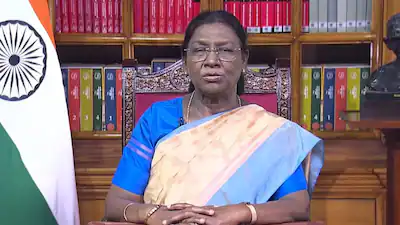
As India prepares to celebrate its 77th Republic Day, President Droupadi Murmu’s address to the nation stood as a moment of collective introspection and renewed resolve. Speaking at a time when geopolitical tensions are escalating across continents from prolonged conflicts to emerging flashpoints, the President framed India’s role not merely as a regional power, but as a civilisational voice advocating peace, harmony, and stability.
Her address seamlessly wove together India’s past, present, and future, drawing from the legacy of the freedom movement, reaffirming the sanctity of the Constitution, and outlining a roadmap toward a developed and inclusive Bharat. At the heart of her message was a confident assertion: India speaks for peace because it stands on strength moral, democratic, economic, and military.
India as a Messenger of Peace in a Turbulent World
President Murmu underscored that India’s call for peace is neither passive nor rhetorical. It is rooted in a long civilisational tradition that views the world as one family Vasudhaiva Kutumbakam. At a time when wars, terrorism, and instability dominate global discourse, India’s consistent advocacy for dialogue, restraint, and mutual respect carries renewed relevance.
She highlighted that India’s voice for peace is credible precisely because it is backed by preparedness and resolve. A nation that can protect its citizens, secure its borders, and dismantle threats to its sovereignty can also champion harmony on the global stage without fear or hesitation.
Becoming Architects of Our Destiny
Recalling the transformative journey of India’s freedom movement, the President reminded citizens that August 15, 1947, marked not just political independence but the beginning of national self-determination. However, it was the adoption and enforcement of the Constitution that truly established India as a sovereign democratic republic.
“Our Constitution is the foundational document of the largest republic in world history,” she noted, emphasising the enduring relevance of its core ideals—justice, liberty, equality, and fraternity. These values, she said, are not abstract principles but living commitments that define India’s national character and unity.
The President paid tribute to the framers of the Constitution, who, despite immense diversity and post-Partition challenges, laid a strong institutional and moral foundation for a united Bharat.
Constitution as a Living Moral Compass
President Murmu stressed that the Constitution continues to guide India through changing times, ensuring balance between rights and duties, authority and accountability. It has allowed India to evolve without losing its democratic soul.
She described the Constitution as a unifying force that binds the nation together, reinforcing nationalism while respecting diversity. In an era of rapid political and social change, she urged citizens to uphold constitutional values not merely as legal obligations but as ethical responsibilities.
Vande Mataram: The Song That Shaped a Nation
A poignant segment of the address was dedicated to Vande Mataram, which the President described as India’s lyrical national prayer. Tracing its journey from Bankim Chandra Chattopadhyay’s pen to mass mobilisation during the freedom struggle, she highlighted its power to awaken national consciousness.
She recalled how Subramanya Bharati popularised Vande Mataram through his Tamil composition “Vande Mataram Yenbom”, ensuring that the song transcended linguistic boundaries. Translations into multiple Indian languages and Sri Aurobindo’s English rendering further cemented its place as a unifying national chant.
The President also linked this cultural legacy to the recent observance of Netaji Subhas Chandra Bose’s birth anniversary as Parakram Diwas, reminding the nation of Netaji’s indomitable spirit and the enduring resonance of his slogan “Jai Hind.”
Nari Shakti: Rising Pillar of Nation-Building
A significant portion of President Murmu’s address focused on the rise of women as decisive agents of national transformation. She noted that Indian women are no longer confined to the margins but are shaping the country’s destiny across sectors from agriculture and entrepreneurship to science, defence, and sports.
Highlighting that over ten crore women are now part of self-help groups, she said this grassroots economic participation is redefining development itself. Women-led initiatives are fostering financial independence, social empowerment, and community resilience.
She also celebrated India’s recent sporting achievements, particularly in women’s cricket and chess, calling them symbols of global excellence. With nearly 46 per cent representation of women in Panchayati Raj institutions and the implementation of the Nari Shakti Vandan Adhiniyam, the President said political empowerment of women is set to reach unprecedented heights.
Operation Sindoor and the Strength to Protect Peace
Reaffirming India’s uncompromising stance on national security, President Murmu highlighted the success of Operation Sindoor, a precision strike that dismantled terror infrastructure across the border. She noted that India’s defence self-reliance played a crucial role in the operation’s success.
Her remarks conveyed a clear message: India seeks peace, but not at the cost of its security or sovereignty. The President linked military preparedness directly to India’s diplomatic credibility, stating that peace advocacy is meaningful only when backed by the capacity to defend.
Drawing from personal experience, she recalled visits to the Siachen Base Camp, sorties in Sukhoi and Rafale fighter jets, and time spent aboard the submarine INS Vaghsheer, underscoring her confidence in the Armed Forces.
Economic Confidence in an Uncertain World
President Murmu hailed India’s position as the world’s fastest-growing major economy, even as global markets grapple with instability. She attributed this resilience to structural reforms, policy consistency, and a renewed emphasis on self-reliance.
She described the Goods and Services Tax (GST) as the most significant step toward economic integration since Independence, creating a unified national market. Guided by the principles of Atmanirbharta and Swadeshi, India is steadily moving toward becoming the world’s third-largest economy.
Investments in infrastructure, labour reforms, and enterprise-friendly policies, she said, are laying the groundwork for sustainable and inclusive growth.
Antyodaya in Action
The President also highlighted India’s progress in poverty alleviation, noting that millions who lived in deprivation for decades have been lifted above the poverty line. Central government schemes currently support nearly 81 crore beneficiaries, ensuring food security and basic dignity.
Invoking Mahatma Gandhi’s ideal of Sarvodaya, progress for all, she emphasised that development must remain inclusive, with special attention to tribal and marginalised communities. Preventing people from falling back into the “poverty trap,” she said, remains a core national commitment.
Viksit Bharat: A Shared National Mission
Concluding her address, President Murmu described the vision of Viksit Bharat as a shared responsibility. She called upon local institutions, communities, and citizens to act as agents of change, transforming villages and cities into engines of progress.
She also spoke of cultural decolonisation, stressing the need to shed colonial mindsets and re-centre Indian languages, traditions, and knowledge systems. Today’s India, she said, is moving forward with renewed self-confidence, deeply rooted in its glorious heritage and guided by a Gyan Bharatam approach.
A Message Beyond Borders
President Droupadi Murmu’s Republic Day Eve address was not merely ceremonial. It was a statement of intent—projecting India as a nation at peace with itself and prepared to engage the world with confidence. By blending constitutional values, cultural pride, economic ambition, and strategic strength, she articulated a vision of India that speaks softly of peace but stands firmly on principle.
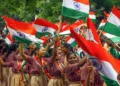
As the tricolour rises on the 77th Republic Day, her words serve as a reminder that India’s greatest strength lies in its ability to harmonise tradition with progress, power with restraint, and diversity with unity.