For centuries, river Ganga in Varanasi was not only a hub of spiritual activity but also a centre of commerce and movement in this country. When boats of grains and textiles navigated this river over a period of time, it became a journey of an economic benefit. Its nearly dead trajectory began to revive after 2014, when the Government of India under Prime Minister Shri Narendra Modi placed a emphasis on inland waterways as part of a broader logistics and infrastructure reform. Varanasi located on the middle stretch of the Ganga has emerged as one of the most important centres of this revival.
Ganga and Ancient Inland Waterway Trade
Trade was largely reliant on the use of inland waters for the conduct of commerce within the land of the Indians, even more so on the Ganga valleys, connecting the metropolitan centers with urban-rural cores of politics within the eastern maritime regions.
River corridors facilitated the transport of commodities such as grains, salt, textiles and metalware at cheaper costs, connecting cities such as Pataliputra with the Ganges valley port of Tamralipti, which was of immense significance for the conduct of maritime commerce and activity. It is stated by classical authors that similar river valleys were of prime importance as internal routes, with the support of the government, for the conduct of commerce.
Policy Push and the Birth of Jal Marg Vikas
India’s inland waterway development received a legislative boost with the National Waterways Act, 2016, which has expanded the number of national waterways from 5 to 111. To operationalise this potential, the government approved the Jal Marg Vikas Project (JMVP) in 2018 with an estimated cost of ₹5,369 crore. The implementing agency for this waterway project in India is the Inland Waterways Authority of India (IWAI) and comes under the Ministry of Ports, Shipping and Waterways. It has been implemented with the help of the World Bank. The purpose was obvious build a waterway that was viable throughout the year with modern terminals and water navigation, by not altering the natural course of the waterway.
What is NW-1?
National Waterway-1 (NW-1) is India’s longest inland waterway, extending about 1,620 km along the Ganga-Bhagirathi-Hooghly river system from Haldia to Prayagraj and passing through four states West Bengal, Jharkhand, Bihar and Uttar Pradesh. It serves major urban and industrial centres including Kolkata, Patna, Varanasi and Prayagraj, along with their extensive hinterlands in the Ganga basin. This area is already congested in terms of the road as well as the rail network, which limits the expansion of capacity in these areas. Having developed the NW-1, there is a possibility of an alternate mode of transportation available, which has good capabilities for the carriage of large volumes of cargo. Inland water transportation is more energy-efficient compared to the use of the roads, thus making the NW-1 an important infrastructure for the strategic needs.
In recent years, a demand has emerged for transporting coal, fly ash, food grains, cement, stone chips, fertilisers, edible oil and over-dimensional cargo through inland waterways. Several major shippers, including thermal power plants, cement and fertiliser companies, edible oil processors and the Food Corporation of India, have indicated readiness to use NW-1 if it supports vessels of 1,200–1,500 DWT. Achieving this requires assured navigational depth, particularly in the upper reaches and substantial investment in dredging, river training, modern navigation systems and terminal infrastructure. Terminals that are planned at locations such as Prayagraj, Varanasi, Ghazipur, Sahibganj, Katwa, etc., will help in the efficient transhipment. With the development of the entire route, NW-1 will offer a reliable 1,620 km barge fairway, thus reducing costs, highway congestion.
Why Varanasi Was Central to the Plan
Varanasi selection was driven by geography and economics rather than symbolism alone. The city lies almost midway on NW-1 and connects eastern Uttar Pradesh to Bihar, Jharkhand and West Bengal. Earlier, goods from this region relied heavily on congested highways or rail freight. Inland water transport, by contrast, offers a cost advantage, where government assessments indicate that transporting bulk cargo by waterways can be 30-40% cheaper than road transport and significantly more energy-efficient.
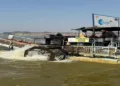
Recognising this advantage, IWAI planned a major cargo handling facility at Ramnagar, across the river from the old city. The Varanasi Multi-Modal Terminal, inaugurated in November 2018, became India’s first such terminal on an inland waterway. Built at a cost of around ₹170 crore, the terminal has an annual handling capacity of about 1.26 million metric tonnes. It is equipped to handle bulk cargo such as fertilisers, foodgrains, cement and fly ash, and is directly linked to road and rail networks.
From Symbolic Launch to Commercial Operations
The first commercial cargoes moved in 2019, containers were transported from Varanasi to Haldia via inland waterways and thereby connects Varanasi to Eastern Ports on a relatively end-to-end basis. Although volumes carried via this mode are small in comparison to what happens on roads and rails, government figures report a consistent rise in cargo carried on NW-1 over successive years a clear indication of how industry is becoming increasingly confident of this mode.
Building Airport is not an one day task, to ease the transport of people and goods in the NW-1 corridor, the government initiated river conservancy works as outlined in the JMVP plan. This involved dredging in shallow stretches of the river, the implementation of the river information system (RIS), night navigation works and the formation of community jetty works. Community jetty works were established in around 60 different positions in the NW-1 corridor and were aimed at promoting the movement of local people and not just of big operations.
Economic Benefits for Varanasi
The most immediate benefit for Varanasi has been improved logistics connectivity. Bulk commodities destined for or originating from eastern Uttar Pradesh now have an alternative route that reduces transport costs and dependence on highways. Local industries including handloom, agricultural produce traders and construction material suppliers stand to gain from lower freight expenses over the long term.
Terminal operation, maintenance, vessels, dredging support services and administrative work have also resulted in the generation of direct and indirect employment opportunities. The decision to elevate the status of the IWAI Sub-Office at Varanasi to the status of a regional office in 2025 is indicative of the significance of this growing inland water transport center in northern India.
· Integration with Multimodal Infrastructures
An essential aspect of the inland waterways strategy is its incorporation with other modes of transport. Ramnagar terminal is being developed as an integral part of a multi-modal logistics concept, where waterways are being connected to highways and railway routes. This is in line with the overall logistics reform agenda pursued by the government through its National Logistics Policy, to reduce India’s logistics costs as a percentage of its gross domestic product.
For Varanasi, this ensures better access to markets in the eastern parts of the country as well as abroad through Haldia and Kolkata. In the future, this could facilitate the availability of warehouses, cool storage, value addition, etc., around the city, although the speed at which this would happen depends on the volumes of cargo movement.
· Tourism and Passenger Movement
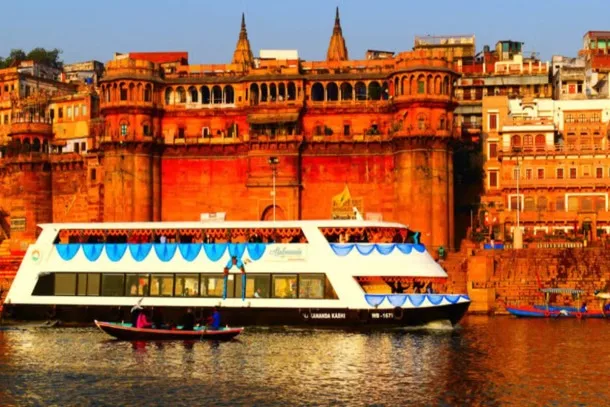
Even though the focus for the inland waterways has been on the smooth functioning of the cargo operations, the sector has presented new opportunities for river-based tourism in India. Cruise operations on the Ganga River have now started to cover Varanasi as a hub tourist destination in their itinerary, connecting the city to the tourist hubs in the districts of Bihar and West Bengal.
In a major move towards sustainable transport, the city of Varanasi also experienced the rollout of the first indigenous hydrogen-fuel-based passenger vessel in late 2025. This vessel was designed in association with Indian maritime facilities, with the vessel burning cleaner energy while releasing zero emissions while in operation. Though currently limited in scale, such initiatives signal a future-oriented approach to inland navigation.
· Environmental and Energy Considerations
Inland water transport is considered as one of the most fuel-efficient modes of transport. It is found that as compared to road transport, the level of carbon dioxide emissions is much less in water transport for every ton-kilometre. JMVP projects have also fit well into the broader context of Indian priorities for green infrastructure development, with emphasis given to environmental protection such as minimal dredging activities in the Ganga riverbed.
For a congested city like Varanasi, which already suffers from problems of traffic congestion and air pollution, reducing congestion to some extent can obviously have other indirect environmental advantages of using water transport.
Despite these gains the inland waterways programme faces challenges. Seasonal variations in river depth, the need for continuous maintenance dredging, and the gradual pace of cargo adoption remain issues acknowledged by the government itself. Officials have consistently maintained that inland waterways are meant to complement, not replace, road and rail transport. The policy direction has altered India’s transport landscape. From being largely symbolic, the Ganga has re-entered the country economic imagination as a working river.
Future-Oriented Transformation of Ganga
Nearly a decade after the inland waterways push began, Varanasi stands at an interesting intersection of tradition and modern logistics. The city has not turned into a river port overnight, nor was that the government’s stated objective. Instead the transformation has been slow and policy oriented where a functional terminal, improved cargo numbers, administrative upgrades and new possibilities in tourism and clean transport is taking place.
By anchoring Varanasi firmly on National Waterway-1, the Modi government has restored a historic role of the Ganga as a channel of movement and exchange using modern infrastructure and cautious planning. The long-term impact will depend on sustained investment, river management and industry participation, but the foundations laid so far mark a significant shift in how India views its rivers not only as cultural lifelines, but also as engines of economic connectivity.