Press freedom at the edge of democracy in Bangladesh
June 6, 2026
  • Read Ecopy
  • Circulation
  • Advertise
  • Careers
  • About Us
  • Contact Us
Android AppiPhone AppArattai
Organiser
  • ‌
  • Bharat
    • Assam
    • Bihar
    • Chhattisgarh
    • Jharkhand
    • Maharashtra
    • View All States
  • World
    • Asia
    • Europe
    • North America
    • South America
    • Africa
    • Australia
  • Editorial
  • International
  • Opinion
  • RSS @ 100
  • More
    • Op Sindoor
    • Analysis
    • Sports
    • Defence
    • Politics
    • Business
    • Economy
    • Culture
    • Special Report
    • Sci & Tech
    • Entertainment
    • G20
    • Azadi Ka Amrit Mahotsav
    • Vocal4Local
    • Web Stories
    • Education
    • Employment
    • Books
    • Interviews
    • Travel
    • Law
    • Health
    • Obituary
  • Subscribe
    • Subscribe Print Edition
    • Subscribe Ecopy
    • Read Ecopy
  • ‌
  • Bharat
    • Assam
    • Bihar
    • Chhattisgarh
    • Jharkhand
    • Maharashtra
    • View All States
  • World
    • Asia
    • Europe
    • North America
    • South America
    • Africa
    • Australia
  • Editorial
  • International
  • Opinion
  • RSS @ 100
  • More
    • Op Sindoor
    • Analysis
    • Sports
    • Defence
    • Politics
    • Business
    • Economy
    • Culture
    • Special Report
    • Sci & Tech
    • Entertainment
    • G20
    • Azadi Ka Amrit Mahotsav
    • Vocal4Local
    • Web Stories
    • Education
    • Employment
    • Books
    • Interviews
    • Travel
    • Law
    • Health
    • Obituary
  • Subscribe
    • Subscribe Print Edition
    • Subscribe Ecopy
    • Read Ecopy
Organiser
  • Home
  • Bharat
  • World
  • Operation Sindoor
  • Editorial
  • Analysis
  • Opinion
  • Culture
  • Defence
  • International Edition
  • RSS @ 100
  • Magazine
  • Read Ecopy
Home World

When Newsrooms Burned: Press freedom at the edge of democracy in Bangladesh

Since independence in 1971, the press in Bangladesh has lived between promise and peril. Early hopes dimmed under state control; in 1975, a one-party system shuttered nearly all newspapers. The following years brought censorship and fear, softened only by the persistence of reporters who learned to survive by caution and courage. The return of electoral politics in the 1990s revived journalism’s public role. The Daily Star and later Prothom Alo helped normalize investigative reporting

Sangram DattaSangram Datta
Jan 25, 2026, 07:40 pm IST
in World, South Asia, Analysis, Asia
Follow on Google News
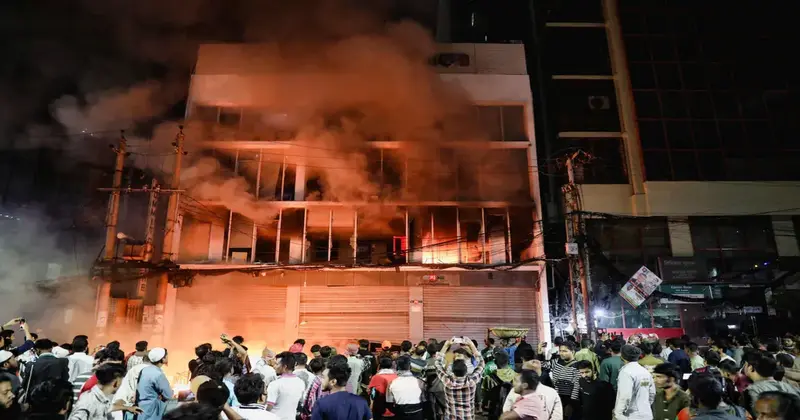
Prothom Alo Newspaper building being burnt in Bangladesh

Prothom Alo Newspaper building being burnt in Bangladesh

FacebookTwitterWhatsAppTelegramEmail

Shortly after midnight in Dhaka, smoke rose where newsrooms once glowed. Mobs moved with purpose. At Kazi Nazrul Islam Avenue, they forced their way into The Daily Star, smashing glass, tearing down posters and setting fires that climbed from floor to floor. Across the city, at Karwan Bazar, Prothom Alo—Bangladesh’s most influential Bangla daily—was ransacked in parallel. Furniture was dragged into piles and burned. Computers and cameras disappeared. Fire safety systems were destroyed. Journalists and staff were trapped for hours as flames and smoke filled stairwells.

By dawn, two of the country’s most important newspapers were silent. Neither could publish in print that day—an unprecedented rupture in their histories. For Bangladesh’s press, it was not merely an attack on buildings. It was a message. The violence followed news of the death of Sharif Osman Hadi, a July uprising frontliner and election aspirant, who died in Singapore a week after being shot in Dhaka. Outside the newsrooms, protesters accused the papers of complicity in his killing—claims both outlets deny. Slogans echoed through the night. Fire service vehicles were blocked. Police and soldiers struggled to clear paths. Rescue came only near morning.

Inside The Daily Star, at least 28 journalists and staff fled upward, sealing themselves on the roof as smoke thickened below. “I can’t breathe anymore”, one investigative reporter wrote online in the early hours. At Prothom Alo, firefighters who finally reached the scene were attacked and forced to retreat before returning under armed protection. Two firefighters were later hospitalized. Several employees were injured while trying to escape.

By daylight, Karwan Bazar stood charred. Floors were gutted. Newsrooms reduced to ash. Across Dhaka and beyond, the night’s violence spilled outward—attacks on cultural institutions, party offices and minority communities. In Mymensingh, a Hindu man was killed by a mob over allegations of blasphemy. The pattern was familiar. The scale was not. Officials condemned the assaults. Editors received calls of sympathy. Promises of support were made. No arrests were announced that day. For Bangladesh, the night fit a longer story.

Since independence in 1971, the press in Bangladesh has lived between promise and peril. Early hopes dimmed under state control; in 1975, a one-party system shuttered nearly all newspapers. The following years brought censorship and fear, softened only by the persistence of reporters who learned to survive by caution and courage. The return of electoral politics in the 1990s revived journalism’s public role. The Daily Star and later Prothom Alo helped normalize investigative reporting. Yet violence never disappeared. In 2004, Manik Saha, a correspondent for The Daily Star and BBC Bangla, was killed by a bomb in Khulna. That same year, another editor was murdered in the same city. Rural reporters were beaten for exposing corruption. Many cases stalled; some never began.

The 2012 murders of television journalists Sagar Sarowar and Meherun Runi—found dead in their Dhaka apartment—became a national wound. Marches filled the streets. Officials pledged swift justice. More than a decade later, the case remains unresolved. The lesson, for many journalists, was stark: even prominence offers no protection. Over time, pressure also took legal form. The Digital Security Act, enacted in 2018, empowered arrests over online speech and reporting. Dozens of journalists were sued. Some were detained. Editors faced cases for stories on prices, corruption, and governance. The law’s chill was felt far beyond courtrooms.

The profession itself grew divided. Some journalists aligned openly with political power, receiving protection and perks. Others—especially outside Dhaka—worked alone, facing threats, fabricated cases and violence. Solidarity frayed. Impunity deepened. Among those targeted were regional reporters whose names rarely reached national headlines. In Srimangal, Rasendra Datta Chowdhury, a correspondent for the daily Sangbad, was attacked repeatedly from the 1970s onward and subjected to years of harassment and land-grabbing attempts linked to local political interests.

His son, Sangram Datta, himself a local journalist, was later repeatedly assaulted between 1991 and 2002 for reporting on terrorism, corruption and criminal networks and at one point faced an attempt to have him jailed through the misuse of administrative power. He survived only through collective resistance by fellow journalists. What happened in Dhaka that night compressed these decades into hours. The mobs did not distinguish between English and Bangla, between editors and interns, between archives and canteens. They destroyed fire extinguishers before lighting fires. They searched desks. They blocked rescue. The intent was not protest alone; it was erasure.

Also Read: Which government health insurance schemes offer the best coverage?

Yet even amid the ruins, the press endured. By morning, journalists returned to burned floors to salvage what they could. Editors spoke publicly, refusing to accept the accusations hurled at their papers. Colleagues from across political and professional lines arrived to urge calm. Cultural institutions vowed to rebuild. Firefighters went back to work. Bangladesh’s constitution promises freedom of expression. Its history tests that promise repeatedly. The night the press burned was not an aberration but an escalation—mob power added to political pressure, digital incitement amplifying street violence.

The question now is whether the country will treat it as a turning point. Accountability would require arrests and trials that do not fade with headlines; laws that protect reporting rather than punish it and a renewed solidarity within journalism itself. Without that, the silence of that morning—the first missed print runs in decades—risks becoming a precedent. As smoke cleared from Dhaka’s newsrooms, the city woke to an absence. Newspapers would publish again. Buildings would be repaired. What remains uncertain is whether the space for independent journalism will be rebuilt with the same urgency as the walls.

Topics: BangladeshPress FreedomJournalismDhakaNewspaperThe Daily StarProthom Alo
ShareTweetSendShareSend
✮ Subscribe Organiser YouTube Channel. ✮
✮ Join Organiser's WhatsApp channel for Nationalist views beyond the news. ✮
Previous News

National Selfhood in Science: Turning the tide with spiritual scienticism

Next News

Republic Day: Decolonisation for renationalisation

Related News

MEA spokesperson Randhir Jaiswal highlights India's resolve to deport illegal Bangladeshi migrants via bilateral mechanisms

India reiterates strong resolve to deport illegal Bangladeshis; Flags delay of bilateral procedures from Dhaka

Bangladesh’s reported JF-17 push has triggered fresh scrutiny after India’s Ops Sindoor exposed the vulnerabilities of Pakistani-Chinese defence systems and precision strike capabilities

Shadows of Operation Sindoor: Questions loom over Bangladesh’s JF-17 ambitions amid Sino-Pakistani tech vulnerabilities

Land transfer to BSF in West Bengal: Securing the porous border

People leaving Bangladesh in 1971 unable to bear the atrocities of Pakistan

May 25 marks Pakistan atrocities during Operation Searchlight: How Bengali Hindus were brutally massacred

Taslima Nasreen denounces attacks on non-Hindus in Bangladesh

In Bangladesh, ‘Blasphemy’ becomes weapon to perpetrate violence against minorities: Taslima Writes to PM Tarique

Gloria Gangte, Ambassador to Norway; Pooja Kapur, Additional Secretary, North Europe; Sibi George, Secretary (West);
Randhir Jaiswal, MEA official spokesperson (Left to Right)

Trust, Democracy and the Limits of Western Moral Authority: An Indian perspective on the Norway media exchange

Load More

Latest News

The terracotta dice that challenges historical assumptions and highlights India's millennia-old civilisational heritage

How a 4,500-year-old terracotta dice is reviving the debate on India’s civilisational continuity & Vedic heritage

The Porumamilla inscription and the ancient science behind a reservoir that survived 650 years

India’s 655-Year-Old Water Policy: The Porumamilla inscription that turned stone into a manual of hydrology

India’s Permanent Representative to the United Nations Ambassador Harish Parvathaneni

India slams Pakistan at UNSC for peddling false narratives on Jammu & Kashmir

Keralam: Pathanamthitta temple property occupied beyond lease period reclaimed by devotees

A series of high-level engagements signals New Delhi's growing focus on building interoperable security networks across the Indo-Pacific

India strengthens Indo-Pacific security architecture with new defence and maritime partnerships

Prime Minister Narendra Modi

“Makes every Indian proud”: PM Modi hails India’s 7.7 per cent GDP growth in FY 2025-26

Once known for maoist violence, Minpa now leads healthcare revolution with telemedicine services in Sukma

From Maoist Stronghold to Healthcare Hub: How Chhattisgarh’s Minpa is transforming through telemedicine & development

Dr Surendra Jain, Joint General secretary, VHP

VHP Demands Audit of Waqf Properties Amid Encroachment Claims: “Land should go to rightful owner,” says Surendra Jain

A Special NIA Court has framed charges against banned PFI and 20 office bearers, including E. Abubakar and O.M.A. Salam, under UAPA and IPC

PFI Terror Case: Special NIA court charges Abubakar, Salam & others for alleged conspiracy to wage war against India

Prime Minister Narendra Modi with women during an event (Old image used for representative purposes)

The Nari Shakti Decade: How 12 years of policy reforms under Modi govt transformed lives of women in Bharat

Load More
  • Privacy
  • Terms
  • Cookie Policy
  • Refund and Cancellation
  • Delivery and Shipping

© Bharat Prakashan (Delhi) Limited.
Tech-enabled by Ananthapuri Technologies

  • Home
  • Search Organiser
  • Bharat
    • Assam
    • Bihar
    • Chhattisgarh
    • Jharkhand
    • Maharashtra
    • View All States
  • World
    • Asia
    • Africa
    • North America
    • South America
    • Europe
    • Australia
  • Editorial
  • Operation Sindoor
  • Opinion
  • Analysis
  • Defence
  • Culture
  • Sports
  • Business
  • RSS @ 100
  • Entertainment
  • More ..
    • Sci & Tech
    • Vocal4Local
    • Special Report
    • Education
    • Employment
    • Books
    • Interviews
    • Travel
    • Health
    • Politics
    • Law
    • Economy
    • Obituary
  • Subscribe Magazine
  • Read Ecopy
  • Advertise
  • Circulation
  • Careers
  • About Us
  • Contact Us
  • Policies & Terms
    • Privacy Policy
    • Cookie Policy
    • Refund and Cancellation
    • Terms of Use

© Bharat Prakashan (Delhi) Limited.
Tech-enabled by Ananthapuri Technologies