Bagurumba Dwhou unfolded recently in Assam as a divine celebration of the rich cultural and spiritual legacy of the Bodo community. Representing one of the biggest 18 sub-ethnic groups within the Kacharis (a generic term applied to a number of ethnic groups, especially in Assam), the Bodos have historically been natives of the Brahmaputra Valley, spreading across Nepal and North-East India, and are majorly settled in the North-Western regions of Assam encompassing Udalguri, Kokrajhar, Baksa, Chirang, Bongaigaon, Nalbari, Darrang, and Sonitpur districts. They speak the Bodo language, recognized as one among the many Scheduled Languages of India. The Bodos are primarily rice cultivators. Besides, they are also engaged in tea plantation, pig and poultry farming, silkworm rearing, and weaving.
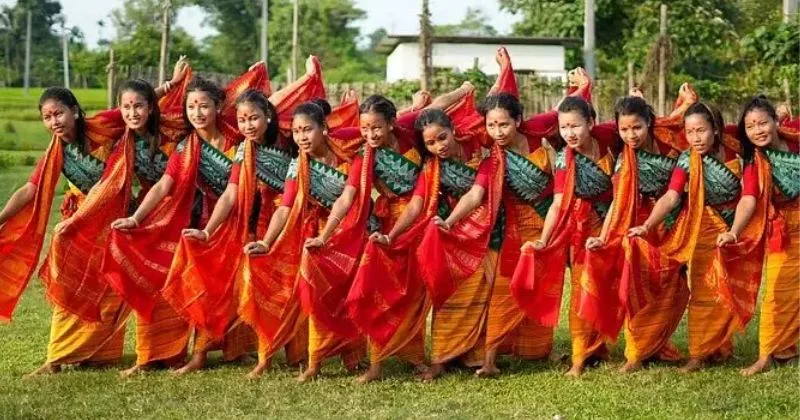
Bagurumba or Bardwisikhla is a traditional folk dance of the Bodos that visually narrates the Dharmic philosophy of human-nature coexistence. It is especially performed by young girls in temples during Magw Domasi (conciding with Makar Sankranti and Pongal in mid-January) and Bwisagu or Bodo New Year festivities in mid-April (coinciding with the Hindu New Year) in honour of their indigenous deity Bathou Bwrai, symbolising the Sizu plant (a variety of cactus) in the Bodo folklore and considered analogous to Sibrai or Siva.
The iconic dance, characterised by slow circular steps and outstretched hands, is passed on from one generation to the next, each adding its own touch to it. It is accompanied by a distinctive Bagurumba song which goes like –“Bagurumba, Hai Bagurumba… Bagurumba, Hai aio Bagurumba… jat nonga bwla khun nonga bwla… thab brum homnanwi bamnanwi lagwmwn kha… hwi lwgw lagwmwn kha…”
Over time, Bagrumba evolved from village ceremonies into a major cultural symbol. During the dance, Bodo women wear the traditional Dokhona, which is a hand-woven bright red, yellow, and green wrap-around cloth, along with the beautifully-designed Jwmgra (shoulder scarf) and Aronai (traditional muffler). Floral ornaments and traditional jewelry are used to enhance the beauty of the performance. The colours chosen are also inspired by nature – green, yellow, and red.
Soft music that makes use of the indigenous Kham, a traditional long drum hand-crafted of wood and goat skin, is coupled with rhythmic, elegant movements that mimic butterflies in flight, flowing rivers, blooming flowers, and trees swaying in the wind. Other instruments used in Bagurumba include Sifung (a long bamboo flute), Serja (bowed string instrument), Jotha (cymbal), Jabsring (a wooden clapper), Gongwna (a bamboo jaw harp), and Tharkha (a block of half-split bamboo).
Today, Bagurumba is sometimes performed without any musical accompaniment. The dance ends with the women bowing down to their parents and elders in reverence. It is succeeded by the worship of Bathou Bwrai, offering the deity live chickens and zou or rice beer. On January 17, 2026 Bagurumba was performed on an unprecedented scale, with 10,000 Bodo youth coming together in a vibrant display of their cultural identity.
It was organized by the Government of Assam under the dynamic leadership of Chief Minister Dr. Himanta Biswa Sarma. The moment gains historic significance as it took place in the august presence of our Hon’ble Prime Minister Shri. Narendra Modi at the Arjuna Bhogeswar Baruah Sports Complex at Sarusajai in Guwahati. As the music rose, it marked a defining moment in the cultural landscape of Assam and its socio-political evolution.
From the synchronised steps to the powerful cultural symbolism, this grand performance stands as a proud reflection of Bodo traditions, embodying the Bodo community’s values and spirit, while at the same time depicting the collective grace of Bodo women and their youthful energy. It brought together performers from 81 Assembly Constituencies across 23 districts of Assam, including districts outside the Bodoland Territorial Council (BTC), underlining the scale and inclusivity of the event.
Performers from Nepal, West Bengal, and Nagaland also participated in this world-record initiative. It has served multiple purposes. Culturally, it has placed Bodo heritage on the national stage; while politically and socially, it has affirmed Assam’s journey from insurgency to peace, and from conflict to cultural unity.
By organising the event in Guwahati, Assam’s largest urban centre, the Government has sent a strong message that the Bodo identity is inseparable from the Assamese society. The presence of the Hon’ble Prime Minister elevated the gravity of the event furthermore, reflecting the Centre’s continued focus on the North-East. This has reaffirmed the Prime Minister’s commitment to peace and development in the North-East and support for the integration and celebration of indigenous cultures,
particularly those previously affected by violence and marginalization. Bagurumba Dwhou was preceded by other culturally integrative initiatives – from the record-setting Bihu performance in 2023 to the 2025 Jhumoir Binandini mega event showcasing the rich culture of the tea tribes of Assam. They represent a deliberate policy to project Assam’s rich cultural traditions onto national and global platforms, while preserving indigenous art forms.
The Bodos have endured decades of political unrest, with demands for autonomy perpetrating a vicious cycle of insurgency and separatism. The 2020 Bodo Peace Accord, signed with all factions of the armed separatist outfit National Democratic Front of Bodoland (NDFB), marked a decisive turning point. It not only put an end to active militancy in the region but also offered ample opportunities for a generation of Bodo youth to return from the jungles and be a part of normal civic life.
Especially since 2021, after the ascendancy of Chief Minister Dr. Himanta Biswa Sarma to power, several dreaded militant outfits of different tribes and ethnicities have laid down arms and more than thousands of former militants rehabilitated through comprehensive policies that include financial aid and livelihood support. Nearly every insurgent outfit in Assam, barring ULFA (Independent), has now joined the peace process.
The Government has taken every possible step to ensure that insurgency in Assam is put to an end forever. At a time when the Christian missionary mafia is trying to establish a strong foothold among the Bodos, a mega performance like Bagurumba Dwhou mega has added depth to Bharat’s folk traditions, besides according the Bodo community and their traditions the visibility and honour they always duly deserved.
This cultural revival replaces earlier periods of violence and unrest with new hopes and aspirations for the future generation of Bodos. It certainly heralds the beginning of a new chapter in Assam where every community stands hand-in-hand with one another bonded by faith and respect. As the Hon’ble Prime Minister stated that Bagurumba Dwhou is not merely a festival but a medium to honor the great Bodo traditions and eminent personalities of the Bodo society such as Bodofa Upendra Nath Brahma, Gurudev Kalicharan Brahma, etc.