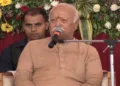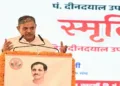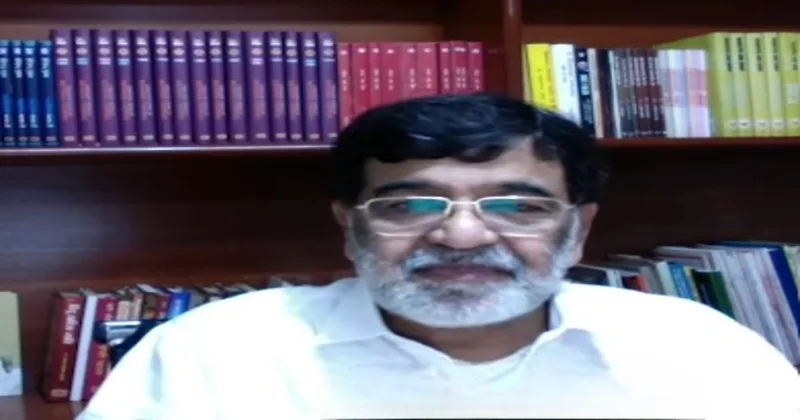
VIJAYWADA: Speaking at a session on ‘Sustainable Development Goals through Integral Humanism’, Atul Jain of the Deendayal Research Institute (DRI) said India must view development as a long civilisational process rooted in philosophy, culture, and lived practice
The remarks were made on the second day of a two-day event revisiting 60 years of Integral Humanism, during a session on ‘Sustainable Development Goals through Integral Humanism’ held at the Indira Gandhi Municipal Stadium. The programme was organised by the BJP (Andhra Pradesh) on January 23 and 24, 2026, marking six decades since the historic Jana Sangh meet that articulated the philosophy of Integral Humanism.
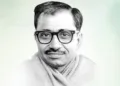
Jain recalled that the Deendayal Research Institute was established in 1968, immediately after the demise of Pandit Deendayal Upadhyaya, by leaders including Nanaji Deshmukh, who had worked closely with him for several years in political and organisational life. He said the decision to establish DRI arose from the conviction that the legacy of Integral Humanism should not remain confined to ideological discussions but must be carried forward through intellectual work and field-based action.
He said that after 1968, senior thinkers, including leaders like Atal Bihari Vajpayee, felt that India’s ideological discourse was slipping into a vacuum where imported ideologies were being adopted without grounding. Jain noted that instead of remaining trapped in abstract ideological debates, Nanaji Deshmukh and his colleagues decided to validate Integral Humanism on the ground.
Jain said the first phase involved nationwide lectures and discussions, after which the focus shifted decisively to villages. Development work was initiated in Bundelkhand and other rural regions, where DRI began evolving holistic models of village development. These models, he said, were not imposed but emerged through continuous engagement with local communities.
He stressed that the experience in villages taught an important lesson — that people living in rural India were not “uneducated” or lacking wisdom. “They possess lived knowledge and wisdom that urban, city-centric systems often ignore,” he said. Jain recalled that Nanaji Deshmukh repeatedly emphasised that the organisation must learn from villagers rather than approach them with the mindset of teaching.
Turning to global frameworks, Jain referred to the United Nations Sustainable Development Goals (SDGs) adopted in 2015. He said that when the SDGs were announced, it was decided that DRI should undertake serious research to examine whether these goals were new ideas or whether they already existed in Indian philosophical thought.
Jain pointed out that the 17 SDGs adopted by the UN were, in fact, a mirror image of Integral Humanism propounded by Pandit Deendayal Upadhyaya in 1965, almost 50 years earlier. He noted the symbolic significance that the SDGs were adopted on September 25, which also coincided with Pandit Deendayal Upadhyaya’s birth anniversary, calling it an unintentional yet meaningful tribute to his vision.
He explained that DRI conducted a detailed study during 2016–17, the centenary year of Pandit Deendayal Upadhyaya. The study mapped each SDG against the principles of Integral Humanism using a four-column framework — listing the SDG, its reflection in Integral Humanism, the role of government, and the responsibility of society.