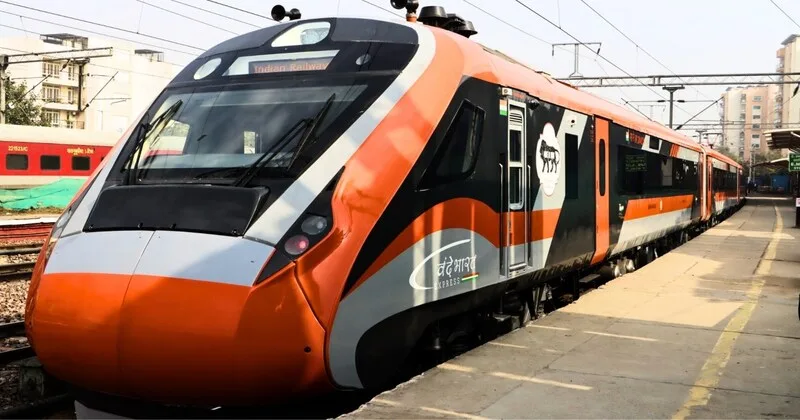
New Delhi: Indian Railways is breaking major challenges in long-distance travel. With the launch of the sleeper variant of the Vande Bharat Express, the country is not only upgrading a service, it is also revolutionizing the experience of overnight travel. For several decades, sleeper services in India have been functional with Rajdhani and Tejas-like trains, which used to be economical and expensive both, but when it came to issues of comfort, speed, and integration with international standards, the country was never a part of such conversations. This is where the Vande Bharat Sleeper Express is set to change experiences.
Breaking away from the legacy of conventional sleeper trains
The long route trains in India, like Rajdhani, Duronto, and Mail/Express, were built for a different generation. Their purpose was transport capacity and reach, not with experience point of view. The width of the berths was limited, the ride was track-dependent, the toilets were self-service, and the safety factors were operator-manual.
Unlike the earlier trains, which were locomotive-hauled, this is an integrated train with distributed power, allowing faster acceleration, smoother braking, and better speed control. This alone cuts travel time and improves punctuality, two long-standing challenges of overnight rail travel.
The design philosophy has changed the train structure. The sleeper variant is not an adaptation of an existing coach design but a purpose-built long-distance train. No detail, no aspect, has been left unchanged, and all have been designed to meet the demands and expectations of this new generation of train commuters, who are now comparing trains with buses and planes.
Designed for the Night: Need to comfort
Night travel requires an entirely different modality than daylight travel. In older trains, sleeping was common without comfort, just as passengers did; in the Vande Bharat Sleeper, sleep is central to the design.
This train is made up of 16 ultra-modern coaches, which can carry a total of 823 passengers. The berths are ergonomically designed to provide superior body support to reduce fatigue during long journeys. Advanced suspension systems reduce the jolting effect of jerks and vibrations, ensuring that the train glides through the night rather than rattling its way through.
Enclosed vestibules between coaches, besides improving safety and temperature control, have introduced noise cut. USB charging ports at each berth acknowledge the realities of today’s digital traveller. Ingeniously planned luggage spaces, overhead racks, under-berth storage, and dedicated places for large suitcases ensure clutter-free interiors, something rarely achieved in conventional sleeper trains.
Cleanliness, Hygiene and Health: A new benchmark
The difference between the Vande Bharat Sleeper and other sleeper trains is quite visible when it comes to cleanliness and hygiene. The older versions of sleeper trains have trouble with sustaining cleanliness over longer routes. To overcome this drawback, Vande Bharat Sleeper has incorporated advanced toilet and disinfection systems, which help it to maintain better levels of cleanliness.
This is not just a superficial focus. There are common areas where one travels, and that involves overnight travel. This is a very important health issue. By doing this, the Indian Railways are meeting the post-pandemic requirement where hygienic Railways are as important as fast or cheap Railways.
Safety through indigenous technology
The safety solutions provided for the older trains consisted of a layering of safety over the existing infrastructure. The new Vande Bharat Sleeper design incorporates safety considerations into the basic design. The introduction of the Kavach indigenous train protection system is a paradigm shift towards technology-based safety solutions for railway networks.
Automatic doors, improved fire safety systems, CCTV cameras throughout the coaches, and an emergency talk-back system enabling the public to communicate directly with the train staff help to create a safe traveling experience. Such an integrated safety package makes the Vande Bharat Sleeper more in line with the global best practices than any other sleeper train running so far on the Indian railways.
The Howrah-Guwahati Corridor: A strategic beginning
The initial operational launch of Vande Bharat Sleeper in the Howrah to Guwahati route has great strategic importance. This route joins East and Northeast India and has a tremendous number of daily passenger traffic, consisting of students, working professionals, and businessmen.
The quickest train operating on this line has a travel time of 17 hours and a distance of 966 kilometers. The Vande Bharat Sleeper train will now achieve this distance in 14 hours, thus saving a travel time difference of nearly three hours. During an overnight journey, such a difference makes a huge impact as one gets adequate rest and more hours for productivity.
It would bring benefits to the districts of West Bengal and the state of Assam, as well as religious centers such as Kalighat and Kamakhya. Better connectivity will also prove to be economically important as it could aid trade, tourism, and the movement of workers within regions where the railway network has been the only means of connectivity for a very long time.
Competing with Air Travel: Affordability
One of the key distinguishing factors of the Vande Bharat Sleeper is the pricing aspect. The fact that it has facilities parallel to those on foreign trains and is affordable to the common man, too, is quite significant. The approximate tariff of Rs. 2300 for 3 AC, Rs. 3000 for 2 AC, and Rs. 3600 for First AC is much lower compared to air travel.
This is where the Vande Bharat Sleeper Train operates under the radar, as more than a rival for old trains, it is actually a rival for the airplane as well. In fact, for overnight train travel, less actual travel time saves the cost, and having the other efficiency of the train, as opposed to the airplane, makes for a great alternative mode of transport.
How it compares with international trains
Nations such as Japan, France, and China are famous for their fast trains. The Shinkansen train from Japanese Railways, the TGV from France, the ICE from Germany, and the CRH from China are best known for their punctuality and safety, speed, comfort, and efficiency.
It is the context that distinguishes the Vande Bharat Sleeper. Whereas in most of the world, high-speed trains serve the purpose of carrying people from one city to another during the daytime, India requires trains that can travel long distances during the night hours, and that is exactly what the Vande Bharat Sleeper does.
Its maximum operational speed of 180 kmph may be somewhat lower than some foreign models, but the strength of the train is that it provides a complete package of speed, comfort, and economy within the context of Indian reality. The fact is that the major technologies used are indigenised.
Regionally rooted culture is another difference that has been made with subtlety and importance. The food services are tailored to include regionally rooted cuisine, be it Assamese from Guwahati or Bengali from Kolkata, so that the experience remains more familiar and less anonymous compared to Anonymous Train Services, where homogeneity of experience matters.
Better working conditions, better service
The Vande Bharat Sleeper train is better designed for railway officials. The ergonomic design of the driver cabin helps reduce fatigue on loco pilots. This train has specific toilet blocks designed to combat hygiene issues prevalent in extended duty hours. TTEs and pantry cabin staff have specific cabins designed for them.
Higher speed capability, faster acceleration, and more advanced train control systems can improve punctuality. Smoother operations and shorter dwell times at stations make overnight journeys more reliable; this is an important consideration for business commuters, students, and professionals.
The Vande Bharat Sleeper is more than a new train; it marks the future path for Indian Railways. The introduction of the new design sleeper, says Rohan Shah, a transportation expert, helps to fill the gap that existed between the country’s strong mass transport sector and the excellence achievable in the railways sector.
A new chapter in India’s rail story
Decades back, sleeper trains have always remained the backbone for long journeys in India. The Vande Bharat Sleeper train is no substitute for this legacy; it is an improvement on it. Being faster than the current trains, more comfortable than before, and on par in terms of safety with global standards, it indeed symbolizes a mature version of railway developments for India.
As the Vande Bharat Sleeper begins its journey from Howrah to Guwahati and beyond, it will change the paradigm of expectations. Journeying overnight in India will not merely take one to a destination. It will take one there comfortably, safely, and with confidence and bring the Indian Railways ever closer to the world’s best, while keeping its own roots planted firmly on the needs of its masses.