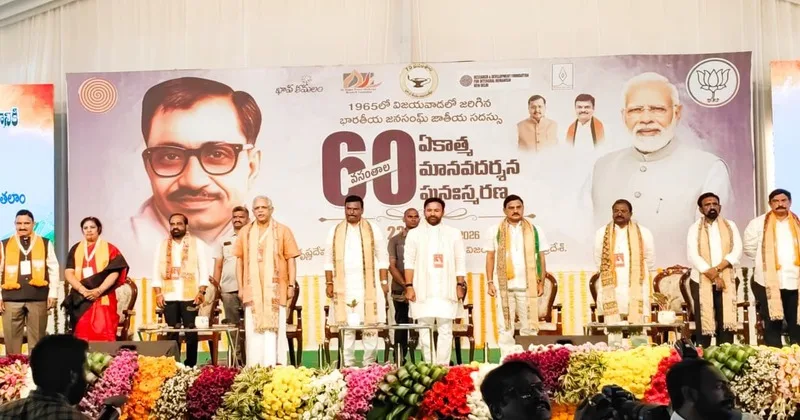
VIJAYWADA: The Ekātma Mānav Darshan Recollection Meeting, marking the historic 12th National Conference of the Bharatiya Jana Sangh held in Vijayawada in 1965, commenced on January 23 with a renewed focus on Integral Humanism as a philosophy aimed at the development of all sections of society and as a guiding framework for India’s present and future.
The inaugural session was attended by a large gathering, with senior leaders and office-bearers present on the dais, including BJP State President PVN Madhav, Union Minister Kishan Reddy, Union Minister of State Bhupathiraju Srinivasa Varma, BJP National General Secretary (Organisation) BL Santosh, State Health Minister Satya Kumar, MPs, MLAs, MLCs, Morcha presidents, state office-bearers, and party functionaries.
Delivering the presidential address, PVN Madhav said that merely preaching principles does not make the world beautiful, and that ideals yield results only when practised, quoting Atal Bihari Vajpayee’s poetry. He said the unveiling of Vajpayee’s statue evokes a deep emotional and spiritual experience.
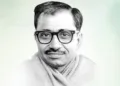
Recalling the ban on the RSS in 1948, he said the response to questions raised by Sardar Patel on its ideology eventually took the shape of Integral Humanism, rooted in the thoughts of Pandit Deendayal Upadhyaya and crystallised by 1965. He traced the process through which the resolution was introduced, debated, and adopted, followed by extensive discussions with karyakartas and its eventual acceptance at the All-India Jan Sangh Meeting, 65 years ago.
In the years that followed, Integral Humanism became a subject of discussion across India and abroad. He said successive governments led by Atal Bihari Vajpayee and Narendra Modi have taken these ideas forward.
He also explained the historical significance of naming the venue Sri Krishnadevaraya Nagar, linking it to Emperor Sri Krishnadevaraya’s association with Vijayawada and his coronation on January 23, 1510.
Addressing the gathering, Kishan Reddy described the land where the 1965 conference was held as sacred and termed the day auspicious, coinciding with Netaji Subhas Chandra Bose’s birth anniversary, observed as Parakram Diwas.
He said Western ideologies such as Capitalism, Socialism, and Communism were imposed on India after Independence, despite being incompatible with the country’s civilisation. He said Pandit Deendayal Upadhyaya presented Integral Humanism as an indigenous alternative suited to India and the world.
Noting that many Capitalist and Communist countries are facing crises, he said Prime Minister Narendra Modi has, over the past 12 years, practised Integral Humanism as a permanent solution to national problems. He explained that the philosophy defines Dharma Rajya as rule of law, balances individual freedom with social responsibility, promotes decentralisation, rejects exploitation, and ensures that development benefits reach all.
He detailed Antyodaya-oriented initiatives taken by PM Modi including free food grains for 81 crore people, Swachh Bharat, drinking water supply, housing for four crore people, Mudra loans, Jan Dhan accounts, Ayushman Bharat, Digital India, scholarships, reservations, support for persons with disabilities, women’s welfare programmes, and social justice measures, stating that Antyodaya represents a dignified life for the last person.
Address by BL Santosh
In his address, BL Santosh described Integral Humanism as the foundational principle of India’s holistic identity. He called upon society to free itself from intellectual slavery, avoid blind imitation of Western models, and embrace Bharatiyata rooted in Dharma. He said no civilisation can survive without Dharma and that Indian ethos alone ensures universal welfare.
Senior RSS functionary Ram Madhav said India is poised to provide new direction to the world amid a global crisis and warned against ideology-less politics. He said Deendayal Upadhyaya’s principles guide India’s journey towards a Viksit Bharat, including in foreign policy and defence preparedness.
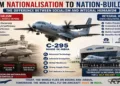
Defence expert and government adviser Satish Reddy spoke on post-2014 transformations in India’s defence sector, citing progress in indigenous manufacturing, exports, research, and global standing. He narrated the growth of defence capabilities in the last decade after a lull and dependence on Western countries for our defence, and the idea journey of Make in Bharat, Atma Nirbarata and now Make for world, where our exports are bound to make key global partner.
Key events
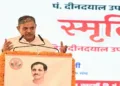
Union Minister Kishan Reddy unveiled a full-length statue of Pandit Deendayal Upadhyaya. Veterans who participated in the 1965 conference were felicitated. A souvenir commemorating the 1965 Jan Sangh conference and a special 60 Years of Jagruti edition were released. Floral tributes were offered to the statues of Sri Krishnadevaraya and Subhas Chandra Bose.
BL Santosh also inaugurated a photo exhibition showcasing delegates, speakers, and karyakartas of the 1965 conference, along with contemporaneous reports from Jagruti, organised by BJP State Secretary Bhogireddy Adilakshmi.
The attendees of this conference include, Union Minister of State Bhupathiraju Srinivasa Varma, State Health Minister Satya Kumar, BJP MPs Daggubati Purandeswari, CM Ramesh, Paka Venkata Satyanarayana, MLC Somu Veerraju, BJP MLAs Penmetsa Vishnu Kumar Raju, Y Sujana Chowdary, Adinarayana Reddy, Dr PV Parthasarathi and others.
The BJP State General Secretaries Ramesh Naidu, Dayakar Reddy, Mattaprasad, Lakshmi Prasanna, BJP State General Secretary (Organisation) Madhukarji, Vice-Presidents Garapati Sitaramajaneya Chowdary, OBC Morcha State President Vangala Gopi Srinivas, Kisan Morcha State President Chigurupati Kumaraswamy, Minority Morcha President Syed Basha, SC Morcha State President Panatala Suresh, Mahila Morcha State President Nishita Raj, Yuva Morcha State President Sunil Kumar Reddy, BJP State Spokesperson Jayaprakash Narayan, Programme Committee Convener Pathuri Nagabhushanam, Media In-Charge Kilar Dileep, and others participated.