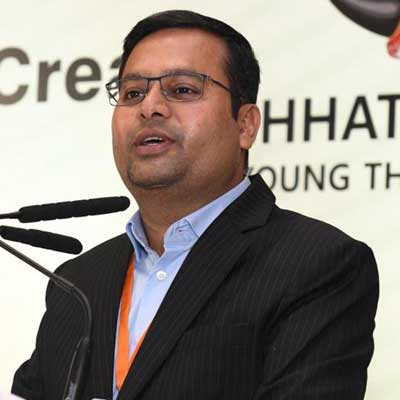

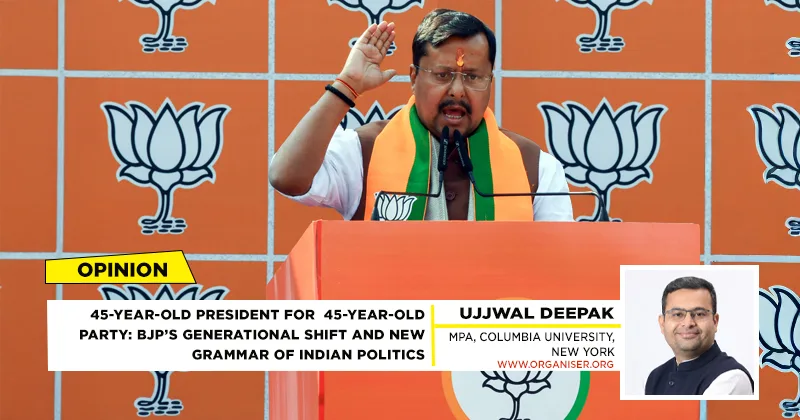
January 20, 2026, marks more than an organisational election in Indian politics. It is a clear political statement on leadership, age, and future vision. In the 45th year of its existence, the Bharatiya Janata Party, the world’s largest political party, has elected 45-year-old Nitin Nabin as its national president through a fully democratic process. The symbolism is striking, but the message is substantive. Leadership is not about longevity alone, but about readiness for the future!
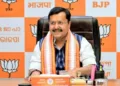
Nitin Nabin is a five-time legislator who has handled significant organisational responsibilities across Bihar, Chhattisgarh, and other states. He belongs to that rare category of leaders whose work precedes their visibility. His style has been understated, collaborative, and sharply outcome-oriented, a “low-profile, high-impact” approach where results matter more than rhetoric. His elevation reinforces a core BJP belief. Merit, organisational commitment, and performance outweigh pedigree or proximity to power.
Founded in 1980, the BJP’s political journey over 45 years has been defined by three consistent pillars. Ideological clarity, organisational discipline, and electoral competitiveness. Selecting a 45-year-old president in its 45th year reflects a deeper institutional confidence that age is not a constraint but a complement to capability. More importantly, it signals a willingness to embrace leadership transition in time, rather than deferring it until compelled by crisis.
This approach contrasts sharply with the leadership culture of the Indian National Congress. In the Congress, the post of party president has largely remained confined to the Gandhi family or to those deriving authority from proximity. Leadership change has often followed electoral setbacks or internal turbulence, not long-term institutional planning. The BJP, by comparison, presents leadership renewal as a continuous, structured process. This difference is increasingly visible to a discerning electorate.
The political significance of this transition was underscored by Prime Minister Modi during the event. “I am still a BJP worker, and from today, Nitin Nabin Ji is my Boss”. The remark was not merely rhetorical humility. It encapsulated the BJP’s worker-centric culture, where positions are subordinate to the organisation, and authority flows through discipline rather than personality. For millions of party workers, the message was unambiguous: hierarchy does not override collective ethos.
Prime Minister Modi began his address by paying tribute to the 75-year ideological and organisational journey of the Jana Sangh. He noted that through decades of sacrifice and dedication, that ideological seed had grown into the BJP, now the largest political party in the world. This framing is central to the BJP’s self-understanding. Politics, in this view, is not merely about electoral arithmetic, but about long-term nation-building rooted in ideas.
Placing the current transition in historical continuity, the Prime Minister recalled recent milestones. The 125th birth anniversary of Dr Syama Prasad Mukherjee, the centenary of Atal Bihari Vajpayee, and the 100 years of the Rashtriya Swayamsevak Sangh. These references were not ceremonial. They were reminders of an ideological lineage that has shaped the party’s evolution from the margins to the mainstream.
The BJP’s leadership arc itself tells a story of institutional depth. From Atal Bihari Vajpayee, L.K. Advani, and Murli Manohar Joshi, who anchored ideology and nationalism, to organisational builders like Venkaiah Naidu and Nitin Gadkari, the party steadily expanded its footprint. Under Rajnath Singh, it secured power with a full majority for the first time. Amit Shah then oversaw an unprecedented organisational expansion and electoral consolidation. In recent years, J.P. Nadda strengthened the party’s presence from panchayats to Parliament.
Nitin Nabin now inherits this layered legacy. His challenge is not to replace it, but to carry it forward in a changed political environment. This is where generational context matters. Describing him as a representative of the millennial generation, PM Modi observed that he belongs to a cohort that grew up with radio and now operates in the age of artificial intelligence. The remark neatly captured the BJP’s current balancing act, blending experience with technological fluency.
Contemporary politics is increasingly shaped by digital communication, social media narratives, real-time feedback, and data-driven decision-making. Electoral mobilisation today is as much about WhatsApp groups and analytics dashboards as it is about physical rallies. Nitin Nabin’s organisational work so far suggests an ease with this new grammar of politics, without abandoning the party’s traditional emphasis on cadre-building.
This leadership transition also coincides with a larger national context. Under Prime Minister Modi’s leadership, the government has articulated the ambition of a “Viksit Bharat” by 2047. Achieving that goal will require not just policy continuity, but robust political organisation capable of sustaining reform momentum. Nitin Nabin’s elevation is therefore being read as part of a longer roadmap, one that looks beyond the next election cycle to the next two decades.
The contrast with the Congress becomes sharper here. The question before India’s oldest party is no longer merely electoral relevance, but organisational credibility. Will it institutionalise internal democracy? Will it genuinely empower younger leaders? Or will leadership remain confined within a narrow familial structure? Today’s voter compares these choices. The distinction between future-oriented politics and nostalgia-driven politics is no longer subtle.
The BJP’s political evolution rests on a clear division of labour. A legacy of organisation-building combined with a contemporary focus on technology, youth aspirations, and outcome-based governance. Nitin Nabin represents this convergence. His selection signals that leadership in the BJP is dynamic, not frozen, evolutionary, not hereditary.
Ultimately, a 45-year-old president for a 45-year-old party sends a larger message to Indian politics. Leadership is no longer defined by age alone, but by vision, adaptability, and institutional trust. In a country where more than half the population is under 35, this signal matters.
Concluding his address, PM Modi underlined the BJP’s ideological consistency. Presidents may change, he said, leadership may evolve, but ideas and direction remain constant. The BJP, he argued, is not merely a political party but a culture, one that values relationships and commitment over formal membership.
Seen in this light, Nitin Nabin’s election is not an isolated organisational event. It is part of a longer story that began with the Jana Sangh, matured through decades of political struggle, and is now adapting itself to a generational shift. The BJP’s ability to combine continuity with change remains its defining strength and perhaps its most enduring political advantage.