
Communists have long displayed an intolerance towards unifying forces, whether in the form of a song or a slogan, and this pattern was once again repeated in Kerala, where a patriotic song, “Paramapavithramamee Mannil Bharataambaye Poojikkaan”, was disrupted after being branded an RSS song and ordered to be stopped, exposing the selective and intolerant approach of those who otherwise claim to champion freedom of expression.
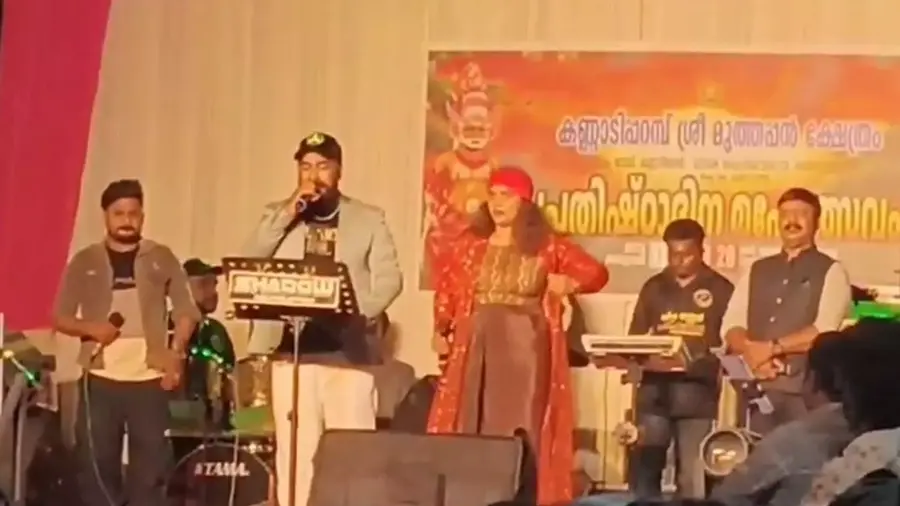
CPM and DYFI goons attempted to disrupt an orchestra organised in connection with a temple festival in Kannur district, an area where the CPM’s strongest party unit under the Kerala state committee prevails. The orchestra was organised on January 19 as part of the festival at Shree Muthappan Temple in Kannadipparambu, Kannur. The performance was rendered by the Patt Family Orchestra troupe from Thrissur.
During the orchestra, a demand for patriotic songs arose from the audience. Accordingly, the singers performed the well-known patriotic song “Paramapavithramamee Mannil Bharataambaye Poojikkaan”. Midway through the song, DYFI–CPM goons climbed onto the dais and asked the singers to stop. When the troupe refused to comply, another individual joined them on the dais. By then, members of the audience intervened, resisted the high-handedness of the CPM workers, and forced them to retreat, leaving the venue peacefully.
Subsequently, CPM and DYFI alleged that the song was meant to praise the RSS and claimed it was part of a Sangh Parivar agenda.
In doing so, they attempted to conceal the fact that the song is not about the RSS but about Bharatmata, and that it is a widely accepted patriotic composition.
They further argued, rather absurdly, that since the programme was organised using public contributions, the agenda of “one section” could not be imposed.
Significantly, the CPM mouthpiece Deshabhimani carried the report on January 20, claiming that CPM cadres had protested against an “RSS song” by climbing onto the dais. Ironically, these are the same individuals who repeatedly proclaim themselves defenders of freedom of expression.
The incident also brings back memories of the controversy created by the so-called “Left comrades”, Congress general secretary K.C. Venugopal, and Kerala’s Leader of the Opposition V.D. Satheesan, over the rendition of the same patriotic song aboard the Vande Bharat Express by students of Saraswathi Vidyaniketan Senior Higher Secondary School, Kochi.
This incident occurred on November 8 2025, during the inaugural ceremony of the Kochi–Bengaluru Vande Bharat at Ernakulam Railway Station, which was flagged off by the Prime Minister from Varanasi Railway Station.
As soon as the rendition was shared on the X handle of Southern Railway, both the ruling CPM-led Left Democratic Front (LDF) and the opposition Congress-led United Democratic Front (UDF) launched a coordinated attack on the children, the Railways, the BJP, and the RSS.
Even the Kerala Chief Minister’s X handle stated that the rendition of the patriotic song violated constitutional principles, claiming that the song belonged to an “organisation known for its communal ideology and hate-mongering”. He further opined that democratic and secular forces must unite to resist what he termed a dangerous move.
General Education Minister and CPM leader V. Sivankutty announced that he had instructed the Director of Public Instruction to conduct a probe and submit a report. DYFI issued a statement echoing Chief Minister Pinarayi Vijayan’s views, while Higher Education Minister R. Bindu followed suit.
However, interestingly, no government official has initiated any enquiry into the matter. Even a primary school student studying in a CBSE institution would know that the state government has no locus standi in the functioning of a CBSE school.
The song rendered during the Kannur temple festival on January 19 was the same one sung by the students earlier:
Paramapavithramamee mannil
Bharathambaye poojikkan
Punyavaahinee sevanamekum
Poonkaavangal undivide…
The song narrates the geography of Bharat and pays tribute to social reformers and spiritual leaders such as Vivekananda, Aurobindo, Sree Narayana Guru, Bhagat Singh, Rani Lakshmibai of Jhansi, Sree Ramakrishna, Samartha Ramadas, and others. It also refers to the divine rivers that nourish the land, the flowers and gardens sustained by them, and the idea of unity in diversity. Notably, it does not mention any religion, caste, or political party. It is entirely positive, without a trace of negativity.
Both incidents ultimately convey a single message: the consistent Communist and Congress policy of opposing anything that is patriotic or nationalistic.