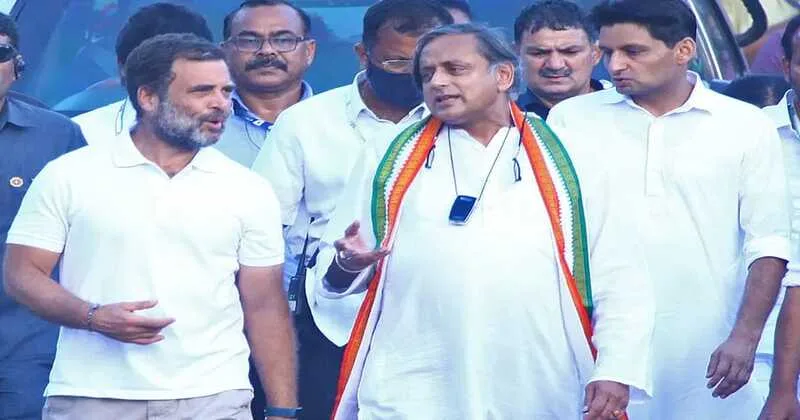
Kochi: The ‘Maha Panchayat’ held in Kochi has become the stage for a dramatic political episode that has raised serious questions about the future of Shashi Tharoor within Kerala’s Congress politics. Despite being a member of the Congress Working Committee, Tharoor found himself at the centre of an unexpected controversy after Lok Sabha Opposition Leader Rahul Gandhi, while addressing the gathering, named all prominent leaders seated on the stage, except Tharoor. Adding to the drama, Tharoor left the stage in protest before Rahul Gandhi returned. This conspicuous omission has sparked intense discussion in political circles, with many interpreting it as a deliberate snub. The question now being widely asked is whether Rahul Gandhi has sent a clear political message that Tharoor has no significant place in the Congress’s Kerala strategy.
The episode has gained further significance because it follows closely on the heels of a contrasting development in Wayanad. Just days earlier, AICC General Secretary K.C. Venugopal had lavishly praised Tharoor at a conclave there, creating an impression of unity and growing acceptance of Tharoor within the party’s Kerala leadership. However, the reception that awaited Tharoor in Kochi was starkly different. Unlike leaders such as K.C. Venugopal, Ramesh Chennithala, and Adoor Prakash, Tharoor neither received comparable attention nor was he given a visible role in the proceedings. Instead, he appeared to be strategically sidelined, a move that angered him and shocked his supporters.
Rahul Gandhi’s apparent coldness towards Tharoor came at a time when the Congress leadership was trying to project a message of unity among Kerala leaders. This contradiction has only intensified speculation. Many within the party believe that the events in Kochi revealed the existence of a faction within the Congress high command that is opposed to Tharoor’s growing influence. According to political observers, Rahul Gandhi’s conduct suggested that the so-called Rahul faction is not inclined to accommodate Tharoor in the political equation in Kerala. Controversy has also erupted over the role played by Deepa Das Munshi, the high command’s representative at the event. Tharoor was reportedly instructed that “only Rahul Gandhi will speak after he arrives.” Acting on this directive, Tharoor began his speech before Rahul reached the venue and concluded it as soon as Rahul arrived on stage. However, what followed surprised everyone present. Despite Rahul already being on stage, K.C. Venugopal, former opposition leader Ramesh Chennithala, and Lok Sabha MP Adoor Prakash were allowed to address the gathering. This sequence of events has reinforced the belief that Tharoor was deliberately denied space and that the move was carefully choreographed to humiliate him publicly.
Adding to the sense of insult was Rahul Gandhi’s apparent disinterest in hearing Tharoor speak. The matter became even more glaring when Rahul, in his address, mentioned the names of all major leaders, from the KPCC president to all leaders, while pointedly ignoring Tharoor, who was seated right next to him. For Tharoor’s supporters, this could not have been an oversight. They argue that such an omission, especially involving a Congress Working Committee member, was too significant to be accidental.
Many believe that the leaders who had publicly backed Tharoor in Wayanad effectively abandoned him in Kochi as part of a carefully scripted political move. Political observers suggest that Rahul Gandhi himself has now directly indicated that Tharoor will not be given a major role in Kerala’s political future. These developments have come as a major shock to Tharoor’s camp, which had begun to feel optimistic after the warm reception he received in Wayanad. It remains to be seen whether Tharoor has fully realised that those who once praised him may have quietly turned against him.
The stand taken by Rahul Gandhi at the Maha Panchayat Sangam in Kochi is increasingly being interpreted as a clear warning that Tharoor does not enjoy a central place in Kerala’s Congress politics. The contrast between the enthusiastic reception in Wayanad and the chilly treatment in Kochi has stunned Tharoor’s fans and supporters alike. Rahul’s silence on Tharoor’s name, despite mentioning everyone else on stage, stood out as the most telling moment of the event. Tharoor’s camp firmly believes that this was not a simple slip of the tongue but a calculated move influenced by a section of Kerala leaders who feel threatened by his rising stature. They argue that these leaders may have used their proximity to Rahul Gandhi to shape his stance against Tharoor. This has led to a growing perception that internal power struggles, rather than ideological differences, are driving the current cold war within the party.
The key question now is whether K.C. Venugopal’s glowing praise of Tharoor in Wayanad was merely a smokescreen. The same leaders who applauded him there appeared to deny him basic political courtesy in Kochi. Many feel that attempting to publicly sideline a globally respected leader like Tharoor on a relatively small political stage in Kerala could soon become a national controversy. Already, Tharoor’s supporters are staging strong protests over the incident, warning that the party leadership may have underestimated the political and symbolic fallout of what happened in Kochi.