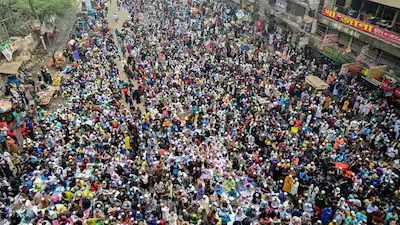
The four-day Biswa Ijtema, one of the world’s largest Islamic congregations, concluded on January 5 at Puinan village near West Bengal’s Hooghly district. The gathering marked the event’s return to India after 34 years, the last such congregation having been held in Howrah’s Nibra area in 1992.
According to an exclusive report by News18, the scale and timing of the congregation, held just months ahead of the West Bengal Assembly elections, triggered heightened scrutiny from central intelligence and security agencies. Officials expressed concern over the potential misuse of such a massive international gathering for ideological indoctrination and clandestine networking.
Sources told News18 that the Biswa Ijtema was shifted to West Bengal after the traditional main congregation in Bangladesh was suspended due to political instability, election-related restrictions, and violent factional clashes within the organising groups.
The Mamata Banerjee-led Trinamool Congress government facilitated the event’s return, with Chief Minister Mamata Banerjee personally overseeing preparations. High-level meetings were held at the state secretariat Nabanna, with directives issued to complete arrangements on a “war footing.”
Senior ministers Firhad Hakim and Siddiqullah Chowdhury were tasked with supervising healthcare services, sanitation, crowd management, and cyber monitoring, underscoring the state government’s direct involvement.
Despite the event concluding with the traditional Akheri Munajat, a final prayer for peace and global harmony, intelligence agencies remain uneasy. According to top intelligence sources cited by News18, such congregations have historically been exploited by extremist elements to identify, influence, and recruit vulnerable individuals.
The agencies pointed to past instances where former members associated with the Tablighi Jamaat later surfaced in banned or radical outfits such as the Popular Front of India (PFI) and Jamaat-e-Islami, deepening apprehensions about ideological spillover.
A major red flag, sources said, was the presence and sermons of Maulana Saad Kandhalvi, a controversial cleric associated with the Nizamuddin Markaz faction of the Tablighi Jamaat. Intelligence inputs accessed by News18 indicate that Kandhalvi’s participation had earlier been restricted in Bangladesh due to concerns over extremism and factional disputes.
Kandhalvi, based in Delhi’s Nizamuddin area, also has an FIR registered against him during the Covid-19 lockdown period. Intelligence officials believe his involvement could amplify radical narratives and exacerbate tensions between rival factions of the Tablighi Jamaat operating across South Asia.
Security agencies have also flagged the venue’s proximity to the porous India–Bangladesh border as a major vulnerability. According to central intelligence assessments cited by News18, the region has previously been used by ISI-backed extremist outfits including Jamaat-ul-Mujahideen Bangladesh (JMB), Harkat-ul-Jihad al-Islami (HuJI), Ansarullah Bangla Team (ABT), and Hizb-ut-Tahrir (HuT).
Border districts such as Murshidabad and Malda, identified as sensitive zones with active sleeper cell networks, were placed under enhanced surveillance during the congregation.
With Assembly elections expected in March-April, intelligence officials believe the congregation also carried political messaging. Sources indicated that allowing the event was seen as a move by the state government to project minority outreach and welfare commitment.
However, they cautioned that such political signalling must be balanced against long-term national security considerations, especially in a border state with a documented history of cross-border radical networks.
Although no immediate security breach was reported during the event, central agencies have maintained a heightened alert even after the congregation’s conclusion. Officials told News18 that post-event monitoring of attendees, funding trails, and digital communications remains underway to assess any delayed security fallout.