

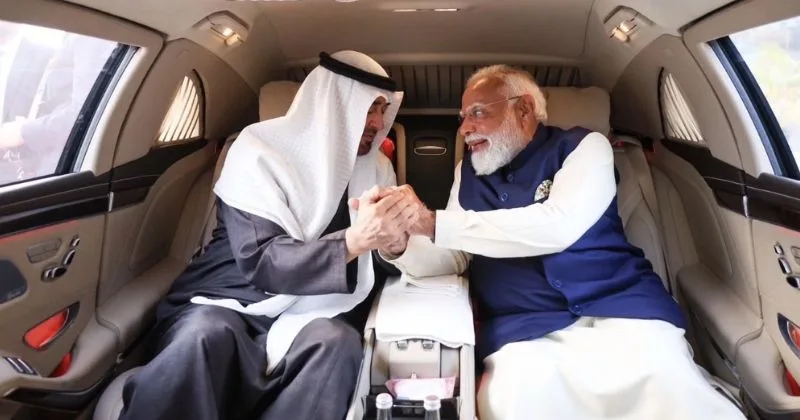
New Delhi: President of the United Arab Emirates (UAE) Sheikh Mohamed bin Zayed Al Nahyan’s visit to India and his meeting with Prime Minister Modi, both in India and abroad, are not unusual. Here and abroad isn’t unusual. Bilateral talks between the UAE and India are viewed against the backdrop of a series of senior-level exchanges over the past two years. India regards the UAE as a key strategic partner in West Asia. However, what excites today’s Sheikh Mohamed bin Zayed Al Nahyan-Modi meeting is the duration of the stopover the UAE president is taking in India and his meeting with PM Modi.
Meanwhile, Social media is abuzz over the short duration of the visit, with many interpreting the less than two-hour window from landing to departure as a sign that this was not a routine diplomatic engagement. Such tightly compressed schedules at the head-of-state level are rare and deliberate. The meeting with Narendra Modi is therefore being seen as driven by urgency rather than ceremony, which they attribute to the Iran crisis and geopolitical developments, indirectly suggesting that Al Nahyan has something ‘very urgent’ to communicate to the Indian PM.
Sheikh Mohamed bin Zayed Al Nahyan – PM Modi Meet- Duration that can go into History..
Al Nahyan landed in Delhi at 4:20 pm, met Prime Minister Narendra Modi at 4:45 pm, and departed by 6:05 pm, making the visit less than two hours from touchdown to take-off. Sheikh Nahyan’s visit to India comes amid serious instability in the Middle East. Relations between Iran and the United States have sharply worsened, tensions between Saudi Arabia and the UAE continue over Yemen, and the political situation in Gaza remains uncertain and troubling.
Social media abuzz over Zayed Al Nahyan–PM Modi meeting duration
“UAE’s Mohamed bin Zayed Al Nahyan lands in New Delhi at 4:20 pm, meets Narendra Modi at 4:45 pm, and departs at 6:05 pm. Do the maths. From touchdown to take-off, one hour and forty-five minutes. This is not a working visit in the conventional sense. This is a stopover with purpose. Maybe a signal.” posts Sonam Mahajan on her X handle.
She adds, “Presidents do not cross the Arabian Sea for photo-ops that can be handled by foreign ministers. A stopover this compressed points to urgency, alignment, or both. Context matters. West Asia is tense, Saudi-UAE frictions are out in the open, and regional power equations are shifting.”
UAE’s Mohamed bin Zayed Al Nahyan lands in New Delhi at 4:20 pm, meets Narendra Modi at 4:45 pm, and departs at 6:05 pm. Do the maths. From touchdown to take-off, one hour and forty-five minutes. This is not a working visit in the conventional sense. This is a stopover with…
— Sonam Mahajan (@AsYouNotWish) January 19, 2026
What could be the reason behind the brief visit, and how are diplomats interpreting it?
Such a short visit by a head of state is unusual, given that discussions typically focus on long-term issues. The timing is therefore considered significant, particularly amid rising tensions in West Asia and shifting relationships among major Gulf countries. UAE–India talks are also analysed in the context of developments involving Iran, Israel, Saudi Arabia, and Red Sea security. In this setting, the UAE’s outreach to India is seen as recognition of India’s balancing role- a country that maintains working ties across rival blocs without appearing partisan.
Indian media and policy circles closely watch the timing and duration of high-level visits. Short meetings between leaders are seen as deliberate and meaningful. They often indicate urgency or coordination, not routine diplomacy.
In India, UAE–India talks are not viewed as regular foreign visits. They are seen as signs of India’s growing importance in West Asia and the UAE’s confidence in New Delhi during uncertain regional conditions.