Using mobile connectivity to tackle cattle accidents on highways
June 9, 2026
  • Read Ecopy
  • Circulation
  • Advertise
  • Careers
  • About Us
  • Contact Us
Android AppiPhone AppArattai
Organiser
  • ‌
  • Bharat
    • Assam
    • Bihar
    • Chhattisgarh
    • Jharkhand
    • Maharashtra
    • View All States
  • World
    • Asia
    • Europe
    • North America
    • South America
    • Africa
    • Australia
  • Editorial
  • International
  • Opinion
  • RSS @ 100
  • More
    • Op Sindoor
    • Analysis
    • Sports
    • Defence
    • Politics
    • Business
    • Economy
    • Culture
    • Special Report
    • Sci & Tech
    • Entertainment
    • G20
    • Azadi Ka Amrit Mahotsav
    • Vocal4Local
    • Web Stories
    • Education
    • Employment
    • Books
    • Interviews
    • Travel
    • Law
    • Health
    • Obituary
  • Subscribe
    • Subscribe Print Edition
    • Subscribe Ecopy
    • Read Ecopy
  • ‌
  • Bharat
    • Assam
    • Bihar
    • Chhattisgarh
    • Jharkhand
    • Maharashtra
    • View All States
  • World
    • Asia
    • Europe
    • North America
    • South America
    • Africa
    • Australia
  • Editorial
  • International
  • Opinion
  • RSS @ 100
  • More
    • Op Sindoor
    • Analysis
    • Sports
    • Defence
    • Politics
    • Business
    • Economy
    • Culture
    • Special Report
    • Sci & Tech
    • Entertainment
    • G20
    • Azadi Ka Amrit Mahotsav
    • Vocal4Local
    • Web Stories
    • Education
    • Employment
    • Books
    • Interviews
    • Travel
    • Law
    • Health
    • Obituary
  • Subscribe
    • Subscribe Print Edition
    • Subscribe Ecopy
    • Read Ecopy
Organiser
  • Home
  • Bharat
  • World
  • Operation Sindoor
  • Editorial
  • Analysis
  • Opinion
  • Culture
  • Defence
  • International Edition
  • RSS @ 100
  • Magazine
  • Read Ecopy
Home Bharat

Using mobile connectivity to tackle stray cattle accidents on highways: A real time initiative of NHAI

Indian highways has witnessed accidents caused by stray cattle, especially in low-visibility conditions. To address this persistent risk, a pilot initiative now uses real-time mobile alerts to warn drivers in advance, shifting road safety efforts from reactive response to timely prevention

Vivek KumarVivek Kumar
Jan 18, 2026, 06:30 pm IST
in Bharat, Technology, Sci & Tech
Follow on Google News
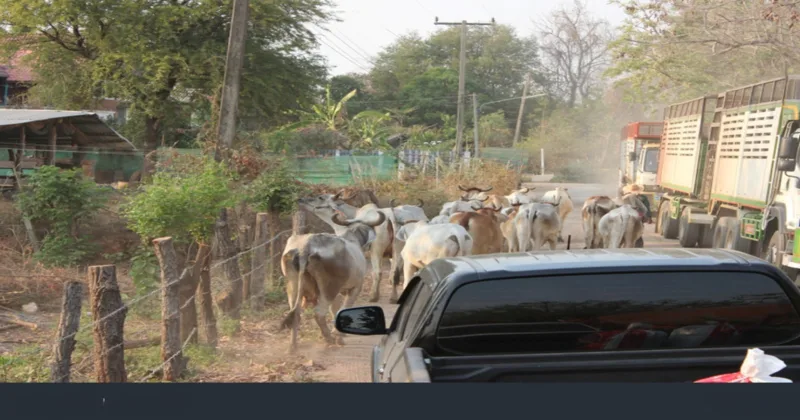
Representative Image

Representative Image

FacebookTwitterWhatsAppTelegramEmail

The highways of India are a lifeline of economic and social mobility, with many millions of vehicles a day on them. Along with the multiple documented problems of traffic congestion and climate extremes, there is one particular risk that is unique to India had continued to be a challenge is of the cattle movement on high-speed roads, leading to deadly accidents. It is in this context that a new pilot initiative using real time mobile alerts has been launched, as a practical response to a recurring safety problem documented over years of accident data.

Why this intervention was needed

Stray cattle on highways are not a marginal issue. In several northern and western states, especially Rajasthan and Haryana, highways cut through agrarian and semi-urban belts where cattle movement is part of daily life. During foggy winter months or low visibility conditions, the risk multiplies at exponential rate. In majority of cases motorists suffers the accident with animals at a late stage, which makes motorists impossible for them to apply brake, thus resulting in crashes, vehicle pile up also lead to secondary crashes. The problem has been tackled using signposts, barriers and police patrols, though its not comprehensively applied in long sections where the grazing pattern is unpredictable.

The need was for a system that could warn drivers before they entered a high risk zone, giving them time to slow down and stay alert. This is the rationale behind the pilot launched during Road Safety Month 2026 by National Highways Authority of India in collaboration with telecom service providers. Instead of relying only on static infrastructure, the initiative uses mobile connectivity to reach drivers directly in real time.

How this pilot projects work

The pilot is currently operational on the Jaipur-Agra and Jaipur-Rewari highway corridors, stretches identified as prone to stray cattle movement based on historical accident records and field level assessments. Drivers approaching these zones receive a location based Flash SMS around 10 km in advance, followed by a voice alert in Hindi warning them of a cattle prone stretch ahead. To avoid alert fatigue, the system ensures that repeat messages are not sent to the same user within a 30 minute window.

It is important to acknowledge the fact that the warnings are not mass messages but are triggered only when people are in the mapped high risk area and hence the warning is appropriate and in time. This requires special support from the telecom infrastructure and in the case of Reliance Jio, it is ready to support the entire country in case there is expansion of the pilot initiative.

Do other countries use similar services?

Globally several countries have adopted animal warning systems, but their context is different. In the United States and Canada, electronic signboards and sensors are utilized in wildlife corridors that notify drivers of deer or moose crossings. Scandinavian nations have utilized infrared sensors and roadside sensors that detect large animals such as elk. Australia uses dynamic signboards that notify drivers in areas that are prone to kangaroos.

These systems are predominantly infrastructure intensive and site specific. They require sensors, cameras or fixed electronic displays, which are quite expensive to establish and maintain throughout the extensive network of highways. This application has been tailored to wildlife crossing points where the population density is high and this does not represent the human wildlife coexistence paradigm.

Also Read: Idea of Longevity or Healthy Ageing: From Indian traditional knowledge to present Research

What makes India’s approach unique

India’s pilot stands out because it leverages an asset already in the hands of most highway users the mobile phone. In contrast to having to wait for the drivers to be aware of the signpost through the signboard in conditions of fog or darkness, the alert message reaches the driver in the handset. It is made accessible using Flash SMS and phone calls.

One of the notable features of the project is the implementation of historical accident data alongside ground level inputs for mapping the accident prone areas for the cattle. The data based identification enables the project to concentrate on the particular sections of the highway where the danger is actual, as opposed to the entire highway being treated as one area. The project demonstrates awareness of behavioral safety, as the messages are restricted in frequency to ensure the audience does not get a chance to dismiss the alert.

In policy terms, this pilot initiative complements the Indian government effort to embrace intelligent transport systems that improve safety with minimal burden on citizens. It also demonstrates how public infrastructure agencies and private telecom operators can collaborate for a clear public good.

The road ahead

The pilot’s outcomes will determine whether the system is scaled up to other cattle prone corridors across the country. If successful it could work in conjunction with other methods, rather than displacing them such as fences, lighting and enforcement. Most importantly, it counteracts a local and pervasive danger in an appropriate and adapted manner.

In doing so the initiative marks a shift from reactive accident response to preventive road safety quietly, without exaggeration but with the potential to save lives on highways where a few seconds of warning can make all the difference.


Topics: Mobile AlertPrecautionRoad SafetyTechnologycattleHighways
ShareTweetSendShareSend
✮ Subscribe Organiser YouTube Channel. ✮
✮ Join Organiser's WhatsApp channel for Nationalist views beyond the news. ✮
Previous News

Assam: 35 kilometers elevated corridor in Kaziranga National Park; PM Modi performs Bhoomi Pujan for Rs 6,950Cr project

Next News

Viksit Bharat Young Leaders Dialogue 2026: A defining moment in India’s youth-led nation building

Related News

Representative Image

Indian scientists embed nano-gold in ultra-thin films; Opening new frontiers in self-powered wearable technologies

The Hague [Netherlands], May 16 (ANI): Prime Minister Narendra Modi and Prime Minister of the Netherlands Rob Jetten during the repatriation ceremony of the 11th-century Chola Copper Plates being returned to India from the Netherlands, in The Hague on Saturday. (@narendramodi X/ANI Photo)

Five-Nation Visit: India and Netherlands elevate ties to strategic partnership in trade, tech and defence

Representative Image

Bharat’s tech future will be defined by AI, semiconductors and Nari Shakti

Representative Image

Radiant Dawn of Atmanirbhar Bharat: From the shores of Keralam to the reactors of Tamil Nadu’s Kalpakkam

Delhi expands ICT infrastructure in schools, upgrade 376 ICT labs, add 31 new digital labs in government schools

Prime Minister Narendra Modi and Austria Chancellor Christian Stocker

India & Austria forge trade, technology & defence pact; Leaders condemn Pahalgam & Red Fort terror attack

Load More

Latest News

Union Defence Minister Rajnath Singh

Uttar Pradesh: Defence land goes green; Rajnath Singh clears 250 MW solar project in Sitapur

Afghanistan Foreign Minister Amir Khan Muttaqi and External Affairs Minister Dr. S. Jaishankar(File Photo)

India extends gratis long-term business visas to Afghan traders; Slams Pakistan for “trade & transit terrorism”

How Modi's Zero-tolerance doctrine reshaped India's anti-terror policy (This is an AI generated image)

Twelve Years of Modi Government and the rise of India’s zero-tolerance doctrine against terrorism

Press Conference organised by Janjati Suraksha Manch at the Press Club, Ranchi, National Convener Dr Raj Kishore Hansda

Success of Janjati Sanskritik Samagam symbolises unity and cultural pride: Dr Raj Kishore Hansda

India delivered a historic performance at the inaugural World Yogasana Championships, finishing at the top of the medal tally with an astounding 114 medals, including 102 golds

World Yogasana Championships: India scripts historic triumph with 114 medals and 102 gold medal wins

Protest erupts in POJK

Why is PoJK protesting? JAAC ban, anti-Pakistan slogans and public anger against Pakistan Army — Read here

India slams Pakistan over its Fatna al Hindustan narrative

India tears Pakistan at UN over ‘Fitna al Hindustan’ narrative; Exposes Islamabad as an ‘organised factory of hate’

India's Permanent Representative to United Nations Ambassador Harish Parvathaneni

India & Afghanistan are “civilisational states”: Indian Envoy at UN reaffirms health, education & humanitarian aid

Bulldozer action on houses linked to drug traffickers in Rourkela's Meenapada area

Odisha: Major crackdown on drug traffickers in Rourkela; Bulldozers demolish houses of Farida, Imran & other accused

Prime Minister Narendra Modi with Agri Minister Shivraj Singh Chouhan

India’s Agricultural Revolution: Rising output, record procurement and expanding farmer support since 2014

Load More
  • Privacy
  • Terms
  • Cookie Policy
  • Refund and Cancellation
  • Delivery and Shipping

© Bharat Prakashan (Delhi) Limited.
Tech-enabled by Ananthapuri Technologies

  • Home
  • Search Organiser
  • Bharat
    • Assam
    • Bihar
    • Chhattisgarh
    • Jharkhand
    • Maharashtra
    • View All States
  • World
    • Asia
    • Africa
    • North America
    • South America
    • Europe
    • Australia
  • Editorial
  • Operation Sindoor
  • Opinion
  • Analysis
  • Defence
  • Culture
  • Sports
  • Business
  • RSS @ 100
  • Entertainment
  • More ..
    • Sci & Tech
    • Vocal4Local
    • Special Report
    • Education
    • Employment
    • Books
    • Interviews
    • Travel
    • Health
    • Politics
    • Law
    • Economy
    • Obituary
  • Subscribe Magazine
  • Read Ecopy
  • Advertise
  • Circulation
  • Careers
  • About Us
  • Contact Us
  • Policies & Terms
    • Privacy Policy
    • Cookie Policy
    • Refund and Cancellation
    • Terms of Use

© Bharat Prakashan (Delhi) Limited.
Tech-enabled by Ananthapuri Technologies