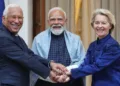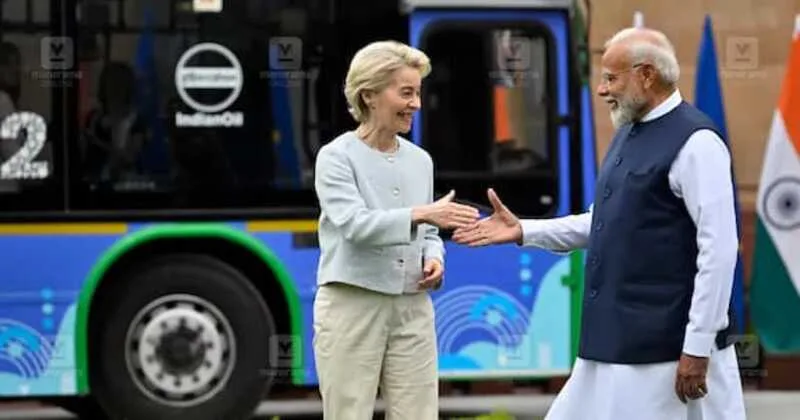
European Union leaders are arriving in India at a crucial moment, just as negotiations over an India–United States trade deal remain uncertain due to Donald Trump’s insistence on demands that India considers excessive and politically sensitive, particularly in key domestic sectors. This year’s Republic Day celebrations will be attended by European Commission President Ursula von der Leyen and European Council President Antonio Costa, signalling the growing strategic and economic importance of India–EU relations. During this high-profile visit, India and the European Union are also expected to make significant progress towards signing a long-pending free trade agreement.
At the same time, the proposed trade agreement between India and the United States is still under negotiation. India’s Union Commerce Ministry has indicated that discussions are continuing, with talks still ongoing. The Commerce Ministry reiterated as recently as yesterday that no definite timeline can be fixed. There are strong indications that the delay is primarily due to Washington’s pressure on India to make sweeping concessions in highly sensitive sectors such as agriculture and dairy. India has firmly resisted these demands, prioritising the protection of millions of small farmers and rural livelihoods that form the backbone of the country’s socio-economic structure. New Delhi’s position reflects a responsible and sovereign trade policy, while the US approach has been viewed as inflexible and dismissive of India’s domestic realities, contributing significantly to the stalled negotiations.
In contrast, the European Union’s negotiating position is seen as far more flexible on these issues, giving India a clear advantage in its talks with Europe and making the India–EU free trade agreement more feasible in the near term. The urgency of diversifying trade partners has grown following the severe impact of US trade measures on Indian exports. A 50 per cent tariff imposed by Trump has placed India’s exports to the US under significant strain, creating what many see as a major crisis for export-oriented sectors. In this context, a comprehensive India–EU free trade agreement could provide a much-needed boost, helping India strengthen alternative markets and reduce its dependence on the US.
Against this backdrop, Indian stock markets reopened today after a one-day holiday with cautious optimism. Investors are hopeful that positive developments on the trade front could lift sentiment. Early signals were mixed; the GIFT Nifty rose 68 points in the morning, but signs of volatility were clearly visible due to global uncertainty. On Wednesday, the Sensex closed at 83,382, down 245 points or 0.29 per cent, while the Nifty fell 66 points, or 0.26 per cent, to end at 25,665. Market attention is now firmly focused on the Union Budget, to be presented by Finance Minister Nirmala Sitharaman on February 1. Sitharaman had surprised many in the previous budget by announcing a substantial income tax cut. However, there is a growing assessment that the existing income tax slab structure remains unattractive. Expectations are building that the slabs may be revised this time, along with possible relaxation of certain income tax rules that have remained unchanged for a decade or more.
Stock market participants are also pressing for a reduction in the long-term capital gains (LTCG) tax from 12.5 per cent to 10 per cent. If the Finance Minister agrees to this demand, it could act as a strong catalyst for a market rally, particularly in equity-heavy portfolios. Trade tensions with the US continue to influence sentiment. Trump justified the 50 per cent tariff on India by citing India’s imports of Russian oil and had urged the European Union to adopt a similar stance. However, the EU made it clear that India is a long-standing trading partner and that it prefers to move forward through dialogue and a trade agreement rather than punitive tariffs. Finland, an EU member state, also reiterated that India is a fast-growing economy and emphasised that the goal is to strengthen trade relations by reducing tariffs, not raising them.
Global geopolitical concerns have also been weighing on markets. Over the past few days, reports circulated that the US could launch a military strike against Iran, with Iran threatening retaliatory attacks on US military bases in Qatar and other locations. These fears have eased temporarily after Trump clarified that there would be no military action against Iran for the time being.
Following Trump’s statement, crude oil prices fell sharply, registering one of the steepest drops in recent times. Prices plunged by around 5 per cent in a single move as fears of supply disruptions in Iran and the Gulf region subsided. WTI crude fell to $59 per barrel, while Brent crude declined to $63.
In the United States, futures markets showed modest gains, with the S&P 500, Nasdaq and Dow Jones rising by up to 0.2 per cent. A newly announced trade agreement between the US and Taiwan lifted sentiment, especially after Taiwanese companies pledged investments worth $250 billion in the US. Adding to the positive tone, Taiwanese chipmaker TSMC reported strong operating results. Asian markets, meanwhile, were mixed. Japan’s Nikkei slipped 0.5 per cent, although gains were seen in some AI chip-related stocks. South Korea’s KOSPI rose 0.3 per cent, Australia’s ASX 200 added 0.22 per cent, while China’s Shanghai index and Hong Kong’s Hang Seng fell by up to 0.15 per cent.