US-Venezuela Conflict: Return of the cold war
June 23, 2026
  • Read Ecopy
  • Circulation
  • Advertise
  • Careers
  • About Us
  • Contact Us
Android AppiPhone AppArattai
Organiser
  • ‌
  • Bharat
    • Assam
    • Bihar
    • Chhattisgarh
    • Jharkhand
    • Maharashtra
    • View All States
  • World
    • Asia
    • Europe
    • North America
    • South America
    • Africa
    • Australia
  • Editorial
  • International
  • Opinion
  • RSS @ 100
  • More
    • Op Sindoor
    • Analysis
    • Sports
    • Defence
    • Politics
    • Business
    • Economy
    • Culture
    • Special Report
    • Sci & Tech
    • Entertainment
    • G20
    • Azadi Ka Amrit Mahotsav
    • Vocal4Local
    • Web Stories
    • Education
    • Employment
    • Books
    • Interviews
    • Travel
    • Law
    • Health
    • Obituary
  • Subscribe
    • Subscribe Print Edition
    • Subscribe Ecopy
    • Read Ecopy
  • ‌
  • Bharat
    • Assam
    • Bihar
    • Chhattisgarh
    • Jharkhand
    • Maharashtra
    • View All States
  • World
    • Asia
    • Europe
    • North America
    • South America
    • Africa
    • Australia
  • Editorial
  • International
  • Opinion
  • RSS @ 100
  • More
    • Op Sindoor
    • Analysis
    • Sports
    • Defence
    • Politics
    • Business
    • Economy
    • Culture
    • Special Report
    • Sci & Tech
    • Entertainment
    • G20
    • Azadi Ka Amrit Mahotsav
    • Vocal4Local
    • Web Stories
    • Education
    • Employment
    • Books
    • Interviews
    • Travel
    • Law
    • Health
    • Obituary
  • Subscribe
    • Subscribe Print Edition
    • Subscribe Ecopy
    • Read Ecopy
Organiser
  • Home
  • Bharat
  • World
  • Operation Sindoor
  • Editorial
  • Analysis
  • Opinion
  • Culture
  • Defence
  • International Edition
  • RSS @ 100
  • Magazine
  • Read Ecopy
Home Politics

US-Venezuela Conflict: Return of the cold war

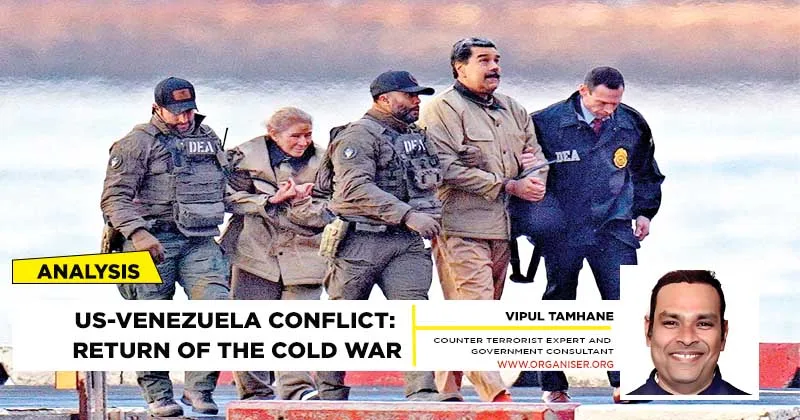
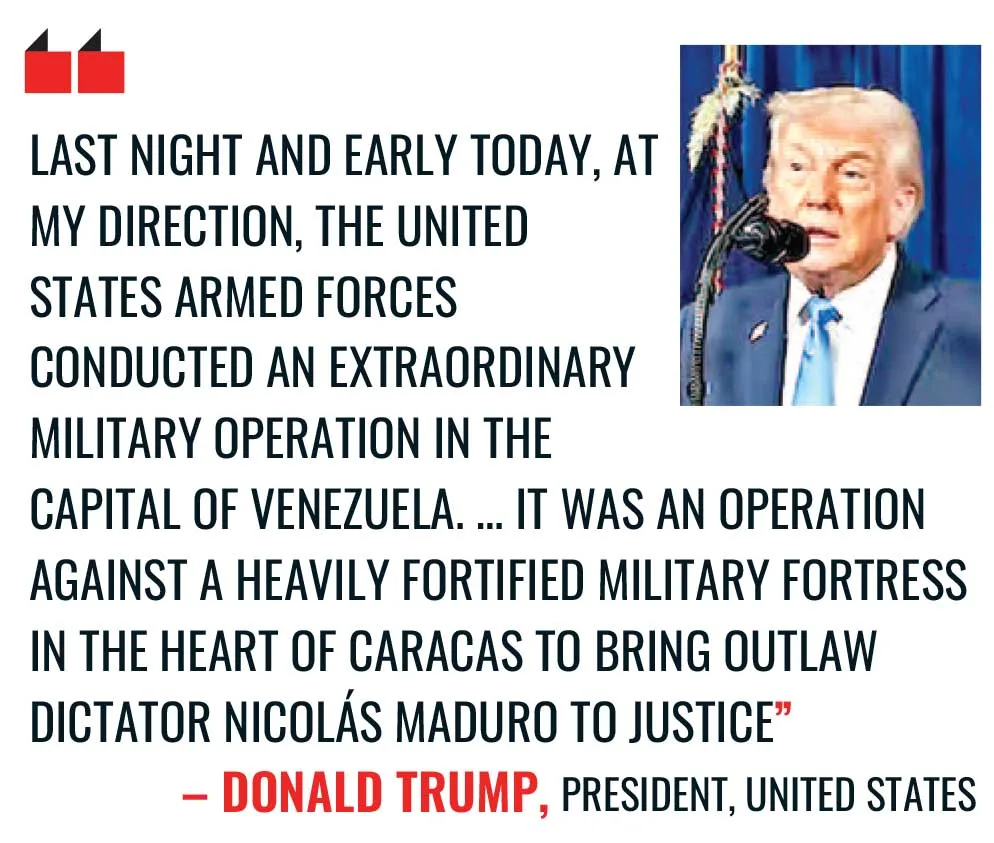
Since he took over as US President, Donald Trump believes he is empowered to violate sovereignty of other nations. By launching Operation Absolute Resolve on Venezuela, Trump has captured Nicolás Maduro & normalised such an aggression. Now other powers will be tempted to flex their muscles over smaller nations. Bharat has expressed concern over Venezuelan President’s capture

Vipul TamhaneVipul Tamhane
Jan 14, 2026, 07:00 pm IST
in Politics, Analysis
Follow on Google News
FacebookTwitterWhatsAppTelegramEmail

The pre-dawn raid that took place in Caracas and led to the capture of Venezuelan President Nicolás Maduro is not only another spectacular incident in Donald Trump’s foreign policy but also a potential inflection point in relations between countries. The latter could speed up the world’s movement towards a Cold War-like scenario, though one that is radically different from last century’s conflict. Past events do not happen again exactly the same, but they are similar sometimes. The critical issue now is whether the US intervention in Venezuela will go down in history as an exceptional case of coercive diplomacy or as the beginning of the era when the great powers could no longer be restrained by the post-1945 unspoken rules of conduct.

Anatomy of A Precedent

What makes the Maduro capture particularly unsettling isn’t the violence itself, the U.S. has conducted military operations in seven countries since Trump took office. Rather, it’s the casual erasure of a foundational norm, that sitting Heads of State, however odious, enjoy a degree of immunity that constrains how even powerful nations can act.

Cold War Echoes, Not Replicas

The question if a new Cold War is inevitable is answered with a ‘No’, yet it uncovers the fact that many of the structural conditions for such a rivalry are already in place.

Take the Cold War model as an example; it needed the above-mentioned conditions of the power structure, the two superpowers, sorts that resemble the two non-Communist and Communist worlds, threats to trade, commerce and economies, disruption to the normal life, the fear of total destruction and deterrent weapons that imposed a non-direct confrontation. Today’s emerging order contains modified versions of each.

We don’t have clean bipolarity, but we do have functional division on fundamental questions. When the operation of Maduro was denounced by China, Russia, Brazil, and a large part of the Global South, the United Kingdom and the European Union. sent a fractured response, marginalised U.N. system response was seen and Argentina, Italy, Israel, and a few showing allies supported it, they were not just picking a side in Venezuela. The parties involved were articulating conflicting notions regarding the global order: conditional sovereignty as opposed to absolute sovereignty; justice bordering on injustice as opposed to borders stopping justice.
Disputes of this nature cannot be settled through diplomacy without great difficulty; they represent different legal viewpoints that are not compatible with one another. This is the very way Cold Wars get to the core: through the hardening of competing normative systems, not military confrontation.

Security Dilemma Reborn

The most dangerous dynamic the Maduro operation has triggered is the classic security dilemma spiral. The U.S. frames its action as law enforcement against a narco-terrorist. But when Beijing and Moscow see Washington militarily seizing a sitting President, they don’t think about drug trafficking, they think about  their own agendas.

If sovereignty is now conditional, what deters expansionism from China or Russia? This fear drives defensive measures, i.e. strengthening domestic security, building alternative institutions, creating legal counter-weapons. Yet these defensive moves appear offensive to the U.S., justifying further American assertiveness. The cycle feeds itself. This is the engine that drove the original Cold War’s arms race.

Today’s version involves not just missiles but legal instruments, financial systems, and competing institutional architectures. The U.S. support to their proxies for regional dominance is prominent. In addition to that is the tool-kit model of activation of unrest and public insurrection to topple governments that are not in the U.S. interest, this is not unheard of, which brings the question of exercising democratic freedom which is best in the national interest now facing stability threats to global governments that are non-U.S. aligned. This makes the world literally a wild-west, where everyone is for themselves.

What Comes Next

The world still is not completely in the Cold War era. Economic interdependence, nuclear deterrence, and multipolar complexity are current limitations that are quite different from those in 1947. Trump’s threats against Colombia and Mexico are still just a talk; the international system still has some ways of absorbing shocks.

But precedents compound. If the Maduro operation becomes normalised, if other powers conclude that Heads of State are now legitimate targets, the restraints will weaken further. The next crisis over Taiwan, the next extraterritorial arrest, the next territorial annexation will find fewer guardrails in place. Russia currently controls 19.2 per cent of Ukraine, including Crimea, what will be next? Cold Wars don’t start with declarations. They emerge when enough actors conclude that rules no longer constrain behavior, when defensive measures spiral into rivalry, when alignment becomes unavoidable. They’re reached not through intention but through accumulation.

The Choice Before Us

Trump justified his Venezuelan operation as necessary for American security. But the broader cost, the erosion of norms that have prevented great-power conflict for eight decades, may far exceed whatever immediate benefits the U.S. gains from toppling Maduro.

The Venezuelan operation isn’t itself a Cold War trigger. But it’s an accelerant poured on smoldering tensions. The escalation of tensions into prolonged contention will be contingent on the options taken by the U.S. and its rivals, and most importantly, by middle powers who will determine if any normative framework left is still worth defending. We are in a period that some historians might label as an interregnum: the perilous gap between the existing international order and the new one to come. The case of Maduro has indicated the extent to which we have already moved. The question is whether we still have time, and will, to choose a different destination.


Topics: Venezuelan President Nicolas MaduroAmerican securityMaduro operationnon-U.S. alignedRussiaChinaBrazilCold War era
ShareTweetSendShareSend
✮ Subscribe Organiser YouTube Channel. ✮
✮ Join Organiser's WhatsApp channel for Nationalist views beyond the news. ✮
Previous News

Kerala: CM Mega Quiz centres on Pinarayi Vijayan’s image-building among apolitical students

Next News

Thiruparankundram reignites debate over anti-Hindu tendencies in Tamil Nadu policing system

Related News

Chinese President Xi Jinping

China Back to Mao Era? Xi unveils new doctrine of party supremacy over state and people

Yoga Day celebrations in Shanghai, China

International Yoga Day: Global celebrations echo the message of health, well-being and timeless ancient Indian wisdom

UK retailers demand tougher curbs on Chinese online giants amid deepening EU–Beijing trade rift

India-Russia Ties Through the Ages: From Soviet cinema halls to Buddhist monasteries

Prestige Denim Mills' $20 million project marks India's industrial entry into one of Africa's fastest-growing textile hubs

India enters Egypt’s textile battlefield, challenging Chinese, Turkish and Pakistani dominance in Africa

In China's strategic map of threats, geography continues to give India a significance that cannot be overlooked

The Rival China Cannot Ignore: Why India matters more than Beijing admits

Load More

Latest News

Bareilly Cantonment Emerges as Model for Sustainable Urban Development in India (Image Source X)

Uttar Pradesh: Bareilly Cantonment becomes India’s first carbon-negative cantonment

CM Yogi Adityanath making industry, investment and the connectivity revolution in Eastern Uttar Pradesh

The Purvanchal Growth Story: How industry, infrastructure, tourism & exports are fueling development in eastern UP

(Left) Fire at the coaching centre in Lucknow (Right) Members of ABVP extending all possible help

Lucknow Coaching Centre Fire tragedy is heartbreaking and deeply unfortunate: ABVP seeks action against culprits

Andhra Pradesh Minister and TDP National General Secretary Nara Lokesh

Nara Lokesh dismisses rumours of TDP sabotaging Modi government, reaffirms unconditional NDA support

With new military deployments, export opportunities and potential Russian production, BrahMos is entering a new era of strategic relevance

BrahMos enters high-volume production as military demand and global export orders surge

Dr Mahrang Baloch

Pakistan: Mahrang Baloch gets life sentence, Balochistan erupts in protest; BYC calls for shutdown

Prime Minister Narendra Modi

‘Maoism is breathing its last’: PM Modi highlights crackdown on red terror in last 12 years and growth in tribal areas

(Left) Dr Shyama Prasad Mookerjee (Right) West Bengal CM Suvendu Adhikari

Syama Prasad Mookerjee was instrumental in creation of West Bengal’: CM Suvendu Adhikari

Female recruitment in Jihadist networks emerges as major security concern

Khadija Terror Case: Female recruitment, online radicalisation in Jihadi networks poses major security concern

Outcry grows after Dalits in Theeyathur village carry deceased woman across paddy fields due to lack of burial access

Tamil Nadu: Dalits forced to carry deceased woman through paddy fields as Pudukkottai village lacks road access

Load More
  • Privacy
  • Terms
  • Cookie Policy
  • Refund and Cancellation
  • Delivery and Shipping

© Bharat Prakashan (Delhi) Limited.
Tech-enabled by Ananthapuri Technologies

  • Home
  • Search Organiser
  • Bharat
    • Assam
    • Bihar
    • Chhattisgarh
    • Jharkhand
    • Maharashtra
    • View All States
  • World
    • Asia
    • Africa
    • North America
    • South America
    • Europe
    • Australia
  • Editorial
  • Operation Sindoor
  • Opinion
  • Analysis
  • Defence
  • Culture
  • Sports
  • Business
  • RSS @ 100
  • Entertainment
  • More ..
    • Sci & Tech
    • Vocal4Local
    • Special Report
    • Education
    • Employment
    • Books
    • Interviews
    • Travel
    • Health
    • Politics
    • Law
    • Economy
    • Obituary
  • Subscribe Magazine
  • Read Ecopy
  • Advertise
  • Circulation
  • Careers
  • About Us
  • Contact Us
  • Policies & Terms
    • Privacy Policy
    • Cookie Policy
    • Refund and Cancellation
    • Terms of Use

© Bharat Prakashan (Delhi) Limited.
Tech-enabled by Ananthapuri Technologies