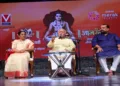
NEW DELHI: Union Minister for Education Dharmendra Pradhan chaired a day-long national consultation on Samagra Shiksha 3.0 under the theme “Reimagining Samagra Shiksha” at Sushma Swaraj Bhawan, Pravasi Bharatiya Kendra in New Delhi. The consultation brought together key stakeholders from across the country, including state education secretaries, project directors, experts, and senior officials, to deliberate on strengthening India’s flagship integrated school education programme. The aim is to develop a strategic and collaborative roadmap for the next phase of Samagra Shiksha, with a focus on equity, access, quality, teacher capacity, and outcome-based learning.
Addressing the gathering, Minister Dharmendra Pradhan said that Prime Minister Narendra Modi’s vision of Viksit Bharat by 2047 can only be achieved when every child in India has access to quality education up to Class XII and the nation achieves 100 per cent school enrolment. He stressed that education is the foundation of national development and the most powerful tool to build strong human capital for the future.
Pradhan highlighted that Samagra Shiksha 3.0 represents the next milestone in India’s education reforms after the successful implementation of the National Education Policy (NEP) 2020. The next phase of Samagra Shiksha must focus on bridging learning gaps, reducing dropouts, and enhancing the quality of learning and nutrition outcomes among students. He urged all stakeholders, from policymakers to teachers, to work collectively to build an inclusive, flexible, and modern school education system that nurtures innovation, critical thinking, and Indian values.
“To realise the dream of Viksit Bharat 2047, we must move beyond the colonial mindset and create an education system rooted in Bharatiyata, driven by technology, and responsive to local and global needs,” Pradhan emphasised.
The consultation had detailed discussions among State Education Secretaries and State Project Directors from 11 states and Union Territories, as well as representatives from various ministries and educational institutions. It focused on strengthening governance structures, improving accountability, and ensuring alignment across schemes and departments involved in school education.
Pradhan said that the Amrit Peedhi, which is the young generation, needs to be equipped with both traditional knowledge and future-ready skills. He noted that Samagra Shiksha 3.0 must act as a bridge between academic learning and skill development to prepare students for life, work, and citizenship in the 21st century. He called for the preparation of a comprehensive annual plan for 2026-27 to make the scheme outcome-oriented, inclusive, and sustainable. He encouraged the inclusion of local innovations and state-level best practices in the framework to promote flexibility and ownership at the grassroots.
Minister of State (Independent Charge) for Skill Development & Entrepreneurship and Education, Jayant Chaudhary, also addressed the session. He said that the strength of any education policy lies in its implementation at the ground level, and that Samagra Shiksha 3.0 has been designed with a bottom-up approach. He emphasised that the new phase of Samagra Shiksha will integrate vocational education, digital learning, and skill pathways into mainstream schooling. By doing so, schools will not only become centres of academic excellence but also hubs for skill development and innovation.
Sanjay Kumar, Secretary, School Education and Literacy, emphasised the need to make learning outcomes the primary driver of school education policy. He noted that ensuring age-appropriate learning and establishing curriculum equivalence across different state boards are critical to providing equitable education to all children. He also called for integration of AI into curricula as a key component of Samagra Shiksha 3.0.
Minister Pradhan noted that five years after the rollout of NEP 2020, India is entering a new phase of educational reform aligned with national development priorities. He urged all to work in a spirit of cooperation and collective responsibility to ensure that the vision of Viksit Bharat 2047 is realised through strong educational foundations.
About Samagra Shiksha
Samagra Shiksha is an integrated, centrally sponsored scheme for school education extending from pre-primary to senior secondary levels. Launched in 2018, the scheme merged three erstwhile schemes – Sarva Shiksha Abhiyan (SSA), Rashtriya Madhyamik Shiksha Abhiyan (RMSA), and Teacher Education (TE) into a unified framework. It represents a paradigm shift from segmented educational programmes to a comprehensive, holistic approach covering access, quality, equity, and inclusion.
The upcoming Samagra Shiksha 3.0 will build on this foundation by introducing technology-driven monitoring, AI integration, vocational pathways, and stronger links to higher education and skill ecosystems.