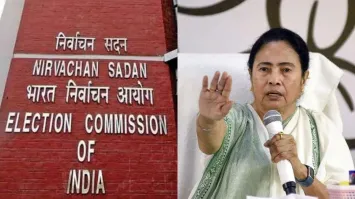
The Election Commission of India (ECI) has given its formal approval to establish polling stations inside multi-storey residential complexes and large housing societies in West Bengal, marking a notable shift in polling infrastructure ahead of the upcoming Assembly elections. The decision comes despite strong objections raised by Chief Minister Mamata Banerjee and the ruling Trinamool Congress (TMC), who have questioned the neutrality and security of such arrangements.
West Bengal’s Chief Electoral Officer (CEO), Manoj Agarwal, has forwarded a consolidated list of 69 high-rise residential complexes to be designated as polling booths. These complexes were identified following directions issued by the ECI to District Electoral Officers (DEOs) in December, instructing them to submit details of eligible apartment complexes across eight districts of the state.
According to officials, once the district-level lists were received, the CEO’s office scrutinised and compiled them into a final proposal, which has now been approved by the Election Commission.
Of the 69 approved high-rise complexes, 10 are located in Kolkata, spanning two parliamentary constituencies. Eight of these are in North Kolkata, while two are in South Kolkata. A substantial number of polling booths, 47 in total, are located in areas adjoining Kolkata within the Kolkata Metropolitan Area (KMA).
District-wise, South 24 Parganas accounts for the highest number with 25 complexes, followed closely by North 24 Parganas with 22. Hooghly has five, Howrah four, and East Burdwan three complexes on the approved list. Election officials say the selection was based on population density, voter convenience, accessibility, and security considerations.
The move follows an ultimatum issued by the ECI to district authorities in December, asking them to proactively identify urban residential clusters where voters, particularly senior citizens, working professionals, and women, often face logistical hurdles in reaching traditional polling stations located outside their residential areas.
Election officials have maintained that the objective is to improve voter turnout in urban constituencies, which historically record lower participation compared to rural areas, despite higher literacy levels.
Chief Minister Mamata Banerjee had earlier written to Chief Election Commissioner Gyanesh Kumar, expressing serious reservations about the proposal. In her letter, Banerjee raised concerns over neutrality, security, and the possibility of undue influence within enclosed residential environments. The TMC has argued that polling booths inside housing complexes could potentially compromise the independence of the electoral process.
However, the Election Commission has reiterated that all polling stations, irrespective of location, will function under strict ECI guidelines, with central forces, micro-observers, and standard security protocols in place.
The Bharatiya Janata Party (BJP) has strongly welcomed the ECI’s decision, describing it as a long-overdue reform that brings the electoral process closer to urban voters.
Calling it a step towards strengthening democracy, BJP IT department in-charge Amit Malviya said, “For years, many urban voters have faced challenges in participating in the electoral process. This move brings the ‘Festival of Democracy’ right to their doorstep.”
Malviya further argued that polling inside residential complexes would reduce the scope for external interference, voter intimidation, and booth capturing. “It becomes far more difficult for anti-social elements to engage in vote rigging or looting of ballot boxes in such controlled environments,” he said.
Highlighting voter safety, especially for elderly citizens and families, Malviya added that the decision would ensure a secure, peaceful, and orderly polling atmosphere, encouraging higher participation in urban centres.
The decision assumes added political significance in a state like West Bengal, where urban constituencies, particularly in Kolkata and its surrounding districts, play a decisive role in shaping electoral outcomes. With elections expected to be keenly contested, changes in polling infrastructure are likely to have both logistical and political implications.