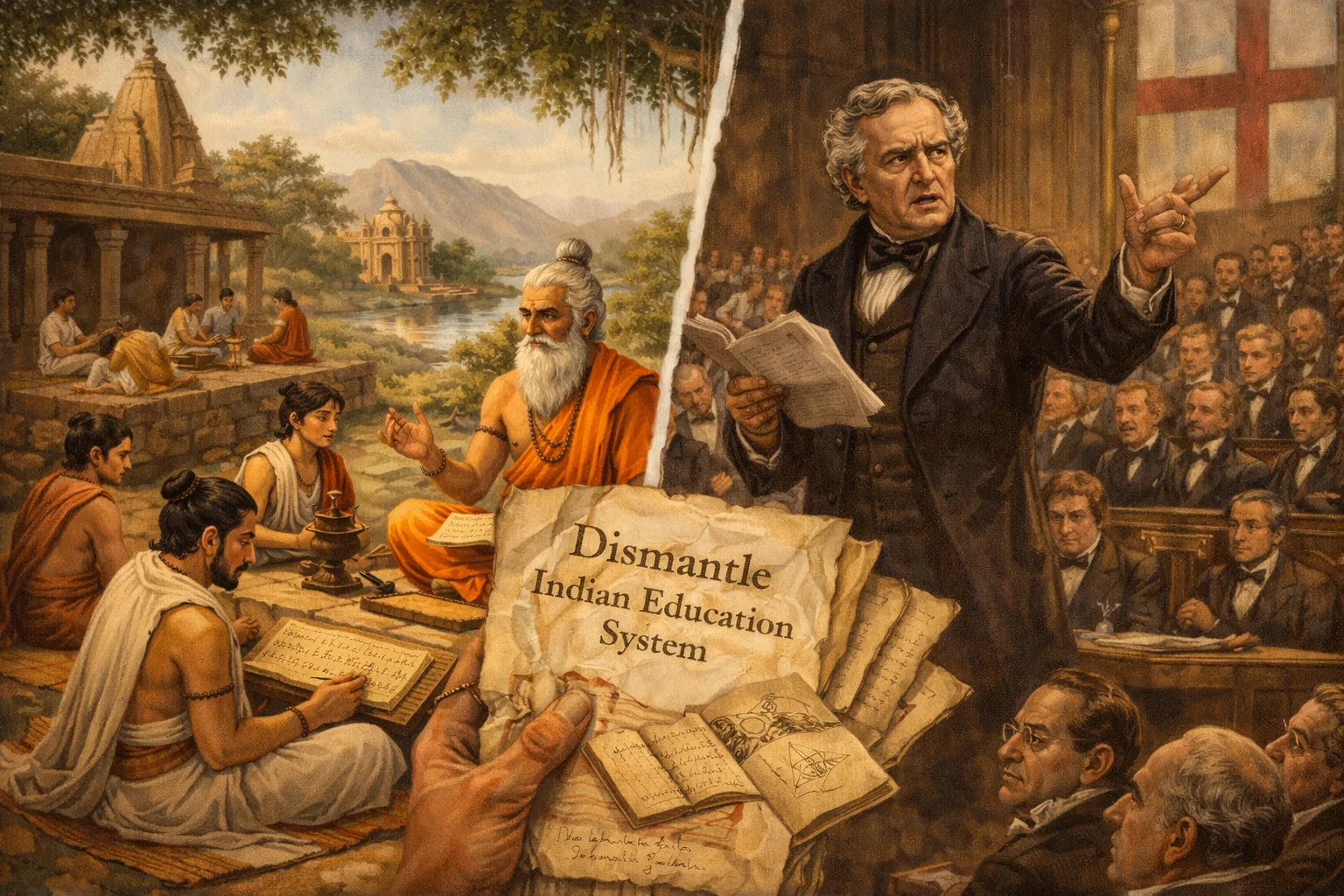
A former Member of Parliament and Congress leader, Mr. Peter Alphonse, has written an article asserting that Macaulay’s system of education was the key to India’s modernity. Such a view only reinforces the reality that even today, we have not fully liberated ourselves from intellectual colonialism. It also reveals how diminished our understanding of India’s own civilizational strengths has become.
Ironically, before Macaulay ever arrived in India, extensive surveys conducted by the British themselves documented the educational landscape of the country. These records are still preserved today in the research archives of museums in London. Through these documents, one can clearly establish the immense intellectual wealth that India possessed.
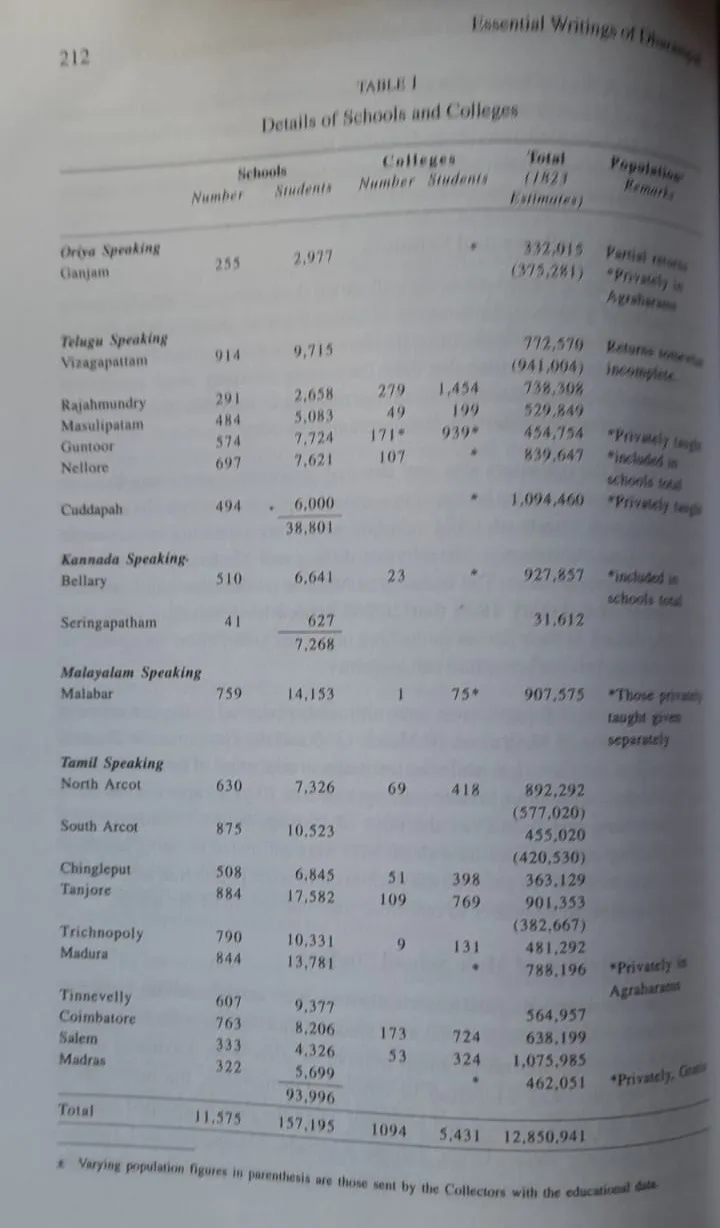
In 1822, Thomas Munro, then Governor of the Madras Presidency, instructed district collectors to assess and report on the state of education in their respective regions. Based on these reports, a narrative was later constructed claiming that the British introduced “systematic education” in India. However, the very same British administrators also meticulously documented indigenous education under the title “Madras Presidency Indigenous Education Survey.” Further corroboration can be found in the letters submitted by collectors and the attached documents presented to the British House of Commons in 1831–32. These records provide undeniable evidence of the quality and depth of India’s education system.
The article’s author questions the Prime Minister of India, Mr. Narendra Modi, who has repeatedly stated that India once excelled in education but lost much of that heritage. The question posed is: What exactly did India possess?
As early as the 3rd century CE, scholars such as Eratosthenes and Galileo mathematically established that the Earth is spherical. Yet long before that, in the Krita Yuga, Indian tradition depicted the Earth as a sphere through the Varaha avatar, symbolically illustrating the planet’s form. Indians had already mastered astronomy, calculated the Earth’s circumference, understood its characteristics, and named it Bhugolam (geography).
Centuries before the Wright brothers named and flew an airplane, Indians had conceptualized and documented the Pushpaka Vimana, complete with descriptions of its design and construction.
When Western architectural structures collapse like card houses during storms and heavy rains, India’s ancient temples continue to stand as symbols of engineering brilliance. Indians installed copper finials atop temple towers to control lightning and even placed grains within them—demonstrating advanced scientific understanding.
Raja Raja Chola proved that it was possible to build a 250-foot tower on a foundation just six feet deep. While bridges constructed using Western engineering textbooks often collapse, the unmatched durability of Karikalan’s Kallanai (Grand Anicut) dam remains poorly understood by those who glorify colonial education.
Modern cities built by those trained in the Macaulay system often stand submerged waist-deep in water after a single rainfall. In contrast, ancient Indians mastered water management by systematically integrating ponds, canals, lakes, rivers, and channels to ensure year-round water availability.
In the 4th century CE, India established Nalanda University and imparted education to scholars from across the world.
Historical records show that in the 17th and 18th centuries, the British purchased ships built at the Bombay dockyards, recognizing Indian excellence in shipbuilding. Inscriptions of Raja Raja Chola mention naval expeditions involving 800 horses, 800 elephants, 2,000 soldiers, and fully stocked provisions crossing the seas to win battles. One may ask: under which Macaulay syllabus was such expertise taught?
Europeans were astonished by Indian metallurgical skills. Documents reveal that Indian steel was exported to the Middle East for forging Damascus swords, and European scholars of the 18th century studied and admired its unique properties.
Ancient Tamil texts such as ‘PATHITRUPATHU’ describe surgical procedures involving stitching wounds with needles—clear evidence of advanced medical practices.
Those who praise Macaulay should examine his speech in the British Parliament, where he explicitly stated that India’s existing education system had to be dismantled to impose British rule effectively.
This explains why classrooms were enclosed within buildings, dependent on artificial lighting and ventilation, transforming India into a market for British goods—from uniforms to furniture.
The British mocked traditional practices like brushing teeth with ash, charcoal, and salt, promoting toothpaste instead. Today, when consumers demand toothpaste containing salt, charcoal, or ash, if we fail to recognize the irony, the fault lies with those educated under Macaulay’s system.
Millets such as ragi, samai, and thinai were once ridiculed as “peasant food,” while oats, bread, and cornflakes were promoted as superior breakfast options. Today, the same traditional foods are marketed as health foods. This reversal itself is a consequence of Macaulay-style thinking.
Macaulay institutionalized occupational divisions and practiced divide-and-rule politics. Meanwhile, Indians who sang “Crows and sparrows are our kin” were dismissed as uncivilized.
Some cite Bharati’s poems describing India’s condition upon British arrival but deliberately ignore the devastation caused by Mughal invasions, including the dishonor and exploitation of women and the resulting societal trauma.
The repeated claim that only dominant castes received education is misleading. Assertions that only Sanskrit, Arabic, or Vedic studies were taught are fabrications.
Survey records from across India—particularly from Tamil Nadu districts such as Tirunelveli, Coimbatore, Madurai, Thanjavur, Chengalpattu, Cuddalore, Tiruchirappalli, Chennai, Salem, and North Arcot—along with Telugu-, Kannada-, and Malayalam-speaking regions, present a different reality. Data was meticulously collected across communities, including Brahmins, Vaishyas, Scheduled Castes, other castes, and Muslims, even documenting smaller communities in some districts. Education was recorded by caste, language of instruction, and field of study.
According to these records, in present-day Tamil Nadu regions, educated women included 4 Brahmin women, 11 Vaishya women, 627 women from Scheduled Castes, 317 from other castes, and 239 Muslim women. Educated men numbered 12,581 Brahmins, 38,127 Vaishyas, 42,240 Scheduled Castes, 12,504 from other castes, and 19,675 Muslims. These figures decisively shatter the long-propagated myth that education was denied to non-dominant communities.
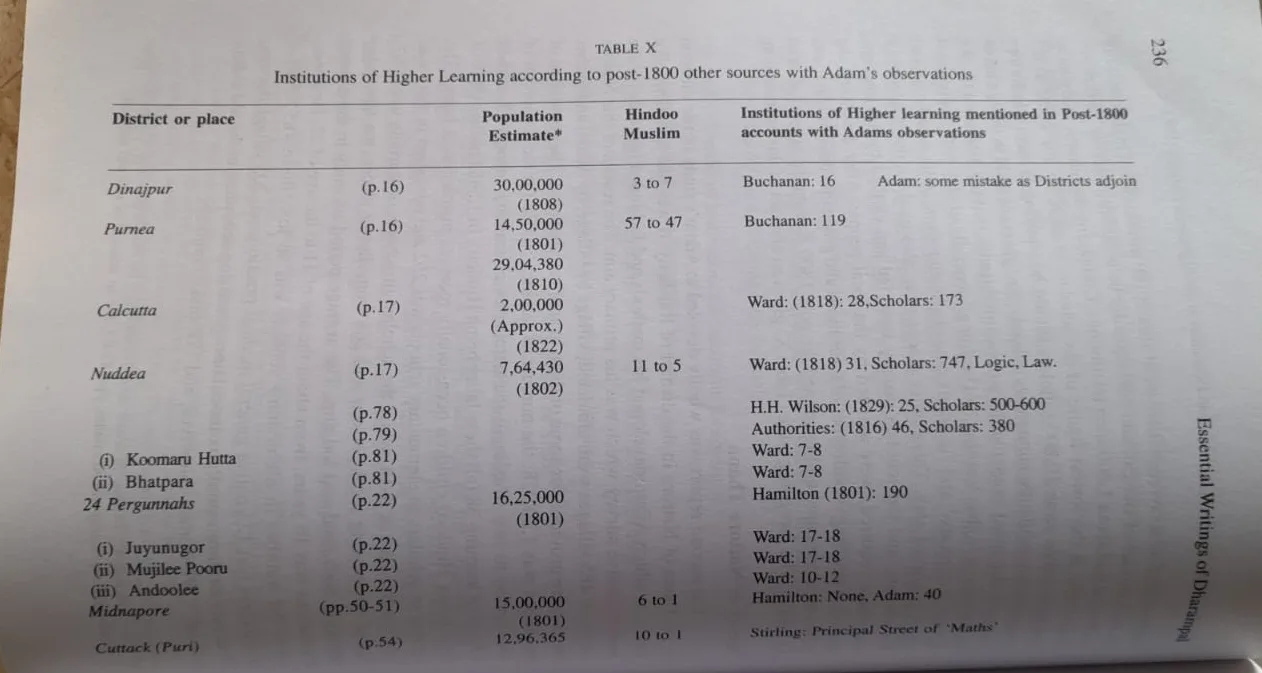
British records themselves acknowledge that education in India during the early 1800s was on par with Cambridge, Edinburgh, and Oxford. Subjects taught included linguistics, epics, religions, geometry, astronomy, physics, chemistry, botany, physiology, music, poetry, philosophy, modern languages, common law, medicine, astrology, history, and languages such as Oriya, Tamil, Telugu, Kannada, Hindi, Marathi, Persian, and English.
Higher education institutions were fewer, but vocational education was widespread. After basic schooling, most students pursued professional training, often taught by parents within their homes. While Brahmins commonly pursued higher education, disciplines like medicine and astronomy were accessible to all.
Records also detail textbooks and dictionaries used across regions like Jaipur and Bengal. These documents confirm that India’s education system was robust long before Western intervention. Schooling typically began at age five and continued for seven to eight years. Higher studies lasted three to five years and included research. Every family engaged in a profession, and there was no concept of hereditary slavery. Professional dignity was upheld.
Details about student fees, teacher remuneration, local administration, and charitable institutions managing schools further reveal a sophisticated educational ecosystem.
India practiced values such as democracy, social justice, socialism, and secularism long before modern definitions existed. When the rest of the world neither recognized nor accepted gender diversity, Indians acknowledged the third gender as “Tritiya Prakriti” and revered them as sacred beings until British rule disrupted this understanding.
The thirst for learning flows in Indian blood. English is merely a language, not knowledge itself—it is a tool. Recognizing this, Indians mastered it and went on to excel in fields ranging from the internet to email technology.
It is unsurprising that some continue to glorify Macaulay’s education. After all, even while granting India independence, colonial thinkers drafted servitude charters proposing that regions like the Madras Presidency be governed from England. What else could one expect from such a mindset?