
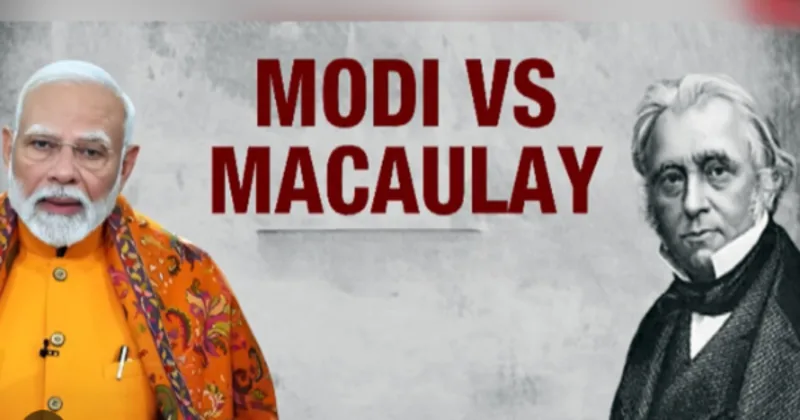
The recent Ramnath Goenka Memorial Lecture delivered by Prime Minister Narendra Modi, along with his address at the ceremonial Flag-hoisting in Ayodhya, has reignited a profound debate on India’s public sphere, its epistemic architecture and its ideological self-understanding. This debate returns India to the foundational question of its intellectual modernity, a question decisively shaped under colonial rule by Thomas Babington Macaulay’s pedagogical doctrine. By explicitly declaring that India must, by 2035 two hundred years after the Macaulay Minute 1835 extricate itself from the cognitive servitude produced by that educational project, Modi situates his intervention in a long, unresolved civilisational struggle.
The resonance is heightened by the political fact that his tenure has already overseen the symbolic closure of a five-hundred-year civilisational wound through the construction of the Ram Mandir, as well as an ambitious push to declare a “deadline” on Naxalism, gestures that cumulatively reinforce the credibility of his leadership in reshaping India’s self-image. In this continuum, the attempt to uproot the “Macaulay stain” from the imagination of a developed India has become a subject of intense intellectual scrutiny, for Macaulay’s colonial policy sought nothing less than to mould Indian society into a formation in which an Indian body would carry an English mind, English values and English moral codes. It was this project that destabilised India’s indigenous knowledge systems and precipitated a new colonial modernity. Post-independence India, despite political freedom, preserved much of that inherited structure. Modi’s lecture therefore constitutes not a routine political address but a substantive intervention in postcolonial studies, cultural politics and theories of nationalism.
Macaulay’s project was never limited to superficial educational reform. Its deeper objective was to delegitimize India’s intellectual traditions and to manufacture a class that would remain Indian in appearance yet become the living conduit of English civilization in thought, sensibility and cultural selfhood. For the colonial state, this was the most enduring technology of mental domination. Macaulay’s epistemic reordering became the central pillar of the imperial power-strategy subordinating knowledge to power in order to control imagination, memory,and moral consciousness. Indian languages, philosophy, mathematics, medicine, literature and artistic traditions were systematically branded “irrelevant” or “inferior,” creating a psychological landscape in which Indians began doubting their own civilisational inheritance. This cultivated “self-doubt” was perhaps the most potent instrument of colonial hegemony. Modernity was defined as synonymous with the West, while Indian civilisation was caricatured as traditionalist, superstitious and unscientific. The dominant image of Indian modernity was thus produced through an externally imposed colonial optic.
Modi’s critique directly targets this historical architecture. His contention is that India has not yet freed itself from the colonial cognitive structures that the British institutionalised in the mid-nineteenth century. Political independence altered the custodians of the state but the mental scaffolding remained virtually intact. English education ceased to be a mere instrument of elite mobility; it crystallised into a narrow epistemic aristocracy that monopolised knowledge, language, aesthetics and the terms of public discourse. Modi therefore poses a fundamental civilisational question: can the future of a nation be built upon a cognitive edifice whose foundations lie in colonial assumptions? If not, what alternative epistemic formation can anchor India’s modernity?
The question intersects with the foundational tension in Indian nationalism, whether Indian modernity must replicate Western modernity or whether India can generate a plural, indigenous modernity grounded in its own experiences, traditions and cultural memory. This is not a debate of cultural pride or emotive nationalism; it is a question of epistemic politics. In this sense, Modi’s lecture aligns itself with global currents of decolonial thought. Thinkers such as Frantz Fanon, Ngũgĩ wa Thiong’o, Walter Mignolo, Partha Chatterjee and Gayatri Spivak have argued that the most insidious legacy of colonialism is mental coloniality the belief that the West remains the sole legitimate locus of knowledge, rationality, science and progress.
Modi’s critique strikes at this intellectual core. His intervention is not merely a recovery of cultural memory but an attempt to democratise knowledge itself. Indian languages, traditions and intellectual systems are not antithetical to modernity. For millennia, India generated original knowledge frameworks in science, mathematics, medicine, astronomy, literature, political theory and social organisation. Yet colonial rule rendered these legacies “backward,” erasing their epistemic legitimacy. The result was a deep psychological bifurcation: one section became the custodians of English knowledge and deemed themselves modern, while another, rooted in Indian languages and traditions, was dismissed as backward. Modi’s lecture challenges precisely this divide.
Post-independence India preserved remarkable continuities with colonial structures: the administrative apparatus, legal system, educational hierarchy, judiciary and intellectual discourse all continued to operate within frameworks devised by colonial authorities. The postcolonial middle class became the primary custodian of this continuity, equating English education with modernity while branding Indian languages as “local,” “unscientific,” or “inferior.” This created a society in which knowledge-power was concentrated in a narrow segment. Modi contests this centralisation and argues for rebuilding modernity on indigenous foundations.
Recent state decisions—renaming the PMO as Seva Tirth, the Central Secretariat as Kartavya Bhavan and Raj Bhavans across states as Lok Bhavan are emblematic of this broader symbolic and cognitive reorientation. Modi extends this critique to the media, arguing that mental coloniality shapes not just what the media reports but how it perceives reality. Media, as the architect of public consciousness, frames events through the language it uses, the value-schemas it privileges and the epistemic norms it accepts. When media operates through Western narratives, sensibilities, and colonial reflexes, India’s own complexities and civilisational richness become invisible. Indigenous experiences, symbols, histories and struggles are marginalised. Hence, Modi insists that the media must emancipate itself from colonial habits of mind and re-centre Indian perspectives, languages and collective memory.
Yet the fulfilment of a “decolonial project” demands that Indian modernity be grounded in inclusivity and plural civilisational legitimacy. An authentically decolonial imagination must recognise Dalit, Adivasi, Sikh, Dravidian, Northeastern and others diverse folk epistemologies as equally integral to India’s knowledge universe. Knowledge cannot be reclaimed by privileging a single linguistic or cultural axis, for that would merely reproduce Macaulay’s narrowness in reverse. Modi’s project can succeed only if it redistributes epistemic authority across India’s plural traditions. Simultaneously, knowledge systems must retain substantive autonomy to critically engage and dismantle lingering colonial logics.
What emerges is a debate that seeks to redefine Indian modernity at its civilisational roots. It gestures toward freeing India from a West-centric epistemic regime and steering it toward an alternative modernity grounded in cultural memory and historical experience. This debate not only points toward liberation from colonial residues but also opens a pathway toward intellectual self-rule—gyan-swaraj. Macaulay’s enterprise was a colonial construction designed to sever Indians from their own epistemic and civilisational roots and compel them to imitate Western models. Modi’s intervention rejects this epistemic politics and asserts that India must enter the twenty-first century anchored in its own knowledge systems, languages, history and cultural modernity. The journey will not be easy; yet it is indispensable if India is to emancipate itself from the psychological domination that has endured long after the formal end of empire. The future depends on how India transforms its internal diversities, historical experiences and cultural inheritances into an inclusive and self-confident modernity.