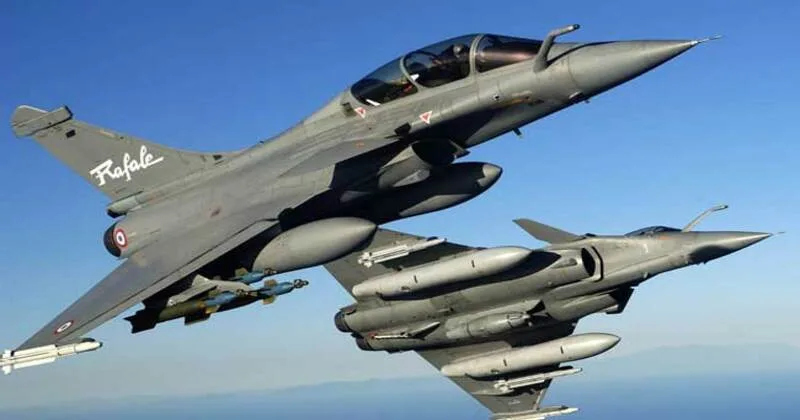
India is on a rampant path to fortify its defence self-reliance and national security architecture amidst spiking geopolitical uncertainties. Underlining this strategic predisposition, New Delhi is inching towards finalising a deal with France to gain additional tranche of the Rafale fighter jets for the Indian Airforce. The negotiations surrounding the deal have gained momentum ahead of the French President Emmaneul Macron’s anticipated visit to India in the next month for the AI Impact Summit in New Delhi.
The highlight of the latest deal is, it doesn’t just include the supply of the fighter jets from France to India, but will also have a Make in India ignition. The deal thus foresees indigenous manufacturing of the Rafale fighter aircrafts. The government-to-government deal aims at 60 per cent value retention in India which reflects the swift resolve for defence indigenisation in India, beyond mere purchasing or flying of the fighter jets. This is thus deemed as a major accelerator in realising the vision of full-fledged self-reliance in the military domain.
As per the reports, India and France are negotiating for the purchase of 114 state-of-the-art fighter aircraft. The process involves formal approval by the Defence Acquisition Council(DAC) in the Ministry of Defence, cost finalisation and ultimately nod by the Cabinet Committee on Security(CCS). In the previous year, India had sealed a contract with France to purchase 24 naval variants of the Rafale fighter jets at a cost of USD 7.4 billion. India is thus the only country besides France to have both the naval and airforce variants of the Rafale fighter jets.
Make in India resonates in the Rafale jets
With the vision of manufacturing the Rafale fighter jets in India, in June 2024, Tata Advanced Systems Limited(TASL) inked a contract with Dassault Aviation of France. This will facilitate the home grown Rafales to be inducted into the Indian Army and the Airforce. The contract between the two defence firms will also inflict critical and cutting-edge technologies into the defence industrial ecosystem of India, thus fortifying the defence self-reliance apparatus of the country. In this direction, TASL is designing and constructing an exclusive manufacturing unit in Hyderabad that will help to design the Rafale as per the strategic requirements of India.
The facility at Hyderabad will have the potential to produce 24 fuselages(main body of the aircraft) annually and the first unit is expected to be delivered by the year 2028. Apart from the facility in Hyderabad, a Maintenance, Repair and Overhaul(MRO) unit is being set up in Uttar Pradesh. All these, will cumulatively bring 60 per cent of strategic Rafale manufacturing into India in terms of value. The latest deal under discussions includes the agenda to purchase both the fourth and fifth generation of the Rafale fighter jets.
These Rafale procurements also aim to etch the gaps in the sanctioned capacity of the Airforce, which currently operates with 29 fighter squadrons against the sanctioned strength of 42 which is critical to successfully defend against the multi-front threat. The IAF hitherto has 36 Rafale jets stationed in the Ambala and Hasimara airbases. The officials also hail the unwavering political commitment and the rapid industrial preparedness that are stimulating this massive scale of defence indigenisation, devoid of any geopolitical compulsions and other internal hiccups.
India’s Rafale purchase signifies strong defiance of the US pressure
The strengthening India-France defence partnership also reflects the solid resolve of India towards self-reliance and strategic autonomy, irrespective of any external pressure. The United States, particularly the Trump administration, pressured India to purchase American fighter jets including the F-18 Super Hornet and F-21 Hard. Enraged by India’s resistance and sound strategic firmness, the US also attempted to indirectly amplify the pressure on India, so that New Delhi will consider the defence purchases from Washington DC. It imposed massive 50 per cent tariffs on India, which includes 25 per cent additional tariffs for purchasing the Russian oil. This is clearly to cut the bonhomie between India and Russia and tilt the interests of India towards the US.
Lately, the US is also threatening India to impose 500 per cent tariffs. This is not solely targeted towards the trade calculus, but a political animosity aimed to thwart New Delhi from its other trade or defence partners and pull it towards the US. President Trump is also accelerating public statements such as “Modi is not happy” or PM Modi requesting Trump as “Sir, May I see you”. However, India did not heed to any of these hegemonic stunts, either done publicly or via the backchannel. Instead, New Delhi focused on its national security, defence self-reliance and collective security.
New Delhi denied the pressure from the US and has reiterated its faith in the Rafale fighter jets. Rafale indeed is war-tested now with proven capabilities due to its incredible defensive performance during the Operation Sindoor, which successfully destroyed the enemy terror targets in Pakistan and secured the country. The political commitment to uphold strategic autonomy and purchase Rafale, without heeding for the geopolitical ramifications implies a profound message of strategic clarity and unequivocal resolve to consolidate the strategic deterrence encircling the nation.