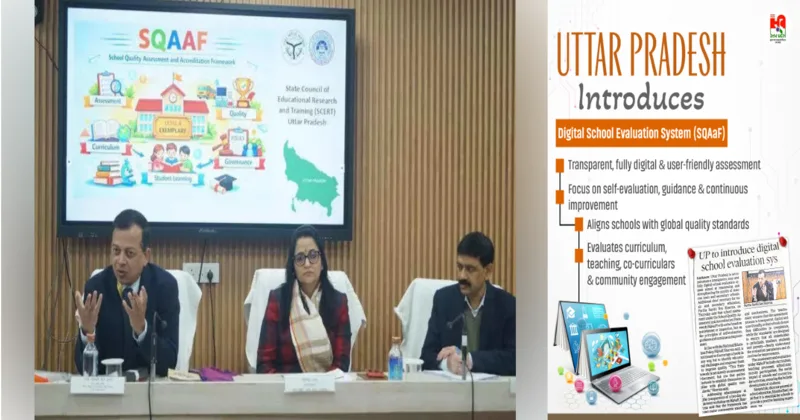
LUCKNOW: The Uttar Pradesh government is set to launch a transparent, easy, and fully digital school evaluation system to strengthen the quality of education in state-run basic and secondary schools. The initiative aligns with the vision of the National Education Policy (NEP) 2020 to promote quality, inclusivity, and continuous improvement in the education ecosystem. The new framework, known as the School Quality Assessment and Accreditation Framework (SQAAF), will redefine how schools in the state are assessed. According to Partha Sarathi Sen Sharma, Additional Chief Secretary for Basic and Secondary Education, the evaluation system will focus not on punishment or inspection but on self-evaluation, guidance, and improvement.
He emphasised that this framework aims to make the assessment process more meaningful and supportive rather than punitive. “The purpose is to help schools identify their challenges and address them through continuous improvement and innovation. This framework guides schools to align themselves with global quality standards,” Sharma said while addressing educationists at the inauguration of a two-day state-level workshop on SQAAF in Lucknow.
Unlike traditional inspection-based systems that often highlight shortcomings, the new digital model focuses on helping schools understand their performance in key areas. It promotes a self-directed approach in which schools assess their strengths and weaknesses, set improvement goals, and monitor their progress.
This self-evaluation model is designed to create a culture of accountability, ownership, and collaboration among teachers, principals, and school communities. Instead of waiting for external evaluation, schools will be empowered to monitor their progress and adopt innovative practices to improve learning outcomes.
Two Major Components: Standards and Mechanisms
The new framework has two major components – Standards and Mechanisms.
- The Standards component ensures that all stakeholders, including principals, teachers, students, and parents, have a clear understanding of the evaluation parameters and quality benchmarks. These standards cover key areas including curriculum design, pedagogy, student engagement, and community involvement.
- The Mechanisms component ensures that the assessment process is transparent, digital, and user-friendly. This digital transformation aims to streamline compliance for schools, eliminate manual record-keeping, and enable real-time data monitoring.
Together, these components will ensure the evaluation system is both efficient and inclusive, leaving no room for ambiguity or bias.
The School Quality Assessment and Accreditation Framework (SQAAF) is comprehensive. It covers multiple dimensions of school operations to ensure students’ holistic development. The key focus areas include:
Curriculum and Teaching Process: Evaluating how well schools implement curriculum design, teaching strategies, and assessment techniques that promote understanding and creativity rather than rote learning.
School-Community Participation: Encouraging collaboration between schools and local communities to create a supportive environment for learning and social development.
Co-Curricular Activities: Recognising the importance of sports, art, and cultural events in shaping students’ all-around personalities
Social Impact and Inclusivity: Measuring how schools contribute to social awareness, equality, and inclusiveness in education.
Learning Environment: Ensuring that schools provide a safe, engaging, and positive atmosphere for both students and teachers
By evaluating schools against these parameters, SQAAF aims to build a system in which the quality of education is measurable, transparent, and continuously improving.
The introduction of SQAAF is fully aligned with the National Education Policy (NEP) 2020, which advocates outcome-based education and regular institutional assessment. The framework’s design reflects NEP’s core objectives, promoting flexibility, creativity, innovation, and accountability within the school system.
Partha Sarathi Sen Sharma noted that the purpose of SQAAF is not to discourage schools but to identify educational challenges and help them improve quality in a structured way. “This is not merely an assessment document,” he said, “but a guidance framework that helps schools enhance their performance based on global quality parameters.”
The framework also emphasises the active participation of all stakeholders, from teachers and principals to parents and students. Making the process transparent and inclusive ensures that everyone involved in education understands their role in improving school quality. Workshops, training sessions, and awareness campaigns are being planned to familiarise teachers and administrators with the digital evaluation process. This capacity-building initiative will be key to ensuring that schools not only comply with the system but also use it as a tool for their own growth.
Director General of School Education, Monika Rani, highlighted that the ultimate goal of this initiative is to ensure a positive learning experience for every student. She emphasised that evaluation should not be seen as a mere formality but as an opportunity to enrich the teaching and learning process. “The framework encourages schools to move beyond traditional metrics and focus on holistic education, nurturing creativity, emotional intelligence, and moral values along with academic excellence,” she said.
Learning Environment: Ensuring that schools provide a safe, engaging, and positive atmosphere for both students and teachers.
By evaluating schools against these parameters, SQAAF aims to build a system in which the quality of education is measurable, transparent, and continuously improving.
The introduction of SQAAF is fully aligned with the National Education Policy (NEP) 2020, which advocates outcome-based education and regular institutional assessment. The framework’s design reflects NEP’s core objectives, promoting flexibility, creativity, innovation, and accountability within the school system.
Partha Sarathi Sen Sharma noted that the purpose of SQAAF is not to discourage schools but to identify educational challenges and help them improve quality in a structured way. “This is not merely an assessment document,” he said, “but a guidance framework that helps schools enhance their performance based on global quality parameters.”
The framework also emphasises the active participation of all stakeholders, from teachers and principals to parents and students. Making the process transparent and inclusive ensures that everyone involved in education understands their role in improving school quality. Workshops, training sessions, and awareness campaigns are being planned to familiarise teachers and administrators with the digital evaluation process. This capacity-building initiative will be key to ensuring that schools not only comply with the system but also use it as a tool for their own growth.
Director General of School Education, Monika Rani, highlighted that the ultimate goal of this initiative is to ensure a positive learning experience for every student. She emphasised that evaluation should not be seen as a mere formality but as an opportunity to enrich the teaching-learning process. “The framework encourages schools to move beyond traditional metrics and focus on holistic education nurturing creativity, emotional intelligence, and moral values along with academic excellence,” she said.