NEW DELHI: In India, road accidents are a serious concern, and the country ranks among the top in global road accident deaths. Approximately 4.5 million road accidents occur each year, placing a significant burden on families, healthcare, and the economy in that country. Close to 11 per cent of global road death casualties occur in one lone country called India. The scale of road accident deaths reveals that someone dies every few minutes in road accidents in that country.
The outcome is usually determined within the first 60 minutes after injury, a period known as the Golden Hour in medical practice. Within this small window of opportunity, timely medical intervention can prevent death, permanent incapacitation and lifelong trauma. For decades, this vital hour was regularly lost not because help was not available, but because people did not act. Fear of police interrogation and involvement, legal hassles and hospital formalities dissuaded onlookers from intervening in cases of stranger injury. These wasted minutes directly led to lost lives.
Recognising the gap between intent and action, the Ministry of Road Transport and Highways, under Shri Nitin Gadkari, has introduced a legal framework to protect and encourage those who choose to help.
Indian Road Accident Crisis: The Numbers Tell the Story
The importance of legal clarity becomes evident when seen against India’s road safety data. In 2021, 1,53,972 people lost their lives due to road accidents. This toll increased dramatically in 2022 to 1,68,491 deaths, a hike of almost 10 per cent. Deaths further rose in 2023 to between 1,72,000 and 1,73,000, an increase of about 2.6 per cent. Provisional estimates for 2024 show about 1,70,000 deaths, though some states, such as Gujarat and Haryana, have reported reductions, which have been offset by increases in other states.
There is a worrisome trend in 2025. In the first half of this year, 26,770 people lost their lives on national highways, pushing average daily fatalities close to 485 deaths per day. On multiple occasions in Parliament, Union Road Transport and Highways Minister Nitin Gadkari has maintained that overspeeding is the leading cause of road accidents, but delays in providing assistance and bystander inaction significantly aggravate outcomes. As if those were not grim enough, after a brief decline during the COVID-19 lockdowns, fatalities rebounded to some of the highest levels recorded in two decades.
Road accidents also contribute significantly to economic impact. According to estimates from the ministry, road accidents cost India 3 per cent of GDP each year, according to a report by IIT Delhi. This includes costs associated with medical treatment and lost productivity, making road safety an economic imperative as well as a societal concern.
Good Samaritan Law: Removing Fear from Helping
In 2020, the Ministry of Road Transport and Highways notified the Good Samaritan Rules under Section 134A of the Motor Vehicles Amendment Act, 2019, to ensure that no punishment shall be inflicted on compassionate impulses. The law says anyone who helps a road accident victim in good faith should not face harassment or legal trouble. Citizens who step forward in such moments are recognised as Rah-Veers.
Under these rules, a Good Samaritan cannot be compelled to disclose personal information, cannot be detained by police, and is not required to remain at the hospital after the victim is admitted. If the helper does not wish to be a witness, that choice is fully protected. Even if they voluntarily agree to assist an investigation, they can be examined only once at a time and place convenient to them. Hospitals are barred from demanding payment from the helper and must provide immediate emergency care to the victim. The Good Samaritan is entitled only to a simple acknowledgement confirming that the injured person was brought for treatment. By clearly defining these protections, the law removes the fear that once paralysed roadside compassion.
RAHV-VEER Scheme
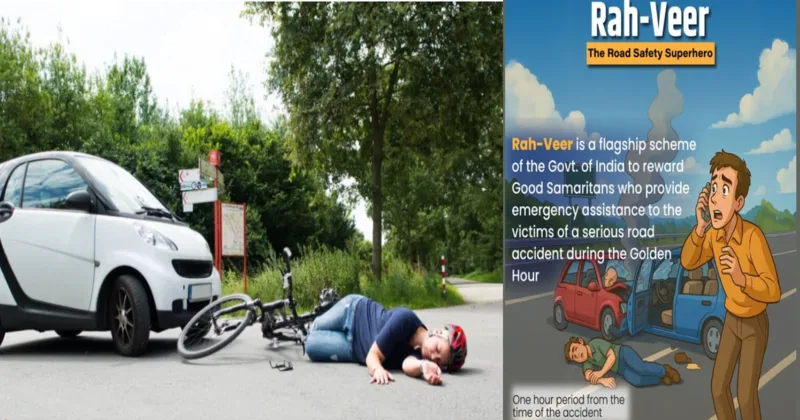
To promote the Good Samaritan Act and encourage prompt action, the government launched the Rah-Veer (Good Samaritan) Scheme. The scheme provides a reward of Rs 25,000, along with a Certificate of Appreciation, to a randomly selected citizen who assists accident victims and arranges their medical treatment within the Golden Hour. The reward would not exceed four times a year. The importance of this message lies in the fact that this award is the nation’s recognition and reward for humanity’s heroes.
The proposed system is not aimed at commercialising compassion but at making it a common practice. By recognising Rah-Veers, the government hopes to encourage citizens to feel confident about doing good deeds for strangers, making it a collective responsibility rather than a personal one.
From Hesitation to Action: Building a Culture of Responsibility
Despite the improvements in roads as well as the growth of the number of medical response units, many deaths are still caused by the fact that medical assistance does not reach the victim in the Golden Hour. Onlookers are often reluctant due to concerns over police protocols or medical complications. Each moment of hesitation yields valuable time. The Good Samaritan law addresses issues of identity and legal responsibility for assistance provided.
The Rah-Veer initiative captures the even larger vision for public participation in public welfare. The state can construct roads and highways, enforce traffic signals, and keep ambulances on standby, but it cannot be at every location where an accident occurs. This is when the country needs its people.
Rah-Veer is something more than a policy and a reward mechanism. It is a reminder that the act of saving a life is not something that requires medical training, only the courage to do it. The hope is that, with awareness of these safeguards, more Indians will come forward unafraid, and the Golden Hour will instead be a time of salvation rather than sorrow.