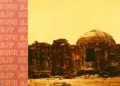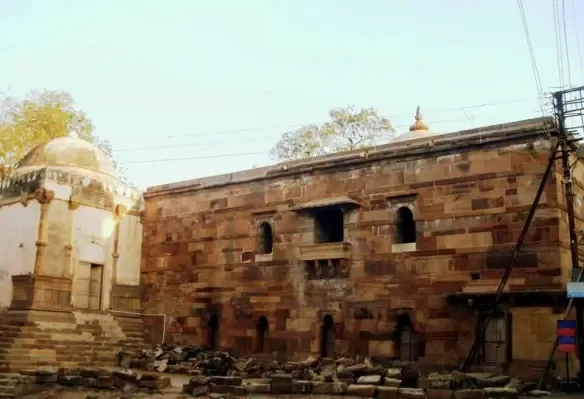
The Jama Masjid of Bharuch, a coastal city with an ancient civilisational past, has returned to the centre of public debate, this time not merely as a monument of medieval architecture, but as a contested historical site layered with religious, archaeological, and legal questions. The immediate trigger was a protest by saints of the Akhil Bharatiya Sant Samiti, who alleged that illegal construction had taken place at the mosque despite it being protected by the Archaeological Survey of India (ASI). Following administrative assurances, the protest was temporarily withdrawn.
Yet the controversy has revived a far older and more consequential question: was the Bharuch Jama Masjid constructed after demolishing Hindu-Jain temples? And if so, what does history, not politics, actually say?
An examination of historical texts, archaeological surveys, British-era documentation, and contemporary government records reveals a striking consistency. Across centuries, authors, archaeologists, and administrators have recorded that the Jama Masjid of Bharuch was built during the reign of Alauddin Khilji using material taken from destroyed Hindu and Jain temples.
Bharuch, historically known as Bhrigukachchha, was among India’s oldest port cities, mentioned in ancient Hindu, Buddhist, and Jain texts. Long before Islamic invasions, it was a flourishing centre of Jain and Hindu religious activity, dotted with temples, viharas, and pilgrimage sites.
This historical context matters. Bharuch was not an empty or neutral landscape when medieval invasions reached Gujarat. It was a city dense with sacred structures, making it a frequent target during campaigns aimed at religious and economic subjugation.
What do Hindu temple records say?
One of the most widely cited modern works documenting temple destruction is Sitaram Goel’s two-volume study “Hindu Temples: What Happened to Them.” While the book is best known for its focus on Ayodhya, it also contains extensive, state-wise documentation of temples demolished during Islamic rule.
In the Gujarat section, Bharuch appears prominently. The very first entry under the district states that the Jama Masjid was constructed in 1321 CE and that materials from Hindu-Jain temples were used in its construction.
The second volume, “The Islamic Evidence,” strengthens this claim by citing Mughal-era records that explicitly mention the reuse of temple pillars in the Bharuch Jama Masjid. These references are not conjectural; they are drawn from Islamic sources themselves.
Multiple historical accounts place the construction of the Jama Masjid squarely within the reign of Alauddin Khilji. Khilji’s campaigns in Gujarat are among the most extensively documented episodes of temple destruction in medieval India.
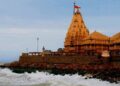
Court chronicler Amir Khusrau records that around 1297–1300 CE, Khilji sent his general Ulugh Khan to subdue Gujarat. The campaign began with the destruction of the Somnath temple and proceeded through coastal cities including Khambhat and Bharuch. Temples were looted, idols destroyed, and building materials repurposed for Islamic structures.
Bharuch, as a prosperous port city with prominent Jain establishments, was a natural target. The historical timeline aligns closely with the recorded construction period of the Jama Masjid.
James Burgess and Archaeological Evidence
Perhaps the most compelling and least disputed evidence comes from British archaeologist James Burgess, who served as Director General of the Archaeological Survey of India between 1886 and 1889. Burgess was not writing as a polemicist, but as a professional documenting architectural realities on the ground.
In his detailed work “On the Muhammadan Architecture of Bharoch (Bharuch), Cambay, Dholka, Champaner and Mahmudabad in Gujarat,” Burgess explicitly states that the Jama Masjid of Bharuch was constructed using materials from demolished Hindu and Jain temples.
He notes several architectural anomalies that support this conclusion:
1. Irregular spacing of pillars, 8 feet in some places, 10 in others, and even 13 feet elsewhere, resulting in uneven domes. Such irregularity, Burgess explains, is typical when temple materials are reused rather than purpose-built.
2. Animal and figurative carvings on pillars, which are inconsistent with Islamic aniconism but common in Hindu and Jain temples.
3. Roof segments that appear to be taken from smaller domes of earlier Jain shrines.
4. A marble gateway in the courtyard bearing defaced Jain figures, unmistakably of temple origin.
Burgess even remarks that the mihrabs of the mosque are architecturally atypical for Gujarat, suggesting adaptation rather than original design.
District and Government Records
The Bharuch District Directory Report further reinforces this historical narrative. It records that during Khilji’s invasions, a Jain derasara was seized and converted into a mosque. Another Jain shrine, Shamaliya Vihar, is also noted as having been demolished and repurposed under Muslim rule.
Most significantly, the official website of the Bharuch District Collector acknowledges that the Jama Masjid was built using remnants of ancient Jain temples. It explicitly states that temple stones were reused and that Hindu architectural markers remain visible in the mihrab.
This point is crucial: there is no contradiction between academic research and official government records. Across centuries and administrative regimes, the story remains consistent.
The historical debate resurfaced after saints of the Akhil Bharatiya Sant Samiti launched a protest, alleging illegal construction at the ASI-protected Jama Masjid. As reported by OpIndia, the saints claim that the site is actually the Samli Vihar Jain temple and the birthplace of Chakradhar Swami.
Speaking to OpIndia, Swami Muktanand stated that the monument is a “living national heritage site” under ASI protection and that even minor alterations, such as installing fans or constructing a wuzu-khana—constitute criminal violations under the Archaeological Act.
He drew parallels with the Bhojshala temple in Dhar and the Taj Mahal, where worship is permitted only on designated days and no permanent religious modifications are allowed. “Even driving a nail into a protected living monument is illegal,” he told OpIndia.
According to report, the Sant Samiti has placed specific, legally grounded demands before the administration:
1. Public disclosure of the gazette notification and takeover agreement under which the ASI assumed control of the site.
2. Strict ASI control over opening hours and access.
3. Removal of all illegal constructions using cement, sand, and bricks.
4. Clearance of encroachments within the prohibited 100-metre and regulated 200-metre zones.
5. Restoration of the monument’s original entrance.
6. Legal action against officials accused of negligence.
Importantly, the saints have clarified that their present demand is not ownership transfer, but strict enforcement of ASI norms and a fresh archaeological survey.
ASI Intervention and Temporary De-escalation
Following the hunger strike that began on January 5, the administration intervened. Swami Muktanand told OpIndia that under the mediation of the Superintendent of Police, ASI officials agreed to initiate a survey within two to three days. Temporary structures are to be removed within 8–10 days, while permanent alterations will be addressed within two months.
Members of the Sant Samaj are also expected to be included in the survey process, an assurance that led to the suspension of the hunger strike.
The Bharuch Jama Masjid controversy is not, at its core, a clash of interpretations. On the historical question, there is remarkable unanimity. From Amir Khusrau and James Burgess to Sitaram Goel and modern district records, the evidence consistently shows that the mosque was constructed during Alauddin Khilji’s reign using materials from demolished Hindu-Jain temples.
As the ASI survey proceeds, the Bharuch case shows a larger national issue: whether India’s archaeological heritage will be preserved as per the law, or slowly altered through neglect and incremental violations. History has already spoken. The question now is whether institutions will listen.