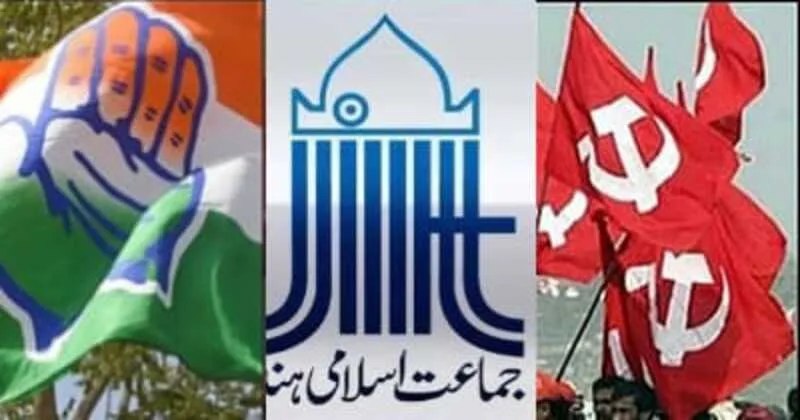
Thiruvananthapuram: Jamaat-e-Islami has openly acknowledged that it has strategically shifted its votes between the Left Democratic Front (LDF) and the United Democratic Front (UDF) with the sole objective of defeating the Bharatiya Janata Party (BJP). The organisation has confirmed that it held discussions with leaders of both political fronts as part of this electoral strategy. According to Jamaat-e-Islami, such tactical voting is not new. The organisation admitted that it had supported the Left in multiple elections in the past, including in 2004, 2006, 2009, and 2011. In the most recent local body elections, Jamaat-e-Islami once again extended support to the Communist Party of India (Marxist) in specific wards of the Thiruvananthapuram Corporation where the BJP was perceived to have a strong chance of winning.
Jamaat-e-Islami Kerala Ameer P. Mujeeb Rahman publicly stated that the organisation’s policy has consistently been to back whichever front stood second in terms of winning prospects, solely to prevent a BJP victory. He questioned why both the LDF and the UDF had repeatedly accepted Jamaat-e-Islami’s support at different points in time, while now disowning it for political convenience. Rahman also asked why those who presently criticise the ideological foundations of Abul A’la Maududi had remained silent when electoral support was extended earlier.
This revelation comes at a sensitive political moment, with both the Left and the Congress-led Right fronts, particularly the CPM and the Congress, having publicly denied any electoral understanding or vote-buying arrangement with Jamaat-e-Islami.
As legislative assembly elections approach, both alliances have been projecting themselves as secular alternatives, and Jamaat-e-Islami’s statement now places them under pressure to explain their past conduct and present contradictions.
Jamaat-e-Islami clarified its position after CPI(M) leader A.K. Balan asserted that the party had no friendship or political alignment with Jamaat-e-Islami. In response, the organisation stated unequivocally that it had, in fact, supported the CPI(M) on multiple occasions, including in recent elections, contradicting Balan’s claims.
Looking ahead to the upcoming assembly elections, Jamaat-e-Islami announced that it would continue its strategy of voting against the BJP wherever the party appeared capable of winning. In such constituencies, Jamaat-e-Islami voters would support candidates from whichever front, Left, Congress, or Muslim League, had the strongest chance of defeating the BJP. Mujeeb Rahman stated that even in constituencies where the Welfare Party is contesting, the primary objective would remain preventing a BJP victory.
Rahman further asserted that if the BJP emerged as a serious contender in any seat, Jamaat-e-Islami would decisively back the Left to ensure the BJP’s defeat. At a press conference, he also demanded that the Congress and the CPM come together in Kerala to strengthen the INDIA front, signalling a push for broader opposition unity against the BJP.
The controversy has also revived debates surrounding CPI (M) leader A.K. Balan’s earlier statement that Jamaat-e-Islami would gain influence over internal affairs if the UDF returned to power, and that incidents like the Marad riots could recur. Jamaat-e-Islami responded to these allegations by issuing a legal notice, accusing Balan of spreading fear and misinformation. Critics have described this exchange as emblematic of political double standards.
When eight poor Hindu fishermen were killed in the Marad massacre, political unity among those accused of shielding the attackers stood in stark contrast to today’s public posturing. The UDF government at the time ignored repeated demands from the victims’ families for justice and, with the joint support of the CPM and Muslim religious organisations, maintained that there was no need for a CBI investigation. The then CPI(M) state secretary Pinarayi Vijayan reiterated this position before the Judicial Commission, asserting that a central probe was unnecessary.
During this period, the CPM provided political backing to organisations such as the National Democratic Front (NDAF) and Jamaat-e-Islami, while the UDF government, under the influence of the Muslim League, extended administrative support. A Jamaat-e-Islami–linked organisation, operating under the banner of human rights, demanded the rehabilitation of the accused even before the charge sheet was filed in the massacre case. Prior to the incident, the families of those later accused were systematically relocated to shield them from the anticipated aftermath of the violence. At that time, CPI(M) and Jamaat-e-Islami leaders raised their voices in unison to defend those involved. The CPI(M) effectively functioned as a political shield for Jamaat-e-Islami, a fact critics argue stands in sharp contrast to the party’s current claims of ideological distance. The CPM’s present stance, according to detractors, amounts to sheer hypocrisy.
The collaboration between the two organisations was not limited to the Marad episode. Over the past three decades, Jamaat-e-Islami has extended electoral support to the CPI(M) in multiple elections. The party’s own mouthpiece published editorials praising this alliance, and former Jamaat-e-Islami amirs have openly spoken about a “gentleman’s agreement” with the CPM during elections. In 2011, then CPI(M) state secretary Pinarayi Vijayan held discussions with Jamaat-e-Islami’s then amir T. Arifali, securing a share of the organisation’s vote base. This cooperation extended beyond Kerala as well. In the last Lok Sabha elections, Jamaat-e-Islami supported CPI(M) candidates in two constituencies in Tamil Nadu and one in Rajasthan.
During the 2020 local body elections, Jamaat-e-Islami backed CPI(M) candidates across several districts, including Kannur, Kozhikode, Malappuram, Palakkad, Thrissur, and Alappuzha.
The so-called Maududi–Marxist alliance contested elections together in 23 village panchayats in Malappuram and jointly contested 11 panchayats in Kozhikode. The two groups also shared power in the Mukkam Municipal Council and the Kodiyathur Panchayat. When Jamaat-e-Islami first entered electoral politics under the banner of the Development Front, later renamed the Welfare Party, it was the CPM that extended political support and helped bring the organisation into the mainstream. Despite Jamaat-e-Islami being numerically marginal within the Muslim community, CPI(M) backing enabled it to gain visibility and electoral relevance.
Critics argue that having once elevated Jamaat-e-Islami and benefited from its support, the CPI(M) is now attempting to distance itself for political expediency. They contend that a tacit understanding continues to exist between the two organisations and that they are likely to reunite politically whenever circumstances permit.
In this context, Jamaat-e-Islami’s latest disclosures have exposed deep contradictions within Kerala’s political landscape, raising uncomfortable questions for both the Left and the Congress-led fronts as they seek to present themselves as principled, secular alternatives in the run-up to the assembly elections.