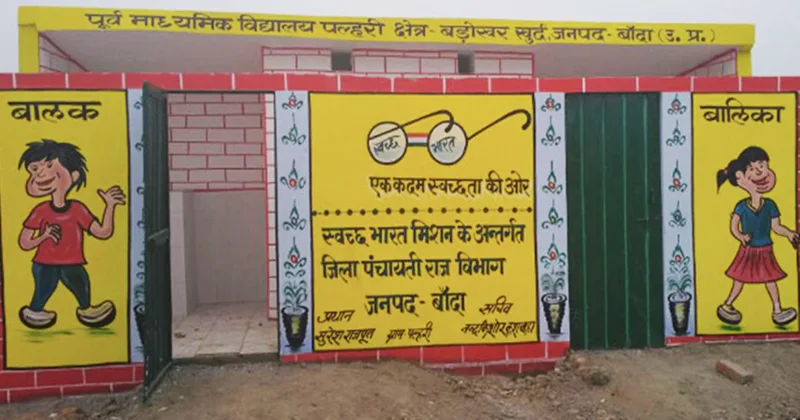
LUCKNOW: Uttar Pradesh has emerged as a frontrunner in the national sanitation mission by accounting for nearly 28 per cent of the total toilets constructed across India in the current financial year, according to official data shared during a review meeting chaired by Chief Minister Yogi Adityanath with the Panchayati Raj Department on Friday. As per the figures, 17.26 lakh toilets have been built across the country during this fiscal year, out of which 4.79 lakh units were constructed in Uttar Pradesh alone. The state was given an individual target of 9.67 lakh toilets, and has already completed nearly half of it. It continues to hold the top position in individual household toilet construction under the ongoing rural sanitation initiatives.
UP Chief Minister Yogi Adityanath praised the Panchayati Raj Department for its dedicated efforts in strengthening rural sanitation and infrastructure. He noted that the construction progress reflects the government’s commitment to improving hygiene standards in villages and promoting the vision of a “Swachh and Swasth Uttar Pradesh.” CM Yogi emphasized that the mission to construct toilets under the government’s cleanliness campaign is not just about infrastructure creation but also about ensuring dignity, health, and safety, especially for women and children in rural areas. He instructed officials to maintain transparency, quality, and timely completion of all ongoing sanitation projects.
Along with toilet construction, the Uttar Pradesh Chief Minister Yogi was also briefed about the progress made in solid waste management. Out of a target of 282 plastic waste management units, the state has so far completed construction of 103 units, spread across 304 development blocks. Another 132 units are currently under construction, reflecting steady advancement toward sustainable waste disposal and recycling in rural belts.
Officials informed that the state has achieved 140.89 per cent of its revenue collection target under the Panchayati Raj Department, recording Rs 271.48 crore in the last financial year compared to Rs 193.84 crore previously. This significant improvement highlights efficient governance and financial discipline in rural administrative functions.
During the meeting, Chief Minister Yogi Adityanath directed officials to create integrated campuses in gram panchayats, combining essential community facilities in one place. These integrated village centres would include arrangements for a school, Utsav Bhawan, sports ground, open gym, park, and model shop, among others.
He said that such a model would not only improve access to amenities but also help in the holistic development of villages. The CM added that public representatives should be included in land selection and project monitoring to ensure transparency and community participation in the development process.
To encourage contributions from Non-Resident Indians (NRIs) originally from Uttar Pradesh, the Chief Minister proposed to link expatriates with the Matribhoomi Yojana, under which they can contribute financially to development projects in their ancestral villages.
Under this scheme, the state government would cover a portion of the cost, with the remainder funded by donors. The CM also suggested that these projects be named after the contributors’ ancestors to honour their roots and inspire others to participate in the initiative.
Chief Minister Yogi Adityanath also directed officials to intensify public outreach and awareness about government schemes through open chaupal sessions in every gram panchayat. These community gatherings will help people learn about available welfare programs, sanitation initiatives, and the benefits of government subsidies. He instructed that beneficiary verification for all rural welfare schemes should be carried out in a time-bound manner to ensure that the right people receive assistance. “Transparency and people’s participation are the key pillars of good governance,” he said.
Discussing improvements in village facilities, the CM reiterated the state’s goal of making every panchayat open-defecation-free (ODF) and garbage-free. He said that clean surroundings lead to better health outcomes, reduced disease burden, and improved quality of life for rural citizens.
The Chief Minister emphasised that toilets should not remain symbolic structures but must be properly maintained and regularly used by households. Local committees and panchayat officials were advised to conduct awareness drives to educate residents on personal hygiene, waste segregation, and cleanliness practices.
Yogi Adityanath directed district authorities to recognise gram panchayats and individuals demonstrating outstanding work in cleanliness, sanitation, and waste management. Awards and state-level recognition programs will be organised to celebrate these achievements and motivate others to follow their example. He also called for including sanitation topics in school activities and youth programs to ensure the hygiene message reaches the younger generation effectively.
UP’s Leadership in Swachh Bharat Mission
Uttar Pradesh’s consistent performance under the Swachh Bharat Mission (Gramin) has placed it among the top-performing states in India. The construction of 4.79 lakh toilets in just one fiscal year not only highlights administrative efficiency but also underscores the government’s strong focus on improving rural life and public health. By coupling toilet construction with waste management, public awareness, and integrated rural development, Uttar Pradesh aims to set a model of sustainable sanitation and inclusive progress for the rest of the country.