Natham Kanavai Battle: How Locals Defeated British
June 20, 2026
  • Read Ecopy
  • Circulation
  • Advertise
  • Careers
  • About Us
  • Contact Us
Android AppiPhone AppArattai
Organiser
  • ‌
  • Bharat
    • Assam
    • Bihar
    • Chhattisgarh
    • Jharkhand
    • Maharashtra
    • View All States
  • World
    • Asia
    • Europe
    • North America
    • South America
    • Africa
    • Australia
  • Editorial
  • International
  • Opinion
  • RSS @ 100
  • More
    • Op Sindoor
    • Analysis
    • Sports
    • Defence
    • Politics
    • Business
    • Economy
    • Culture
    • Special Report
    • Sci & Tech
    • Entertainment
    • G20
    • Azadi Ka Amrit Mahotsav
    • Vocal4Local
    • Web Stories
    • Education
    • Employment
    • Books
    • Interviews
    • Travel
    • Law
    • Health
    • Obituary
  • Subscribe
    • Subscribe Print Edition
    • Subscribe Ecopy
    • Read Ecopy
  • ‌
  • Bharat
    • Assam
    • Bihar
    • Chhattisgarh
    • Jharkhand
    • Maharashtra
    • View All States
  • World
    • Asia
    • Europe
    • North America
    • South America
    • Africa
    • Australia
  • Editorial
  • International
  • Opinion
  • RSS @ 100
  • More
    • Op Sindoor
    • Analysis
    • Sports
    • Defence
    • Politics
    • Business
    • Economy
    • Culture
    • Special Report
    • Sci & Tech
    • Entertainment
    • G20
    • Azadi Ka Amrit Mahotsav
    • Vocal4Local
    • Web Stories
    • Education
    • Employment
    • Books
    • Interviews
    • Travel
    • Law
    • Health
    • Obituary
  • Subscribe
    • Subscribe Print Edition
    • Subscribe Ecopy
    • Read Ecopy
Organiser
  • Home
  • Bharat
  • World
  • Operation Sindoor
  • Editorial
  • Analysis
  • Opinion
  • Culture
  • Defence
  • International Edition
  • RSS @ 100
  • Magazine
  • Read Ecopy
Home Politics

Natham Kanavai Battle 1755: How Hindus defeated a temple-looting British officer and retrieved sacred Murtis

A victory from 1755 has returned to public attention after the Madras High Court recalled the Natham Kanavai battle while clearing a memorial for it. The judgment recounts how local forces defeated British troops led by a temple-looting officer and recovered sacred murtis, exposing an early chapter of resistance to colonial plunder

Surender KumarSurender Kumar
Jan 5, 2026, 05:00 pm IST
in Politics, Bharat, Tamil Nadu
Follow on Google News
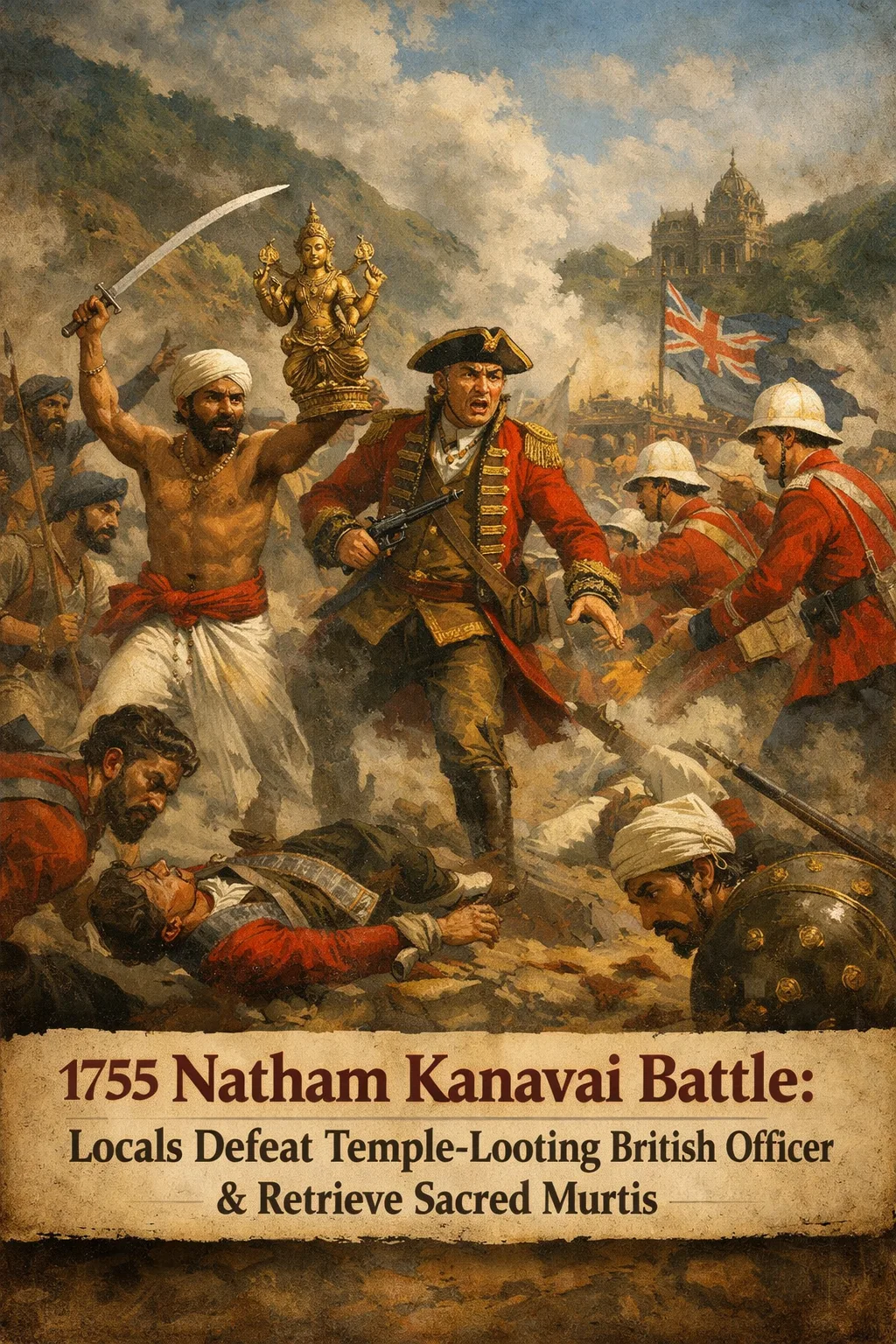
Representative AI image

Representative AI image

FacebookTwitterWhatsAppTelegramEmail

The Natham Kanavai battle of 1755 is recorded as one of the armed confrontations between locals of Tamil Nadu and East India British colonial troops. The clash took place at Natham Kanavai (Natham Pass), a strategic mountain passage in present-day Dindigul district, which served as a critical transit route during the mid-18th century.

As per historical accounts placed, the British forces had looted the Thirumogur (Koilkudi) Temple and removed brass murtis from the temple. The contingent responsible for transporting the looted murtis was led by Colonel Alexander Heron, a British officer operating in the Madurai region at the time. The British force intended to pass through the Natham Kanavai while moving the seized temple property.

In response, members of the Melur Kallar community, known for their martial tradition, mobilised in large numbers to intercept the British troops. A fierce and bloody confrontation followed at the Natham Pass.

Madras High Court-recorded material indicates that thousands of lives were lost during the encounter, underscoring the scale and intensity of the battle.

Despite heavy casualties, the Kallar forces emerged victorious, successfully retrieving all the looted temple murtis from the British convoy. Colonel Heron is said to have retreated to Tiruchirappalli with only about 30 surviving soldiers, marking a decisive defeat for the European colonial forces.

The battle has since been remembered as a victory of native forces over colonial rule, predating the more widely documented phases of India’s freedom struggle.

The historical episode of the Natham Kanavai battle (1755) came under judicial review when members of the Kallar community approached the court seeking permission to erect a memorial stupa in its memory on private patta land. While hearing the petition, G.R. Swaminathan referred to the battle in detail in order dated November 21, 2025, placing it in the context of early resistance by native forces against British colonial expansion in the Madurai region.

Also Read: British archive reveals enormous loot of valuable Indian resources during the colonial period

The Court recorded that the Kallar community possessed a strong martial tradition, comparable to groups such as the Gurkhas and Rajputs. This very resistance to colonial authority, the judgment noted, was a key reason why the British subsequently branded the Kallars as a “criminal tribe”. The Court observed that the community languished for decades under this colonial stigma, facing sustained social discrimination and hardships, until later leaders worked towards redeeming their status and dignity.

This episode also highlights how British officers looted temples in India during the colonial period, in a manner comparable to earlier Muslim invaders. The difference lay mainly in method, not intent. Whenever an opportunity arose, British officers removed ornamental murtis and temple artefacts and diverted them to British coffers, while Islamic invaders typically plundered such wealth and distributed it among themselves as ganimah.

As a result, institutions such as the British Museum today house vast collections of Indian artefacts and murtis looted during colonial rule. Officers like Colonel Alexander Heron, who led temple-looting expeditions under the guise of military authority, can thus be seen less as colonial officers and more as thieves operating under imperial protection.

The branding of communities such as the Kallars was institutionalised through the Criminal Tribes Act, first enacted by the British colonial administration in 1871 under the British Raj. In the Madras Presidency, the British listed around 237 castes and communities under this cruel law. Entire groups were subjected to routine police surveillance, harassment, and severe restrictions on movement, effectively stripping them of personal liberty under the pretext of controlling “habitual offenders”, even though the vast majority were innocent members of these notified communities.

The Act was based on the colonial assumption that certain communities were “criminal by birth” rather than by individual conduct. Entire castes and tribes were notified under the law, meaning that every member—men, women, and even children—was treated as a suspect by default.


Topics: Natham Kanavai BattleBritish temple lootColonial plunder in IndiaKallar community historyTemple murtis looted by BritishJustice G R Swaminathan
ShareTweetSendShareSend
✮ Subscribe Organiser YouTube Channel. ✮
✮ Join Organiser's WhatsApp channel for Nationalist views beyond the news. ✮
Previous News

India gains from power shift in Venezuela as Left aligns with China against New Delhi’s economic & strategic interests

Next News

Saffron Shields: The 2025 saga of RSS and Sewa Bharti’s unwavering service to Bharat

Related News

Justice G.R. Swaminathan faces targeted attack by The News Minute after his Deepam ruling

The News Minute does it again: Manufacturing communal outrage over Justice G.R. Swaminathan comment on Karthigai Deepam

Natham Kanavai (1755): Temple plunder, indigenous resistance and restoring forgotten warriors of Bharat

Justice GR Swaminathan (Right)

Tamil Nadu: Law & order cannot be a ground for flouting court’s order – Justice GR Swaminathan on Karthigai Deepam row

Tamil Nadu: Madras HC summons ADGP, Chief Secretary in Karthigai Deepam row

Load More

Latest News

Screen grab of the viral video of Ayaaz Madare and the victim

Nagpur Conversion Case: Absconding Maulana involved in rape of Air Force officer’s wife arrested

Telangana: Secunderabad Cantonment renames 21 British-era roads after Indian military heroes and national icons

Keralam former CM Pinarayi Vijayan - Veena Vijayan (Left to Right)

Keralam CMRL Case: ED examines bank lockers of former CM Pinarayi Vijayan’s daughter Veena

A Constitutional Lesson for Priyank Kharge

Government employess of Balochistan begin indefinite strike against Pakistan

Balochistan on Boil: Govt employees start indefinite strike against Pakistan; 400 LPG bowsers stranded in Tuftan

Uttar Pradesh: Yogi govt unveils farm-to-consumer model to deliver chemical-free food via ‘Poison-Free Food’ mission

Hindu activists booked by Bhatkal police for attempting to save a Hindu girl who was being kidnapped by a muslim man

Karnataka: Hindu activists booked for rescuing girl being taken by Muslim man; Bhatkal police action sparks criticism

NTA Changes Prayagraj Exam Venue Ahead of NEET UG 2026 Re-Test, Releases New Admit Cards

NEET UG 2026 Re-Test: NTA moves Prayagraj centre, launches WhatsApp alerts and anti-fraud advisory

Security forces have arrested Aizaz Ahmad Khanday, Arbaz Ahmad Mir, and Nasir Ahmad Dar in Shopian after recovering explosive substances and Hizbul Mujahideen posters from their possession (Image Source: X)

J&K: High grade explosive PEK seized in Shopian from 3 OGWs working for HM; 2 held in Kishtwar for terror links

PM Modi’s Gift to Global Leaders: Kalamkari Mahabharat, Charaka Samhita reflects India’s timeless artistic heritage

Load More
  • Privacy
  • Terms
  • Cookie Policy
  • Refund and Cancellation
  • Delivery and Shipping

© Bharat Prakashan (Delhi) Limited.
Tech-enabled by Ananthapuri Technologies

  • Home
  • Search Organiser
  • Bharat
    • Assam
    • Bihar
    • Chhattisgarh
    • Jharkhand
    • Maharashtra
    • View All States
  • World
    • Asia
    • Africa
    • North America
    • South America
    • Europe
    • Australia
  • Editorial
  • Operation Sindoor
  • Opinion
  • Analysis
  • Defence
  • Culture
  • Sports
  • Business
  • RSS @ 100
  • Entertainment
  • More ..
    • Sci & Tech
    • Vocal4Local
    • Special Report
    • Education
    • Employment
    • Books
    • Interviews
    • Travel
    • Health
    • Politics
    • Law
    • Economy
    • Obituary
  • Subscribe Magazine
  • Read Ecopy
  • Advertise
  • Circulation
  • Careers
  • About Us
  • Contact Us
  • Policies & Terms
    • Privacy Policy
    • Cookie Policy
    • Refund and Cancellation
    • Terms of Use

© Bharat Prakashan (Delhi) Limited.
Tech-enabled by Ananthapuri Technologies