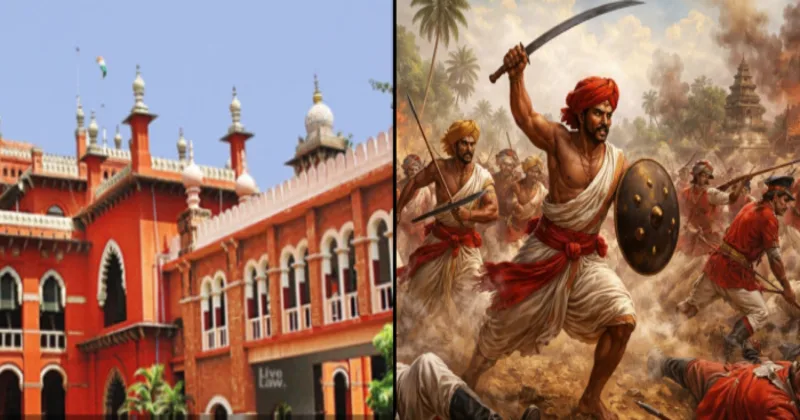
How a civilization remembers its past determines how it understands its present and imagines its future. In Bharat, the memory of resistance to foreign domination has often been reduced to selective episodes, dominant personalities or popular nationalist movements, leaving aside countless local and community-based acts of courage that never entered formal historical accounts. The battle of Natham Kanavai in 1755, recently brought back into public discourse through a judicial decision of the Madras High Court, presents one such moment of forgotten or lesser-known resistance that prompts an examination of how indigenous struggles are remembered—or neglected—in independent Bharat.
This confrontation, fought at Natham Pass in present-day Tamil Nadu, saw the Melur Kallar community rise against the British forces to recover sacred murtis looted from the Thirumogur (Koilkudi) Temple. Thousands of lives were lost in the struggle, yet the Kallars succeeded in reclaiming the stolen idols, marking a decisive moment of indigenous resistance that has, until recently, remained largely forgotten. By briefly tracing the events of 1755 battle, understanding the recent verdict of the Madras High Court, and situating the episode within the broader framework of civilizational continuity, the article underscores the significance of restoring the memory of Bharat’s forgotten warriors, ensuring that their sacrifices are acknowledged and integrated into our collective historical consciousness.
The immediate controversy and the Madras High Court’s ruling
The immediate trigger for renewed attention to Natham Kanavai battle of 1755 was the refusal by local authorities to permit the construction of a memorial stupa commemorating the warriors who participated in the battle. As noted in the proceedings before the Madras High Court, the proposed memorial was to be erected on private patta land, not on public or government property. Despite this, administrative permission was denied, compelling the petitioner lawyer Siva Kalaimani Ambalam to approach the Court.
The judgment of Justice G.R. Swaminathan has brought the Natham Kanavai battle into contemporary discussion, reaffirming the significance of recognizing historical acts of indigenous resistance. The Court underscored that the erection of memorials on private property, particularly to honor acts of historical and civilizational significance, does not require governmental authorization unless explicitly restricted by law. In doing so, Justice Swaminathan highlighted that memorialization is a civilizational and historical duty, which contributes to shared memory and national identity. He emphasized that remembering local victories against colonial powers is equally vital to instil pride and historical awareness. The judgment further emphasized India’s plural and civilizational unity, noting that distinct communities and their heroic acts collectively enrich the country’s historical consciousness.
Resistance as Dharma: Why temple defense was non-negotiable
The confrontation at Natham Kanavai was far more than a mere armed clash; it was an expression of dharma in action, reflecting the Hindu civilizational understanding of temples as living institutions. An attack on a temple or its idols is not perceived merely as property damage but as an assault on dharma itself. This civilizational understanding provides the conceptual framework within which resistance at Natham Kanavai becomes intelligible. The very act of intercepting the colonial convoy and reclaiming the idols can thus be seen as an affirmation of dharma—an assertion that spiritual and cultural continuity cannot be subordinated to foreign domination.
Furthermore, the Natham Kanavai battle illustrates how resistance was structured around collective responsibility. Communities came together, coordinating their efforts to face a formidable adversary, guided by shared values. The bravery of the Kallar community serves as a testament that defending sacred institutions was considered non-negotiable, not optional, and that such resistance formed the backbone of civilizational continuity in the face of colonial incursions. The episode challenges the often-repeated narrative that Hindus passively accepted foreign domination. On the contrary, resistance arose naturally whenever the core of civilizational life was threatened, spanning regions, castes and communities. The Natham Kanavai battle underscores that collective action was possible even amid social and political heterogeneity, particularly when the threat touched the spiritual, cultural or moral essence of society.
By viewing the battle through this lens, one appreciates that such resistance was not isolated or opportunistic; it was deeply embedded in the Hindu civilizational ethos, demonstrating that the protection of dharma, temples, idols and rituals could inspire coordinated action that shaped history. Even where resistance did not crystallize into large-scale movements, it manifested in localized, intense and meaningful confrontations that expressed civilizational self-respect. This framework of collective mobilization offers insight into countless other localized resistances across Bharat, many of which have been forgotten in mainstream historical narratives.
Selective commemoration and the question of moral consistency
The discussion around Natham Kanavai is not merely historical; it is also deeply relevant to contemporary patterns of recognition and memory in Bharat. The denial of permission to commemorate Natham Kanavai warriors invites comparison with other instances where memorials have been permitted. In recent years, memorials have been allowed even for individuals accused under stringent laws. While permission for a memorial celebrating indigenous resistance of Natham Kanavai warriors was denied, memorials for controversial contemporary figures, such as Stanislaus Lourduswamy—popularly known as Stan Swamy—was allowed, despite the fact that he faced serious charges under the Unlawful Activities Prevention Act (UAPA) and was linked to the Bhima Koregaon case, a controversy that distorted historical events and created rifts within Hindu society.
This contrast raises pressing question of moral consistency in honoring individuals or events. When a figure (Stan Swamy) accused of undermining national unity, especially Hindu unity is granted public memorialization, the denial of recognition to warriors who sacrificed life and limb to protect sacred institutions and resist foreign domination appears glaringly unjust. The Natham Kanavai warriors acted to protect temples, dharma, and community honor—fundamental aspects of Hindu civilization—yet decades, even centuries later, their deeds face bureaucratic resistance and selective forgetfulness.
Such selective commemoration is not merely symbolic. It shapes public consciousness, influencing how present and the future generations perceive their own history and civilizational identity. By allowing memorials for individuals with contested legacies while questioning those for genuine freedom fighters, there is a risk of eroding respect for dharmic resistance and weakening the moral framework that supports national and cultural cohesion.
Distorted histories and the cost of civilizational amnesia
The whole episode reflects a broader pattern of civilizational amnesia that has afflicted Bharat over centuries. When historical events are selectively remembered, reshaped or suppressed, the collective understanding of resistance, sacrifice and dharmic duty becomes distorted. This distortion often portrays colonial-era conflicts as internal disputes among Hindus, obscuring the fundamental truth that these were confrontations between indigenous communities defending dharma, temples and societal continuity and foreign powers seeking dominance.
Civilizational amnesia carries serious consequences. It weakens social cohesion, undermines confidence in India’s historical resilience, and encourages narratives that depict Hindus as passive or complicit in their own subjugation. Considering the events like Natham Kanavai as minor skirmishes or internal conflicts diminishes the bravery and sacrifices of countless individuals who confronted overwhelming odds to safeguard their land and faith. In contrast, recovering and commemorating such battles foster a more honest engagement with history, reminding present and future generations of the courage, strategy and sacrifice inherent in defending dharma. Fact-based remembrance is not merely an academic exercise; it is essential for restoring cultural confidence, reinforcing moral continuity and inspiring unity in the face of challenges.
The cost of forgetting, therefore, is not just historical—it is civilizational. By neglecting or selectively remembering episodes of indigenous resistance, Bharat risks losing touch with the principles and values that have enabled it to endure repeated invasions and foreign domination. Recognizing and memorializing these struggles is a step toward correcting this historical imbalance, ensuring that the memory of sacrifice remains alive and instructive for generations to come.
The Natham Kanavai battle is far more than a historical footnote; it is a vivid testament to Bharat’s enduring civilizational spirit and the unwavering commitment of its communities to protect Dharma, temples and sacred continuity. The decisive resistance of the Melur Kallar community against colonial plunder exemplifies the courage, strategy and sacrifice that have defined Hindu civilization across centuries.
Memorializing such warriors is not merely a symbolic act. It restores dignity to those whose sacrifices were forgotten, strengthens national unity, and reaffirms the civilizational confidence of contemporary Bharat. Honoring these struggles is also one of our fundamental duties under Article 51A of the Constitution. Recognizing Natham Kanavai and similar episodes reconnects modern Bharat with the deeper currents of courage, dharmic duty and collective memory that underpin its identity.
Remembrance, in this context, is not about glorifying conflict or fostering animosity; it is about truth, continuity and the moral imperative to honor those who defended the homeland and heritage. By acknowledging the heroism of such warriors, Bharat can celebrate its history honestly, civilizationally and inclusively, inspiring present and future generations to value courage, unity and dharmic duty. The Natham Kanavai episode reminds us that the fight for Dharma and independence has always been a collective, intergenerational endeavor and that safeguarding these memories is essential for a nation that honors both its past and its responsibilities toward the future.