BHUBANESWAR: Emphasising the need to preserve the spiritual sanctity of Bharat’s sea coasts, Jagadguru Shankaracharya Swami Nischalananda Saraswati asserted that the shoreline must not be allowed to transform into a centre for alcohol consumption and immoral activities. He urged society to ensure that coastal areas remain dedicated to religious observance and spiritual discipline.
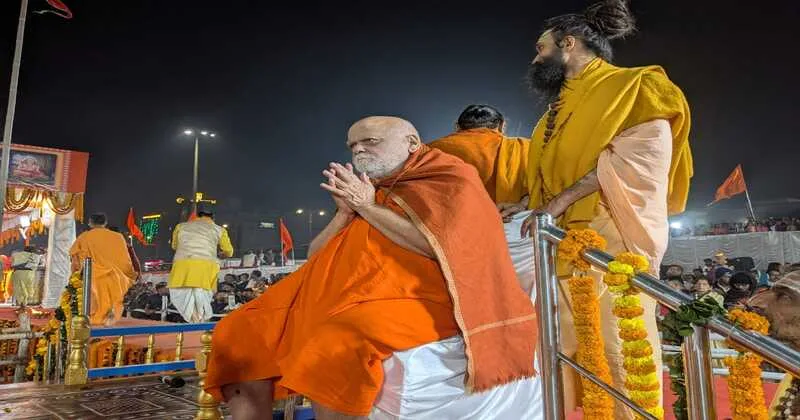
The Jagadguru addressed the gathering at the 20th edition of the Tirtharaj Shri Mahodadhi Aarti Mahotsav, held on the evening of January 3 in Puri, on the occasion of Paush Purnima. Thousands of devotees attended this grand spiritual event on the sacred seashore.
Swami Nischalananda Saraswati stated that the ocean represents a living, sentient form of divinity associated with Lord Varuna and therefore deserves reverence and disciplined conduct. “The sea coast must remain pure and spiritually uplifting,” he said, adding that religious activities on the shore help restore moral and cultural balance.
Recalling an incident from his early spiritual life, the Jagadguru explained the background behind the practice of performing daily aarti at the seashore. He narrated that while staying in Kashi under the guidance of his Guru, he was once asked whether he wished to witness Kaliyuga. “I was filled with fear,” he said. His Guru then advised him to walk along the banks of the Ganga after sunset, saying that the manifestations of Kaliyuga could be witnessed there in the form of alcohol and moral degradation.
Drawing a parallel, the Jagadguru noted that the location where the Mahodadhi Aarti is performed today had once become a hub for alcohol consumption. After assuming the position of Shankaracharya, he resolved that the sacred seashore would not be allowed to degenerate into such a centre again. “With that resolve, the concept of Mahodadhi Aarti was envisioned and implemented,” he said.
He asserted that Bharat can never be rendered directionless. “Whenever such a crisis has arisen in history, enlightened saints and realised souls have appeared under divine inspiration to guide society,” he said. The Jagadguru urged individuals to dedicate their lives to the welfare of society and to fulfill their duties with responsibility and selflessness. According to him, a person endowed with pure sattvic qualities naturally works for the collective good.
Highlighting the spiritual purpose of human life, Swami Nischalananda Saraswati stated that mankind has been blessed with human birth by divine grace, and this life should be devoted to dharma and devotion. He stressed the need to harmonise spiritual wisdom with scientific inquiry through the understanding of Bhagavat philosophy.
Quoting the Srimad Bhagavatam, he explained that liberation (moksha) is not a created outcome but an eternal, self-realised state. “Truth, consciousness, bliss, goodwill, service, and organisational strength must be embraced to invoke divinity in one’s life,” he said.
The Jagadguru stated that India is the heart of the world, where Bhagwan Vishnu incarnated as Ram and Krishna, and the divine feminine manifested as Sita and Rukmini. He noted that Siddha sants also take human form in this land to guide humanity. Elaborating on spiritual progression, he explained that dharma leads to vairagya, vairagya to samadhi, samadhi to gnyan, and gnyan ultimately to mokshya. “To realize the soul in its true nature is mokshya, for the soul is inherently free,” he added.
In another context, Swami Nischalananda Saraswati remarked that despite threats against Hindus, no force can ever harm India. He called for unwavering faith and unity.
During the ceremony, the Jagadguru offered naivedya and performed the grand Mahodadhi Aarti. The sight of the aarti at the confluence of all sacred rivers drew massive crowds. The rhythmic sound of bells, conch shells, and Vedic chants created a deeply moving spiritual atmosphere. Devotees described the moment as divine, as if the sea itself moved closer and the waves surged higher during the ritual.
Include Bhagavat, Ramayana, and Mahabharata in Curriculum: Gajapati Maharaja
Addressing the gathering, Adya Sevak of Bhagwan Jagannath, Gajapati Maharaja Dibyasingha Deb, emphasised that the Shri Purushottam Kshetra is the living embodiment of Bhagwan Jagannath and must be kept free from non-vegetarian food and unethical activities. He stated that a person’s character and personality are shaped during childhood education, yet India’s traditional scriptures have been excluded from modern curricula.
He advocated including the Bhagavat, Ramayana, Mahabharata, and the Vedas in school and college syllabi, asserting that such an initiative would help build ideal character, strong personalities, and a morally robust nation. Stressing the importance of holistic education, he stated that without spiritual and moral instruction, it is impossible to create exemplary citizens or a strong nation. He urged the Education Ministry to give the matter serious consideration.
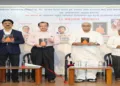
The event witnessed the presence of several eminent saints, including Rashtriya Swayamsevak Sangh Sah Kshetra Pracharak Jagadish Prasad Khadenga, Puri MP Dr Sambit Patra, BJP state president Manmohan Samal, Higher Education Minister Suryabanshi Suraj, MLA Ashrit Patnaik, former MLA Jayant Sarangi, Govardhan Math secretary Swami Nirvikalpananda, Mahodadhi Aarti Mahotsav general secretary Engineer Prashant Acharya, senior servitors, and other distinguished guests.
The program was anchored by Shri Rishikesh Brahmachari, Pandit Matru Prasad Mishra, and Purna Chandra Khuntia. As part of the celebrations, 1,008 lamps were lit, illuminating the seashore and filling the entire area with spiritual radiance.