
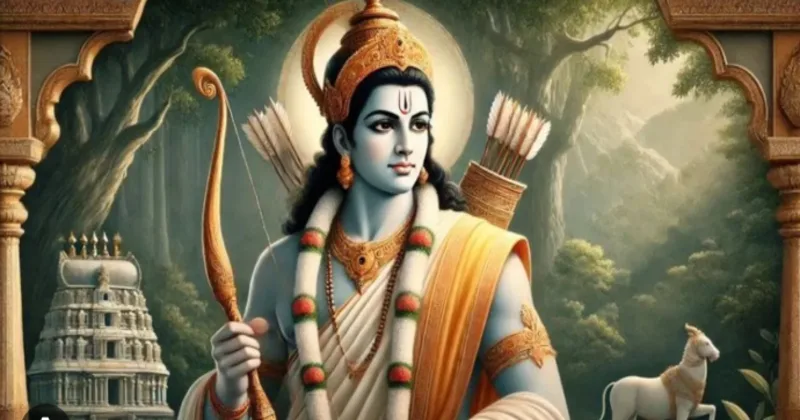
Today is the day to commemorate the life and values of Bhagwan Shri Ram and apply them in one’s own life, business life, corporate life, political system, international diplomacy and relations, development taking ecological concerns into consideration, and so forth in a world full of conflicts, mistrust, ego, selfishness, and lack of accountability towards humanity and the environment. The world, particularly avaricious superpowers and religious fanatics, is putting it in a hazardous state where people’s lives are becoming dreadful and terrible. Are we not giving the world to the next generation in the worst possible way? The only way to resolve all of these problems is to study and apply the lessons learned from Bhagwan Shri Ram, the world’s greatest example of humanity and character.
The life of Prabhu Shri Ram is a reflection of the highest moral standards and values that ought to be ingrained in every individual, family, society, political and social leadership, and nation. It is not merely the story of a prince who saves his wife from the grasp of a malevolent demon. Ram Rajya is a humanistic vision that is based on the principles of virtue, harmony, and peace. It was popularised by Valmiki and later expressed by Tulsidas in the well-known Ramcharit Manas. According to Tulsidas, Rama Rajya is a state that eradicates corporeal, spiritual, and physical pain. This will result in a peaceful life and obedience to laws and ethics based on Dharma. In addition, it ensures that no sin, even unintentional, is committed by promoting truth, purity, compassion, and charity. This worldview highlights the significance of divine-democratic leaders in business, politics, and society, ranging from authoritarian to democratic. Rama Rajya is a Divine-Democracy.
The core of Prabhu Shri Ram’s journey in the Ramayana is the 16 virtues of Dharma, as expressed by Valmiki. Virtuous, Righteous, Self-determined, Adept, Brilliant, Civilised, Knowledgeable, Grateful, Non-envious, Competent, Truthful, Equanimous, Benevolent, Aesthetic, Courageous, and Deterrent are the attributes. These 16 characteristics are fundamental to Prabhu Shri Ram’s character and, hence, to Bharat’s civilizational nature. The foundation of Prabhu Shri Ram’s character is his steadfast honesty and devotion to dharma (righteousness). He consistently upholds the truth, honours his commitments, and behaves morally. Promoting social progress, economic growth, political stability, international relations, and peace all depend on dharma-based (not religious) good governance. It guarantees that authority is used sensibly and in the best interests of the populace. By encouraging openness, responsibility, involvement, the rule of law, efficacy, efficiency, and moral behaviour, good governance and foreign diplomacy founded on Dharma advance the prosperity and well-being of societies and organisations.
Prabhu Shri Rama was born in a time when Dharma was disregarded, misconstrued for self-serving purposes, and its adherents were discouraged. In this regard, Prabhu Shri Ram’s primary goal became to both put an end to Adharma and give the common people a way to follow Dharma. He demonstrated how a mortal human can pursue the path of Dharma and accomplish great things, contributing to “Universal Prosperity,” through his reincarnation.
Prabhu Shri Ram frequently instructs Lakshmana in the Ramayana on duty (Dharma) and the importance of upholding it, even at personal sacrifice. During their banishment, Rama imparts a crucial lesson on the need to uphold one’s responsibilities as a son, brother, and ruler. “Dharma is what guarantees people’s well-being. Upholding justice is your duty as a king, even if it causes you personal suffering. (Ramayana, Ayodhya Kaand, 2.51) (Valmiki, 1952, Ayodhya Kaand, Ch. 51, V. 2).
Indeed, the greatest example of humanity, wise leadership, and wisdom is Shri Ram. For example, in Janakpur, when the competition to lift Lord Shiva’s arrow is at its peak, Shri Ram remains completely unaffected. Until his guru, Vishwamitra, asks him to rise and break the bow, there is no indication that he is making any effort. His gesture is noteworthy even when he is fully capable of carrying out the command.
ठाड भये उठि सहज सुभाये
ठवनि युवा मृगराज लजाये । बालकाण्ड २५३/४
And Ram shows no resentment when the competitors challenge him after he effortlessly breaks the bow. Even Parashuram is perplexed as to whether he might be his offender because his actions showed that he was a performer of the noble mission.
सभय विलोके लोग सब जान जानकी भीरु
हृदय न हरषु बिसाद कछु बोले श्री रघुवीर । बालकाण्ड २७०
नाथ संभु धनु भंजनि हारा
हुइहै कोउ इक दास तुम्हारा । बालकाण्ड २७०/१
Ram replied softly and without malice when he saw that Sita Devi appeared concerned and that the entire assembly was frightened. O, wonderful Prabhu, the only people who can break this enormous bow are your servants and followers.
It is evident that Parashuram does not speak in the manner of a (non-doership) Karmyogi. As a result, Laxman advances to the position of interpreter. As a result, he reports that the bow snapped as soon as Ram touched it. It is essentially an act in which the performer is completely absent. In this situation, how could Shri Ram be conceited or boastful about his bravery?
This Ayodhyakand shlok is another example of Rama exhibiting complete control over his behaviour by staying steady and unwavering in both favourable and unfavourable circumstances.
प्रसन्नतां या न गताभिषेकतसतथा न मम्ले वनवास दुखित: । अयोध्याकाण्ड
When Ram found out he was being enthroned, he was never joyful, and the following morning he was banished for 14 years.
Shri Ram’s prayers, which he delivered to the Indian Ocean to provide a route for his massive army to reach Lanka, demonstrate his ongoing pursuit of karma. Even though Laxaman was not at all persuaded, he decided to sit quietly in meditation for three days.
The final and most significant example is when Ram gave Angad the difficult task of serving as his messenger to Ravan in order to see whether the Great War might be prevented.
When Ram finally triumphs over Ravan and wins the war, he crowns his adversary’s younger brother, Vibhishana, and wishes.
करहु कल्प भर राज तुम । लंकाकान्ड ११६ घ
You ought to govern this country for the entire Kalp (4.32 billion years, or a daytime Brahma) term right now. This shows that he was not power hungry and showed the world that grabbing land from other nations is not ethical.
Bharat is receiving praise and support from around the world, whether consciously or unconsciously, for trying to follow Lord Rama’s path through 16 attributes ingrained in Bharatiya culture. The attempt to walk on this delicate yet glorious path is what distinguishes Bharat and makes it a distinct, principled, and rooted rising global power. However, one can always argue in the context of contradictions or point out the blatant failure of Bharat’s global strategy to walk on this path. The world will only be peaceful and environmentally benign if world leaders learn about Prabhu Shri Ram and his Bharatiyatva teachings.
Prabhu Shri Ram teaches us innumerable values. Even if we only learned 10% of his values, we would still benefit greatly. We can learn something from each action of his life. His personality is beyond words. Tulsidas asserts that even if we use water from all seven oceans as ink and the entire earth as our paper, the majesty of Prabhu Shri Ram cannot be fully expressed.
With Pranam to Prabhu Shri Ram.